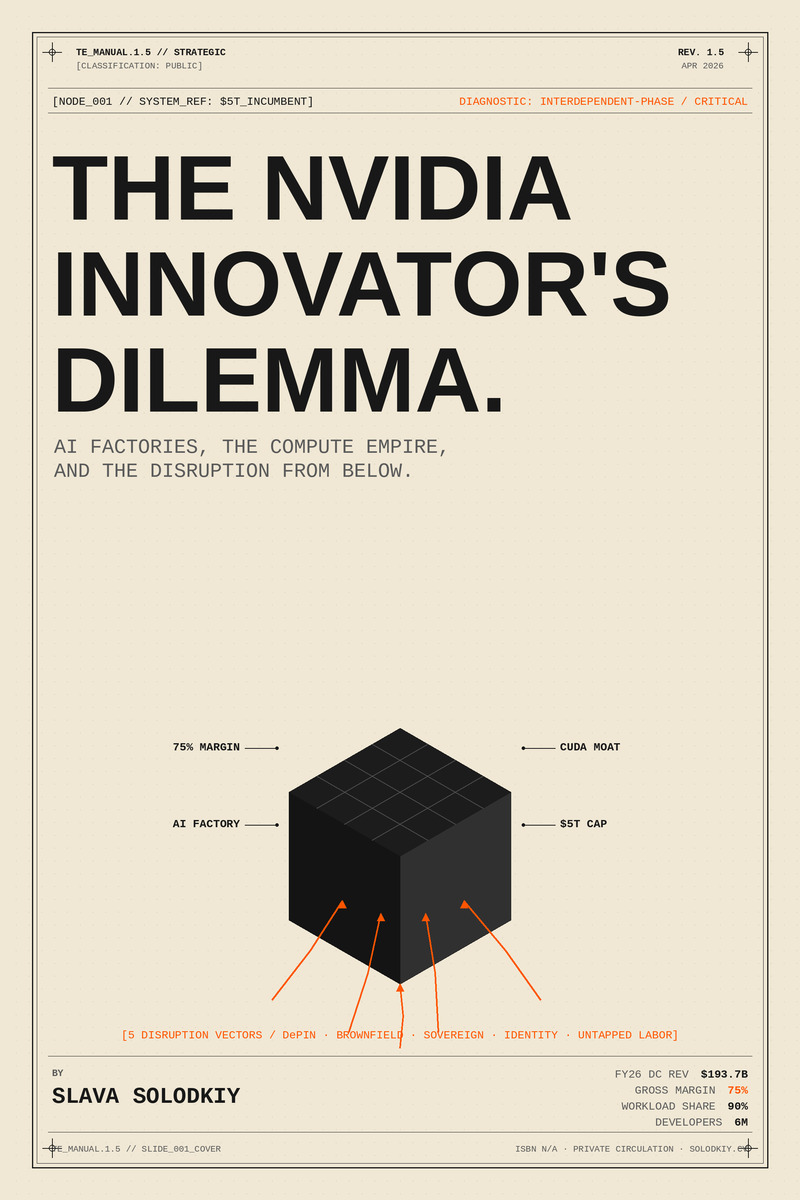
In late 2023, the binding constraint on AI was silicon. NVIDIA could not ship Hopper fast enough; lead times stretched past a year; the value of every H100 in inventory tripled. By the end of 2024, NVIDIA had ramped Blackwell production fast enough to clear that bottleneck. The new constraint became power — a 500 MW data centre in Loudoun County, Virginia, could not be powered before 2032 because the grid interconnection queue had collapsed. The brownfield repower thesis priced.
By the time The NVIDIA Innovator's Dilemma went to press in April 2026, the bottleneck had migrated again. Chips were available. Power was being repowered. The new binding constraint was memory — specifically, high-bandwidth memory, and behind it, the entire DRAM stack.
"A modern AI data centre is, increasingly, a vault of high-bandwidth memory with some silicon attached."
The fight over Samsung, Micron, and SK hynix capacity in 2025 and 2026 — for HBM3, HBM4, GDDR7, and the long tail of LPDDR — is the next chapter of the same story. The vendors got religion in 2024 and are now the most strategically priced semiconductor companies on earth, more strategically priced than NVIDIA itself for some classes of workload.
This appendix exists to track the memory layer of the argument the book makes about silicon. The two are not separate stories. They are the same story with the bottleneck migrating along the value chain. Three bottlenecks in three years. The interesting question is what gets bottlenecked next — and the answer, the moment you write it down, is unembarrassed by ambiguity: result. The token. The unit of useful thought, delivered on time. That is the subject of the companion essay.