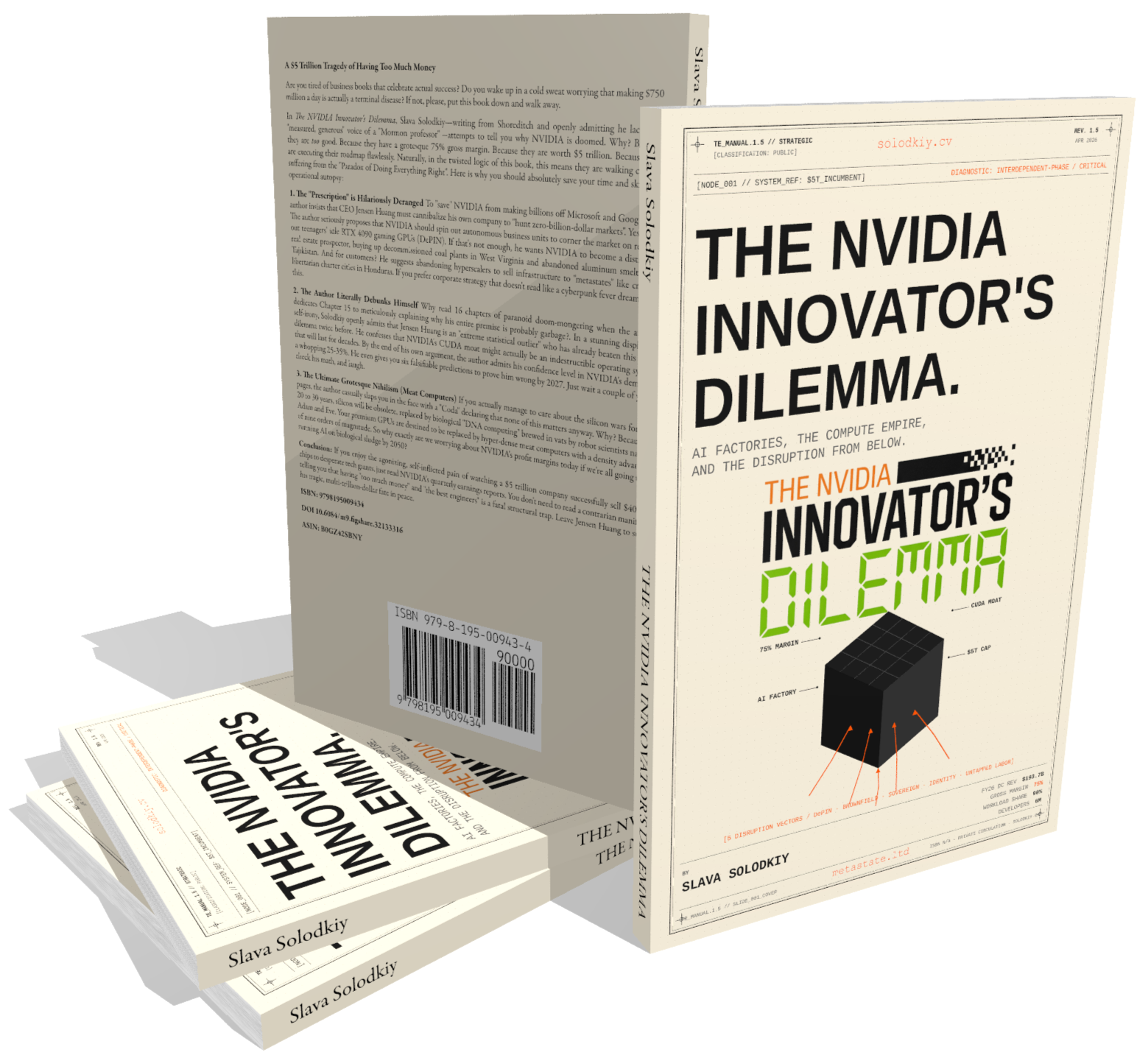
THE FULL TEXT · APRIL 2026 EDITION
THE NVIDIA
INNOVATOR’S
DILEMMA
AI Factories, the Compute Empire, and the Disruption That Comes From Below
SLAVA SOLODKIY · APRIL 2026
ISBN 9798195009434 · PAPERBACKDOI 10.6084/m9.figshare.32133316ASIN B0GZ42SBNY
The complete text of the April 2026 edition, as shipped to Amazon — set here in the site’s reading room. Press PRINT THE BOOK above (or Ctrl/Cmd-P) for a clean, book-formatted layout: every chapter starts on a new page, no navigation, no decoration.
AUTHOR’S NOTE
Clayton Christensen died in January 2020, six weeks before the world locked itself in a room with a screen and discovered, by accident, that the room itself had become the marketplace. He never saw GPT‑3, never watched the world spend a trillion dollars on graphics chips, never had the chance to update The Innovator’s Dilemma for a market that, in scale, speed, and structural absurdity, feels purpose‑built for his framework.
This book is an attempt to do that work in his absence. It is written in his analytical spirit but, candidly, not in his voice. Christensen wrote like a Mormon professor, measured, generous, methodical. I do not. The version of him who would have written this book in 2026 would, I suspect, have allowed himself to be sharper than the 1997 edition required, because the stakes are higher and the dilemma is more obvious. NVIDIA’s market capitalization, by some weeks of this year, exceeded the GDP of every nation on earth except the United States and China. There is no genteel way to write about a company that has eaten the global capital stack.
So I have tried to honor Christensen in two ways: by using his frameworks honestly, and by refusing to pretend I am him. Where the analysis is his, the credit is his; where the opinions are mine, the responsibility is mine; where I disagree with him, and there are places, I say so.
The five pillars in Part III are not Christensen’s. They are mine, drawn from work I have been doing for the last several years on decentralized AI infrastructure, brownfield energy, sovereign and uncensored AI, digital identity, network states (which I prefer to call metastates), and the broad category of untapped human capital, re‑entry workers, transitioning veterans, displaced industrial and white‑collar workers, the unhoused population, and (with explicit ethical scaffolding) voluntary participants from currently incarcerated populations. I make the case that these are not “humanitarian projects” or “side bets.” They are precisely the kind of small, awkward, non‑consuming markets in which Christensen taught us to look for the next wave of disruption. NVIDIA’s biggest mistake, if it makes one, will not be missing AMD. It will be missing them.
The Coda concerns DNA computing, and the work of Prof. Ross King at Cambridge and Chalmers, whose Robot Scientist Adam and Eve projects I have followed for a decade. If silicon is the substrate of this decade, biology is the substrate of the next. Jensen Huang, who will be eighty in 2043, may well live to see the dilemma he is solving today be made obsolete by a substrate he did not build. That is also Christensen’s point.
A note on what’s been left out. There is almost nothing here on AMD or Intel as primary disruptors. They are second‑sustaining challengers, not Christensen disruptors. I treat them as such, briefly, in Chapter 4. There is also less than I would like about China, partly because much of the most interesting Chinese strategy is not legible from the outside, and partly because the DeepSeek moment of April 2026, which I treat in Chapter 6, deserves its own book. Someone should write it.
This is the version that exists. The version Christensen would have written would be better. We do not get that version.
The CD’s most profitable year came right before the bottom fell out - the industry was never richer than the moment before Napster. (For the full anatomy of that collapse, see Steve Knopper, ‘Appetite for Self-Destruction: The Spectacular Crash of the Record Industry in the Digital Age’, 2009.)
— Slava Solodkiy, Shoreditch, April 2026
PROLOGUE
The Paradox of Doing Everything Right
“The reasons that great firms fail to innovate are not because they are badly managed. It is because they are well managed.” — Clayton M. Christensen
Some business catastrophes only happen to excellent companies. They do not look like catastrophe at the time. At the time, they look like a victory parade, confetti cannon, record quarter, CEO on the cover of every magazine. Then, five years later, you look up and the parade is over, the route was the wrong street, a different industry is being celebrated three blocks away, and the company you were running (still profitable, still with the best products, still the technology leader on every benchmark) has somehow become irrelevant.
This is the pattern Clayton Christensen documented in The Innovator’s Dilemma in 1997, drawing on disk drives, mechanical excavators, mini‑computers, and steel mills. It happens, he argued, not because incumbents are stupid or lazy or asleep, but precisely because they are not, because their resource‑allocation processes, value networks, and customer‑listening discipline are working exactly as designed. The disk‑drive incumbents who missed each generational architecture transition were better engineers than the upstarts who unseated them. They had better customers, more revenue, more talent, and better management. They lost anyway.
Christensen’s diagnosis was that “good management”, listening closely to your most profitable customers, allocating capital to opportunities with the highest projected returns, and improving products along the dimensions those customers value, is the cause, not the prevention, of disruptive failure. The disk‑drive companies that died were not killed by the technology shift. They were killed by their own discipline.
I bring this up because, in April 2026, the most disciplined company in the history of computing, NVIDIA Corporation, is sitting at $5 trillion of market value, with 90% share of cloud AI workloads, roughly 80% of the AI accelerator market by revenue, and an ecosystem of six million CUDA developers whose accumulated tooling represents one of the deepest software moats ever constructed. Its most recent product, Blackwell B200, with the Vera Rubin successor due in late 2026, represents a generational leap in AI compute. Its CEO, Jensen Huang, is widely considered the most consequential founder‑operator of the 2020s. Demand exceeds supply by an order of magnitude. There is no plausible competitor on a two‑year horizon.
And the case I will make in this book is that this is the most dangerous moment in NVIDIA’s history.
Why this is more than a Christensen exercise
It would be easy to write a book that simply takes Christensen’s 1997 framework, finds the analogous variables in the AI compute market of 2026, and concludes that NVIDIA is “due” for disruption. That book would be intellectually correct and operationally useless. The interesting question is not whether the dilemma applies, it does, but how the dilemma applies uniquely in this market, why the standard Christensen prescriptions are necessary but not sufficient, and what specifically Jensen Huang would have to do to avoid the fate that has befallen ninety‑plus percent of his historical analogues.
NVIDIA in 2026 is not Digital Equipment Corporation in 1985, nor Intel in 1999, nor Cisco in 2000, though it shares structural features with all three. It is something new: an integrated platform monopoly at the base of a global capital‑expenditure cycle that may, by some estimates, absorb $5 trillion of investment by 2030. The dilemma plays out at a scale, speed, and capital intensity that Christensen never had to model. The original 1997 framework needs to be sharpened, not merely reapplied.
Five things are true about NVIDIA’s position in April 2026, and they are simultaneously true:
One. NVIDIA’s gross margins of approximately 75% function as a “tax” on its largest customers. Every $10 billion that Microsoft, Google, Amazon, or Meta spends with NVIDIA delivers roughly $7.5 billion of margin. A hyperscaler that can replace NVIDIA silicon with internal silicon — even at 70% of the performance — captures a multi‑billion‑dollar annual cost saving. This is the rational basis for the custom‑ASIC programs at Google (TPU v7, code‑named Ironwood), AWS (Trainium 3), Microsoft (Maia 200), and Meta (MTIA). These programs are not an accident. They are an inevitability. Hyperscalers represented roughly 50% of NVIDIA’s data‑center revenue in fiscal 2026; in Q2 of that year, two customers alone accounted for 39% of total revenue. The customer concentration is a Christensen‑shaped time bomb.
Two. The “job to be done” in AI compute has fundamentally shifted. Through 2023, the dominant job was frontier‑model training: a small number of hyperscalers and frontier labs pouring billions of dollars of capex into ever‑larger pre‑training runs, where NVIDIA’s integrated architecture and high‑precision parallel performance was unbeatable. By 2026, the dominant workload is inference: by some estimates, two‑thirds of AI compute cycles are now spent serving models in production. Inference rewards different things than training: cost per token, watts per token, deterministic latency, low‑precision arithmetic. NVIDIA’s premium GPUs are over‑engineered and over‑priced for most inference workloads. This is the textbook Christensen condition of performance overshoot, and it is the condition under which “good enough” disruptors finally have an opening.
Three. The CUDA software moat, which has been NVIDIA’s deepest competitive advantage for fifteen years, is being bypassed, not breached, by a new generation of universal abstraction layers. OpenAI’s Triton compiler now allows developers to write hardware‑agnostic high‑performance code that targets NVIDIA, AMD ROCm, and a growing list of custom ASICs with near‑native efficiency. vLLM, the dominant open‑source serving framework, treats AMD, Intel, Google TPUs, and NVIDIA as first‑class targets. In late April 2026, DeepSeek released the V4 family. The smaller V4‑Flash (~284B parameters) was trained on Huawei Ascend silicon end‑to‑end; the flagship V4‑Pro (~1.6T) was almost certainly trained on NVIDIA but explicitly optimized for Ascend inference, and DeepSeek pointedly declined to disclose the Pro training stack. The “DeepSeek moment” was not a chip story. It was a software portability story, and the messy version of the fact (Pro on NVIDIA, Flash on Ascend, both deployable on Ascend) is actually stronger evidence for the thesis than a clean substitution would have been. The CUDA moat is not breaking. It is being routed around.
Four. Five new value networks are emerging at the edges of the AI economy that NVIDIA’s current resource‑allocation process is structurally incapable of pursuing. Decentralized physical infrastructure networks (DePIN), aggregating idle prosumer GPUs into “Airbnb for AI” capacity at 30–50% of cloud cost. Brownfield energy — repurposed coal plants, smelters, decommissioned industrial sites — becoming the cheapest path to grid‑connected megawatts in a world where new interconnection queues stretch to fifteen years. Sovereign AI and metastates (network states, chartered cities, special economic zones) becoming first‑order buyers of AI infrastructure, with price sensitivity, governance models, and procurement logic radically different from corporate hyperscalers. Digital identity, the cryptographic substrate that makes a decentralized agent economy possible. Untapped human capital — re‑entry workers, transitioning veterans, displaced workers, the unhoused, and (with explicit ethical scaffolding) currently incarcerated voluntary participants — integrated into the AI annotation, model‑auditing, and red‑teaming labor pipeline as a market‑creating innovation in the most literal Christensen sense.
Each of these five pillars is, individually, too small for NVIDIA to chase from inside its current P&L. Each, together, represents the new value network in which the next era of AI compute will be built.
Five. Jensen Huang himself is the variable. He is, by his own description, a paranoid operator who runs NVIDIA “thirty days from bankruptcy.” He has read Christensen, taught Christensen, and lectured at Stanford on Christensen. He has personally executed two prior platform pivots (from gaming GPUs to general‑purpose CUDA computing in the late 2000s, and from CUDA computing to AI factories in the late 2010s) that, by Christensen’s own framework, should have been impossible from inside the incumbent. He is the anti‑Christensen case: the one founder‑operator who has, twice, beaten the dilemma. The question this book ultimately turns on is whether he can do it a third time, against asymmetric threats coming from five directions at once, and against gravity that is more punishing than anything he has faced before.
The answer, as I will argue across the next fifteen chapters, is that he probably can, but only if he is willing to do something he has so far refused to do, which is to spin out autonomous units with their own P&Ls, their own metrics, their own customers, and explicit permission to ignore the metrics that built the parent. Christensen’s prescription has not changed in twenty‑five years. The execution is the part that breaks.
The argument of the book in one page
Here, with the disclaimer that any one‑page summary of a book about a $5‑trillion company is necessarily a caricature, is the argument:
NVIDIA in 2026 is the most perfectly Christensen‑shaped company in history. Its sustaining innovation roadmap (Blackwell → Rubin → Feynman) is unbeatable; its hyperscaler customers are simultaneously its largest source of revenue and the largest funded threat to its margin structure; its software moat is being bypassed by modular abstraction layers; its premium products are overshooting most real workloads; and the new value networks emerging at the edge are precisely the kind of small, awkward, low‑margin opportunities that its current organization will reflexively starve.
The classical Christensen prescription is to spin out autonomous units to chase those new networks before others do. The classical Christensen failure mode is for the incumbent to instead double down on sustaining innovation, retain dominance in the high end, and watch the volume market commoditize beneath it. NVIDIA is currently executing the failure mode beautifully.
There is one variable that gives me hope: Jensen Huang himself, who has solved this problem twice before. The remainder of this book is an attempt to lay out the map, the threats, the five pillars, and the prescription, so that he, his successors, and the rest of us can see the dilemma clearly while there is still time to act.
The dilemma does not forgive flinching.
PART I
THE GIANT’S SUCCESS
Sustaining Innovation at Scale
“Successful firms are usually adept at responding to evolutionary changes in their markets… It is the disruptive innovation, where the customer of the established firm has not yet become aware of the new technology, that the established firm tends to fall behind.” — Clayton M. Christensen, The Innovator’s Dilemma
CHAPTER 1From Graphics to AI Factory: How Disruptors Become Incumbents
Before we get to NVIDIA’s dilemma, one Christensen pattern is worth dwelling on: the embarrassingly common, almost deterministic irony of the disruptor becoming the incumbent it once defeated. NVIDIA is not, in 2026, a company that learned the innovator’s dilemma from a textbook. It is a company that was the innovator’s dilemma, twice, on its way up. The fact that it is now sitting in the seat of the disrupted is not just historical poetry. It is part of the structure of the problem.
NVIDIA as disruptor: 1993–2006
NVIDIA was founded in 1993 in a Denny’s in San Jose by Jensen Huang, Chris Malachowsky, and Curtis Priem. For its first decade, it was a graphics‑chip company in a market dominated by 3dfx, ATI (later acquired by AMD), Matrox, and Silicon Graphics. The company nearly died several times, the NV1 was a commercial failure; the company laid off half its staff in 1996; Microsoft’s DirectX standard nearly orphaned its architecture. By the late 1990s, NVIDIA was alive but unremarkable: a competent player in a commodity market, with a paranoid founder and a habit of betting the company on architectural transitions.
Two decisions saved it.
The first was the GeForce 256, released in 1999, which NVIDIA marketed as the world’s first “GPU”, a graphics processing unit, not just a graphics card. The branding mattered less than the architecture: GeForce 256 was the first consumer chip with a hardware transform‑and‑lighting engine, offloading work from the CPU to a dedicated parallel processor. The conceptual leap that a graphics chip was, in fact, a parallel computer that happened to be drawing triangles, would take seven more years to fully arrive.
The second was the introduction of CUDA (Compute Unified Device Architecture) in 2006. CUDA was, by every Christensen metric, a low‑probability bet. NVIDIA spent roughly $10 billion of accumulated R&D over the next decade building it. It made every GeForce card more expensive to manufacture than it needed to be for gaming. It returned approximately zero revenue for the first five years of its existence. No customer asked for it. No analyst recommended it. The thesis (that scientists, researchers, and eventually deep‑learning engineers would discover that a gaming chip running CUDA was a vastly cheaper supercomputer than anything Cray or IBM was selling) was, at the time, the kind of thing a boardroom would reasonably classify as founder pet project.
It was also exactly the kind of bet that Christensen describes as the only way out of the disruption trap. CUDA was not a sustaining improvement to the gaming GPU. It was a new architecture for a non‑existent market — high‑performance parallel computing, accessible to anyone with a $300 graphics card and a dorm room. The market was zero billion dollars in 2006. By 2012, it was the substrate on which AlexNet was trained, launching modern deep learning. By 2020, it was the foundation of a $500‑billion market. By 2026, it is the operating system of the global AI economy.
This is the first Christensen moment in NVIDIA’s history. The disruptors NVIDIA defeated were not just the other graphics chip companies. They were Intel, which spent the same decade believing that high‑performance parallelism would be done on CPUs with vector extensions and Larrabee, and which never built a credible discrete‑GPU product until Arc in 2022, by which point the market had been won. They were the supercomputer manufacturers, who never imagined the bottom of their market could be eaten by a gaming card. They were every analyst who, in 2008 or 2010 or even 2014, looked at NVIDIA’s gaming‑centric P&L and concluded that “data center” was a side project for the company.
NVIDIA disrupted them all by going down‑market and sideways, by selling general‑purpose parallel computing as a $500 commodity to graduate students, who then made themselves indispensable inside every AI lab on earth, who then dragged enterprise procurement into NVIDIA’s value network ten years later.
NVIDIA as ascending incumbent: 2006–2020
The second Christensen moment is less dramatic but, in some ways, more impressive. From 2006 to 2020, NVIDIA quietly transformed itself from a chip company into a full‑stack platform company. The company invested aggressively in software (cuDNN, TensorRT, NeMo, Triton Inference Server, NIM microservices), networking (the 2020 Mellanox acquisition for $7 billion, which gave NVIDIA InfiniBand at the moment it became the bottleneck of every large‑model training run), systems (DGX, HGX, NVL72), and reference designs for entire data centers (“AI factories”). By 2020, NVIDIA was not selling silicon. It was selling capacity. By 2024, it was not selling capacity. It was selling compute as a sovereign capability, the substrate of national AI strategies, frontier‑model labs, and hyperscaler buildouts.
Every step of this evolution looks, in retrospect, like sustaining innovation. Each generation of chip was faster than the last; each generation of system was more integrated than the last; each generation of software was more locked‑in than the last. But the strategic evolution, from chip to system to factory to infrastructure to sovereign capability, was a sequence of Christensen‑style platform moves, each one made before the market knew it needed it.
By 2020, NVIDIA had successfully climbed the value chain in the way Christensen describes incumbents climbing it: from low‑margin commoditizable components into higher‑margin integrated systems, where customer switching costs are higher, gross margins are fatter, and the moat is wider. The Mellanox acquisition is the single most important strategic move in NVIDIA’s history that nobody talks about. It turned the company from a vendor of GPUs into the architect of the rack, and the rack, not the chip, is what hyperscalers actually buy.
The pattern, by the time you reach 2020, is unmistakable: NVIDIA was once a low‑end disruptor that crawled into the data center through the dorm rooms of graduate students. It is now the high‑end incumbent that defines what the data center is. It has, in Christensen’s vocabulary, become its own enemy.
NVIDIA as embattled incumbent: 2020–2026
The transition from “ascending incumbent” to “embattled incumbent” is the subject of the rest of this book. For now, it is enough to mark the territory.
Through the period from 2020 to 2026, three things happened simultaneously:
First, the AI training market exploded in a way that nobody — including Jensen Huang — fully predicted. The release of GPT‑3 in 2020, ChatGPT in late 2022, and the subsequent capex arms race among Microsoft, Google, Amazon, and Meta drove NVIDIA’s data‑center revenue from approximately $3 billion in fiscal 2020 to $193.7 billion in fiscal 2026, a 65× increase in six years. Gross margins climbed from the low 60s to the mid‑70s. The company’s market capitalization, which started 2020 at around $145 billion, crossed $5 trillion in early 2026.
Second, the customer base concentrated to a degree that would, in any other market, be regulated. Hyperscalers (Microsoft, Alphabet, Amazon, Meta) and a small number of frontier labs (OpenAI, Anthropic, xAI, Google DeepMind, Mistral, DeepSeek, Cohere) now represent the overwhelming majority of NVIDIA’s data‑center revenue. Two customers alone accounted for 39% of total revenue in Q2 fiscal 2026. These are not ordinary customers. They are quasi‑sovereign actors with multi‑billion‑dollar internal silicon programs, the world’s deepest software talent benches, and the rational economic motivation to escape NVIDIA’s margin tax as quickly as they can.
Third, the architecture began to ossify. NVIDIA’s chips, software, networking, and systems are now so tightly co‑designed that they are nearly inseparable from a customer’s standpoint, and nearly impossible for NVIDIA itself to unbundle. The company is, in Christensen’s language, in an interdependent architecture phase: a moment in technological history where vertical integration is the source of competitive advantage, and where the company is structurally unable to participate in a future where the same components are commoditized and recombined. Every dollar NVIDIA invests in deepening Blackwell→Rubin→Feynman co‑design makes the next architectural transition harder for NVIDIA itself to execute.
It is here, at this moment, that the dilemma takes hold.
The disruptor’s curse
Christensen made an observation, almost in passing in The Innovator’s Solution (2003), that has aged better than most of his other claims: the companies most likely to be victims of the next wave of disruption are the companies most recently saved by the last one. Their organizational memory is fresh. Their culture has been re‑forged around the last hard pivot. Their executive team is full of people who personally executed it. They are exactly the wrong shape to do it again, because doing it again would require dismantling the structures they just built.
This is the disruptor’s curse, and NVIDIA has it acutely. Jensen Huang’s executive team is full of people who personally executed the CUDA pivot, the data‑center pivot, the Mellanox integration, and the AI factory pivot. Their entire mental model of “how NVIDIA wins” is defined by sustaining innovation in interdependent architecture, by pushing harder, integrating tighter, climbing higher. The cultural assumption, implicit in every meeting and every roadmap, is that the next decade looks like the last decade, only more so.
The next decade does not look like the last decade. It looks like the previous decade, the one in which NVIDIA was the disruptor.
In 2006, NVIDIA was a $1‑billion company that sold low‑margin commodity GPUs to non‑consumers (graduate students, hobbyists, academic labs) who couldn’t afford supercomputers, and who used a free software toolkit (CUDA) to do work that nobody at IBM or Cray took seriously. The combination, cheap commodity hardware, free general‑purpose software, non‑consuming customer base, is exactly the structure of every disruption that has ever happened.
In 2026, that structure exists again. It is called DePIN. It is called Triton. It is called vLLM. It is called Etched. It is called Groq. It is called the Sohu transformer ASIC. It is called the Russian, Indian, Brazilian, Saudi, and UAE sovereign AI programs that don’t want to spend their treasuries on $40,000 GPUs. It is called the gaming PC in your basement, the converted coal plant in West Virginia, the chartered city in Honduras, and the state prison in Pennsylvania running a data‑labeling pilot.
NVIDIA looks at all of this, in 2026, the way IBM and Cray and DEC looked at NVIDIA in 2006: interesting; cute; not relevant to our customer base; certainly not at our margin structure. That is the disruptor’s curse. The map of who said this last is sitting in NVIDIA’s own corporate history. It is the map of the companies that NVIDIA replaced.
What this means for the rest of the book
If you remember nothing else from Chapter 1, remember this: NVIDIA is not in trouble despite its excellence. NVIDIA is in trouble because of its excellence, and specifically because the same kind of company that NVIDIA was twenty years ago is now growing in the cracks of the market NVIDIA dominates, with the same playbook NVIDIA used, against the same kind of incumbent NVIDIA defeated.
This is not pattern‑matching for the sake of pattern‑matching. It is the structural prediction of the Christensen framework, and it is not optional. The remainder of Part I lays out the architecture of NVIDIA’s current dominance, the moat, the integration, the trap. Part II lays out the asymmetric threats. Part III lays out the new value networks. Part IV lays out the prescription. The Coda points to the substrate beyond silicon.
But the foundation of the entire argument is this: NVIDIA has been here before, sitting on the other side of the table. They know how this game ends. They know it because they are the ones who ended it last time.
The question is whether knowing it is enough.
CHAPTER 2The Interdependent Architecture: Blackwell, Rubin, and the Castle Walls
There is a passage in The Innovator’s Solution in which Christensen distinguishes between two phases of any technology market: the interdependent phase, where vertical integration wins, and the modular phase, where the same components get unbundled and recombined by faster‑moving entrants who don’t carry the integration cost. The transition between these phases is, in his framework, the single most important strategic discontinuity a technology company faces. Get it right and you ride the next wave. Get it wrong and you are DEC, Sun Microsystems, or Wang.
In April 2026, NVIDIA is in the most interdependent phase of its history. It is also, by accident or design, sitting exactly on the cusp of the transition to the modular phase. Both things are true at once. This chapter is about why the moat looks unbreachable, and why, by Christensen’s framework, that is precisely the warning sign.
The architecture of dominance
A modern NVIDIA AI factory is not a chip. It is not even a server. It is a roughly thirty‑two‑rack system, with up to 144 Blackwell or Rubin GPUs per rack, interconnected by NVLink and InfiniBand, running CUDA on the GPU and DOCA on the data‑processing units (BlueField), orchestrated by NVIDIA’s own software stack (NIM, Triton Inference Server, NeMo, NIMble, MGX), connected to storage via GPUDirect, and tuned end‑to‑end so that a frontier model training run distributes across thousands of GPUs with minimal communication overhead. The system is the product.
This is the architecture that NVIDIA has been building, decision by decision, for fifteen years. It is the reason no competitor can field a credible alternative to the DGX H200 NVL72 system at any price: even if a competitor matched NVIDIA’s silicon, they would have to match the networking (InfiniBand, post‑Mellanox), the rack‑level cooling, the scheduling, the firmware, the driver stack, the runtime, the libraries, and the developer ecosystem. They would have to do it without breaking customer workloads that depend on the integration.
The result is the most powerful interdependent moat in the history of computing. To understand it, it helps to break it into layers.
Silicon. NVIDIA’s Blackwell generation (B200, GB200, B300) shipped throughout fiscal 2026. It delivers approximately a 5× performance‑per‑watt improvement over Hopper (H100/H200) on FP4 inference, and a 2.5–3× improvement on FP8 training. The architecture splits the GPU die into two reticle‑limited chiplets connected by an NV‑HBI (high‑bandwidth interconnect) bus, allowing NVIDIA to ship ~210 billion transistors per package while staying within TSMC’s 4N reticle limit. Vera Rubin (R100), scheduled for Q3 2026, adopts HBM4 and TSMC’s N3P 3‑nanometer process; Rubin Ultra is on the roadmap for 2027, with Feynman (named for Richard Feynman, foreshadowing themes of this book’s Coda) following in 2028. NVIDIA’s silicon roadmap is locked in through the end of the decade, and on every relevant benchmark (FP64 HPC, FP16 training, FP4 inference) Blackwell and Rubin lead.
Networking. NVLink 5, introduced with Blackwell, delivers 1.8 TB/s per GPU bidirectional, allowing 72‑GPU rack‑scale systems (NVL72) to function as a single addressable compute domain. InfiniBand NDR/XDR, descended from the Mellanox acquisition, is the de facto standard for inter‑rack communication in frontier training clusters. Spectrum‑X Ethernet allows hyperscalers who prefer Ethernet to get InfiniBand‑like performance at lower cost. There is no competitor in 2026 with a credible end‑to‑end networking story for AI clusters at this scale. Even Google, the most vertically integrated of the hyperscalers, runs its TPU pods on a custom fabric that nobody outside Google can buy.
Software. CUDA, the original 2006 platform, has accumulated 300+ acceleration libraries, 6 million developers, and approximately 250–300 million CUDA‑capable GPUs in the installed base. On top of CUDA, NVIDIA has stacked cuDNN (deep learning primitives), cuBLAS (linear algebra), TensorRT (inference optimization), Triton Inference Server (deployment), NeMo (training framework), Riva (speech), Parabricks (genomics), Modulus (physics), and dozens of others, each one a piece of accumulated tooling that any competing platform would have to replicate. The top of the stack, NIM (NVIDIA Inference Microservices), introduced in 2024, is the most strategically important: it is NVIDIA’s bid to make itself the deployment runtime for foundation models, in the way that Docker became the deployment runtime for web services.
Systems. The DGX SuperPOD, HGX server, and NVL72 rack systems are NVIDIA’s full‑stack hardware reference designs. Hyperscalers buy these directly or build modified versions through ODMs (Foxconn, Wiwynn, Quanta) under NVIDIA’s MGX modular reference architecture, which standardizes the rack interface so that NVIDIA silicon, networking, and cooling drop in as a unit.
Data‑center reference designs. The “AI factory” itself, the building, the power distribution, the cooling, is now part of NVIDIA’s design vocabulary. Jensen Huang’s 2024–2026 keynotes have systematically reframed NVIDIA’s customer interaction from “selling chips” to “co‑designing factories,” complete with reference layouts for liquid cooling, 1‑megawatt rack power densities, and immersion options for sites where the local grid cannot deliver chilled water.
Each layer of this architecture is, individually, not insurmountable. AMD has competitive silicon (MI300X, MI325X, MI355X); Cerebras has wafer‑scale alternatives; Broadcom and Marvell can fabricate custom ASICs; Open Compute Project standards exist for racks and networking; ROCm, oneAPI, Triton, and vLLM are real software stacks. But all of them at once, integrated, co‑designed, and battle‑tested at hyperscaler scale, is a different problem. It is the problem of catching DEC’s VAX in 1985, or IBM’s mainframes in 1975, or Sun’s UltraSPARC servers in 1995. It is, to borrow a phrase from Mellanox CEO Eyal Waldman, “the difference between a war and a battle.”
The Christensen warning
Here is where the framework starts to bite. Christensen’s argument, in The Innovator’s Solution, is that the deeper and more complete the interdependent architecture, the closer the company is to the modular transition. This sounds counterintuitive, and incumbents systematically refuse to believe it, but the historical record is unambiguous: every technology market that has ever had a strong vertically‑integrated incumbent has eventually transitioned to a modular structure, and the transition has consistently destroyed the incumbent.
DEC built the most beautifully integrated minicomputer in history (VAX/VMS) and was destroyed by modular x86 PC servers running Unix and Windows. IBM built the most beautifully integrated mainframe in history (System/370) and was nearly destroyed by modular x86 PC servers; the company survived only by reinventing itself as a services firm. Sun built the most beautifully integrated Unix workstation in history (Solaris/SPARC) and was destroyed by modular Linux/x86 servers. Apple built the most beautifully integrated personal computer of the 1980s (Macintosh) and watched its market share collapse to under 5% before Steve Jobs’s return.
The pattern is consistent. Vertical integration wins when the underlying technology is not good enough to satisfy customer requirements; the integration is what closes the performance gap. As the technology improves, the performance gap closes by itself; customers no longer need integrated solutions; the basis of competition shifts to cost, modularity, and ecosystem; and the incumbent, whose entire organization is built around the interdependent architecture, cannot turn fast enough.
In Christensen’s words: “When the basis of competition shifts from functionality to cost or convenience, the modular architecture wins, and the integrated incumbent cannot follow because its cost structure is built on the integration.”
This is the central warning of Chapter 2. NVIDIA’s interdependent architecture is currently winning because the technology is not good enough. Frontier‑model training in 2026 is still bottlenecked on raw FLOPS, on memory bandwidth, on inter‑GPU communication, on power efficiency. Every additional terabyte of HBM, every additional terabit of NVLink bandwidth, every additional teraflop of FP4, all of it gets used. Customers want more.
But this condition will not last forever. It might not even last another three years.
Three signs the modular transition has begun
How do you know when the modular transition is starting? Christensen’s framework gives three diagnostic signs. All three are visible in the AI compute market in April 2026.
Sign #1: Performance overshoot in the volume segment. When the integrated incumbent’s products start delivering more performance than most customers can use, the basis of competition begins to shift. In AI compute, this is happening in inference, where, by 2026, two‑thirds of the workload sits. An NVIDIA Blackwell B200 GPU costs approximately $40,000 and dissipates roughly 1,000 watts. For a recommendation‑engine inference query that needs to return in 50 milliseconds, the B200 is wildly over‑provisioned. The job can be done by a Groq LPU (lower latency, 60% lower cost), a Google TPU v7 inference instance, an Etched Sohu transformer ASIC, or a small AMD MI355X, and increasingly, by all of the above mixed in the same cluster via Triton/vLLM. The integrated NVIDIA system is paying a premium for capabilities (FP64 precision, training‑class memory bandwidth) that the inference workload doesn’t need. That is performance overshoot.
Sign #2: Modular substitutes appearing at the high end. Disruption rarely starts in the high end, but the modular transition does, because the modular incumbents’ first move is to assemble a credible system from off‑the‑shelf components and price it against the integrated leader. In AI, this is the Trainium 3 cluster, the TPU v7 pod, the AMD MI355X+ROCm+UALink alternative, and increasingly the open‑hardware Open Compute “AI rack” specifications. None of them is yet a one‑for‑one Blackwell substitute at frontier‑training scale. All of them are credible at sub‑frontier scale, and they are improving generationally faster than NVIDIA. The first time a major enterprise — not a hyperscaler, runs a serious training job on a non‑NVIDIA cluster and is satisfied, the modular transition will be visible to everyone. That moment will probably arrive in 2026 or 2027.
Sign #3: The software abstraction layer goes universal. The third diagnostic, and historically the most reliable, is when the dominant software ecosystem starts being abstracted away. In x86 PCs, this happened when Linux and Java made the underlying chip irrelevant for most application code. In smartphones, this happened when the JavaScript browser engine and React Native made the underlying OS irrelevant for most app code. In AI compute, this is happening right now, through OpenAI Triton (a universal high‑performance compiler), vLLM (a universal serving framework), MLIR (the LLVM successor for AI compilation), and the Linux Foundation’s PyTorch ecosystem (which now treats AMD, Intel, Google, Apple, Meta, and NVIDIA as roughly equal first‑class targets). CUDA is not going away. But the layer above CUDA is becoming hardware‑agnostic, which means that the strategic value of CUDA, the lock‑in, is decaying.
When all three diagnostics fire simultaneously, Christensen’s prediction is that the modular transition is two to four years away from being irreversible. All three are firing in AI compute in April 2026.
Why NVIDIA cannot pivot from inside
The most painful part of Christensen’s argument is the asymmetry of the pivot. The integrated incumbent cannot lead the modular transition from inside its existing organization, because every metric, process, and incentive structure it has built is calibrated to the integrated architecture. Specifically:
Resource allocation. NVIDIA’s R&D budget is allocated against projects that promise to maintain or extend the 75% gross margin. A modular product line, by definition, would have lower margins (closer to 30–40%, the long‑run gross margin of the modular x86 server market). Inside NVIDIA, every project that proposes lower‑margin business has to fight every project that proposes higher‑margin business, and the higher‑margin project always wins. This is not a failure of management. It is the mathematical consequence of having a 75% gross margin and a public‑market valuation that depends on it.
Customer listening. NVIDIA’s customer relationships, by 2026, are dominated by the hyperscalers and frontier labs that buy at the high end. These customers do not want a modular product line; they want NVIDIA to keep climbing. When NVIDIA listens to its best customers, it hears “build us Rubin Ultra,” not “modularize and commoditize so we can mix and match with Trainium.” The voice‑of‑customer signal is structurally biased toward sustaining innovation.
Talent. NVIDIA’s engineering talent is concentrated in deeply specialized integrated‑systems roles: chip designers who optimize for NVLink topology, software engineers who optimize for CUDA primitives, systems engineers who tune NVL72 cooling. The talent stack is built for integration. A modular product line would require different talent: generalists, ecosystem builders, low‑margin operators, partnership integrators — people NVIDIA has historically not hired and is poorly positioned to attract.
Public‑market valuation. This is the hardest one. NVIDIA’s $5‑trillion market cap is priced against its 75% gross margin. The day NVIDIA announces a major modular product line at 30% gross margin, the public market will reprice the company. The CFO and CEO know this. The board knows this. Every quarterly call is implicitly a conversation about defending the margin. Lowering the margin voluntarily, to chase a future market, is, in the modern public‑market environment, almost impossible. Intel learned this lesson painfully through the 2010s.
These are not problems that can be solved by Jensen Huang’s willpower, his Christensen literacy, or his thirty‑days‑from‑bankruptcy paranoia. They are structural. They are why Christensen, in 2003, prescribed the only treatment that has ever worked: spin out an autonomous unit with a different cost structure, different customers, different metrics, and explicit permission to ignore the parent.
We will return to that prescription in Part IV. For now, the point is this: NVIDIA’s interdependent architecture, the source of its current dominance, is also the source of the transition that is coming for it. And the fact that the architecture is more interdependent today than it has ever been is not a sign of strength. It is a sign of how much further the company has to fall when the modular phase begins.
CHAPTER 3The Sustaining Innovation Trap: When 75% Margins Become Golden Handcuffs
I want to start this chapter with a number, because the number is the entire chapter compressed into three digits.
75%.
That is, give or take a quarter, NVIDIA’s gross margin in fiscal 2026. It is the number around which everything else in this chapter, and arguably this book, orbits. It is the number that defines what NVIDIA can and cannot do, what its board will and will not approve, what its CFO does and does not dare to say out loud on an earnings call. It is the number that, in Christensen’s framework, is the trap. Not the cause of the trap, not a symptom of the trap. The trap itself.
Let me explain.
The economics of premium gross margins
Most public companies operate at gross margins between 30% and 60%. Software companies operate higher (often 70–80%); commodity hardware companies operate lower (often 20–40%); hyperscalers like AWS or Microsoft Azure operate in the 30–40% range on their compute services. A 75% gross margin in a hardware business is an extraordinary outlier. Apple, the canonical “premium hardware” company, operates at roughly 38% gross margin on iPhone hardware (higher with services blended in). Cisco at its 1999 peak operated at roughly 65%.
The reason 75% is unusual is that hardware businesses have to physically manufacture, ship, and support physical objects, and physical objects have a non‑trivial bill of materials. NVIDIA’s gross margin is so high not because the silicon is cheap to manufacture (it is the most expensive silicon ever made) but because demand exceeds supply by a wide margin and NVIDIA captures most of the surplus.
That is the economic definition of monopoly rent. NVIDIA is currently the rent‑collector of the AI revolution.
What 75% gross margins do to a company
If you have not personally run a public hardware company at premium gross margins, it is hard to feel viscerally what those margins do to the internal operation of the business. So let me try to convey it.
When you have 75% gross margin, every dollar of revenue is, accounting for everything except R&D and SG&A, almost entirely profit. Every additional unit you ship is a windfall. Every customer relationship is enormously valuable. Every product cycle that maintains or extends the margin is a victory worth celebrating.
What this means in practice is that the company’s entire internal value system organizes around defending the margin. R&D spending gets allocated to projects that maintain or extend it. M&A gets directed at companies that fit into the high‑margin product mix. Hiring gets prioritized for engineering talent that can build the next high‑margin product. Marketing gets oriented toward the customers who pay the premium. Compensation — especially executive compensation, much of which is stock‑linked — gets tied to maintaining the margin, because the public market has priced the margin into the stock.
In Christensen’s vocabulary from The Innovator’s Solution, this is called the values layer of the Resources‑Processes‑Values (RPV) framework. An organization’s values are the criteria by which it makes prioritization decisions, what gets funded, what gets killed, who gets promoted, which customers are courted. At a company with 75% gross margins, the values are extreme: anything that doesn’t extend the margin is a distraction; anything that threatens the margin is an existential risk.
The problem, as Christensen identified, is that a company’s RPV is its core competence in one phase of the market, and an existential liability in the next phase. NVIDIA’s values, at 75% gross margin, make it the best company in the world at sustaining innovation in high‑end AI compute. They also make it structurally incapable of pursuing low‑margin, high‑volume, “good enough” inference and edge compute, which is precisely where the next era is being built.
Asymmetric motivation: why NVIDIA cannot fight low‑margin disruptors
Christensen’s most famous derivation from the RPV framework is what he called asymmetric motivation. The argument is simple but devastating:
“What looks like a small, unattractive opportunity to a large incumbent looks like a massive growth opportunity to a small disruptor. The incumbent rationally ignores the opportunity. The disruptor rationally pursues it. By the time the opportunity is large enough to attract the incumbent’s attention, the disruptor has built capabilities the incumbent cannot match.”
In the AI compute market of 2026, asymmetric motivation looks like this:
A startup like Groq, valued at ~$3 billion in early 2026, sees a $500 million inference niche where its LPU architecture offers 5× better cost‑per‑token than NVIDIA. To Groq, $500 million is a transformative win. To NVIDIA, which generates roughly $750 million of revenue per day in the data center segment, $500 million is an inconvenient distraction that would also actively cannibalize a multi‑billion‑dollar Blackwell sales pipeline. NVIDIA’s rational response is to ignore Groq.
A startup like Etched, building the Sohu transformer‑specific ASIC, claims to replace 160 H100 GPUs for transformer inference workloads. To Etched, displacing a few thousand H100s is a billion‑dollar business. To NVIDIA, it is a rounding error against a 250‑million‑GPU installed base. Rational ignoring.
A DePIN network like Bittensor or io.net or Akash orchestrates idle consumer GPUs (RTX 4090s, 5090s) into compute capacity at 30–50% of cloud cost. Each node is a single consumer GPU that NVIDIA already sold once and cannot resell. The DePIN economics are catastrophic for NVIDIA’s data‑center P&L (every prosumer GPU running inference is a Blackwell unit not sold) but lucrative for the network operators. Rational ignoring.
The pattern repeats across every disruptor I will discuss in Parts II and III. Each individual threat is too small for NVIDIA to take seriously. The aggregate threat is exactly the right size to be fatal. This is the exact dynamic Christensen documented in disk drives, in mini‑computers, in steel mills, in mechanical excavators, in retail, and in mobile telephony. The historical track record of the incumbent’s “rational ignoring” strategy is approximately zero successes out of approximately fifty observed cases.
NVIDIA, in 2026, is rationally ignoring an unusually large number of disruptors all at once.
Climbing up‑market: the only direction the incumbent can move
Christensen also predicted what the incumbent does when it cannot fight the low‑end disruptors, which is to climb up‑market, to retreat to ever‑higher‑performance, ever‑higher‑margin products served to the smallest, most demanding customers. This is exactly what NVIDIA is doing in 2026.
The Blackwell GB200 NVL72, priced at approximately $3 million per rack, is the most sophisticated computing system ever built for the broadest commercial market in history. Vera Rubin, scheduled for late 2026, will be more sophisticated. Rubin Ultra (2027) and Feynman (2028) will be more sophisticated still. Every generation extends NVIDIA’s lead at the high end. Every generation widens the gap between NVIDIA’s premium products and the actual needs of the median enterprise inference workload.
Every generation also abandons more of the low end to disruptors.
This is the climbing pattern Christensen documented in disk drives, where the leading manufacturers retreated from 5.25‑inch drives to 3.5‑inch high‑performance drives, then to high‑capacity enterprise drives, then to fibre‑channel storage, then to specialized nearline storage, each move generationally more profitable, each move ceding more of the volume market to disruptors who never had to defend the old margin structure. By the time the disruptors had climbed up to threaten the incumbents, the incumbents had retreated so far up‑market that they had no organizational ability to fight back at the volume layer. They were destroyed not by a failure of execution, but by the geometry of their own retreat.
NVIDIA, in 2026, is executing the same retreat. It is doing so brilliantly. And it is doing so for the same reason every prior incumbent did: because retreat is the only direction the 75% gross margin allows.
The values that built NVIDIA are the values that will eat NVIDIA
I want to be very precise about the claim I am making here, because it is easy to overstate.
NVIDIA’s values, the deep prioritization criteria that govern its organization, were forged during the period from roughly 2006 to 2020, when CUDA was a contrarian bet and Jensen Huang’s signature management style (“there is no one above me; we are thirty days from bankruptcy”) was forcing the company to act with a paranoia that, in retrospect, was utterly justified. Those values produced NVIDIA’s CUDA pivot, its Mellanox acquisition, its full‑stack AI factory strategy, and its fifteen‑year ascent to $5 trillion.
Those values are why NVIDIA is the best‑managed semiconductor company in history.
The trap is that those same values, the ones that built the company, are the ones that make it structurally incapable of executing the next pivot. The Christensen prediction is not that NVIDIA’s management will get stupid. It is that NVIDIA’s management will continue to do exactly what made the company great, while the world shifts underneath them, and the same actions that produced excellence in the prior era produce stagnation in the next.
This is what Christensen meant when he wrote, in The Innovator’s Dilemma, that “the very capabilities that constitute companies’ competitive advantage in their primary markets become disabilities when faced with disruptive change.” The capabilities are not the problem. The capabilities are the foundation of the dilemma.
A diagnostic for the trap
How would you know, from outside, that NVIDIA was caught in the sustaining innovation trap? Here are five diagnostics, all of which are visible in April 2026.
One. The R&D roadmap is dominated by sustaining innovation in the high‑end product line (Blackwell → Rubin → Rubin Ultra → Feynman). There is no equivalent product line, funded and staffed and prioritized, for low‑margin inference, edge compute, or DePIN orchestration.
Two. Every public statement from senior leadership defends the margin. Every analyst question that probes margin compression is met with a confident reaffirmation. The CFO is rewarded for defending the margin. The compensation structure is built around it.
Three. The company’s M&A activity targets companies that fit the high‑margin profile (Mellanox, Run:AI, networking specialists) and avoids companies that would dilute it (no DePIN acquisitions, no edge‑inference specialists, no consumer plays).
Four. The customer base is concentrating, not diversifying. Two customers represent 39% of revenue. The top ten customers probably represent 70%+. Concentration is a signal that the company has retreated into a narrow upper segment.
Five. The most aggressive low‑end and inference‑specialized disruptors (Groq, Etched, Cerebras, the Chinese alternatives) are growing at multi‑hundred‑percent rates without triggering any visible response from the incumbent. The non‑response is the diagnostic.
All five fire in April 2026.
The Christensen prescription, when all five fire simultaneously, is unambiguous: spin out an autonomous unit immediately. Do not wait for the disruption to mature. Do not wait for the customers to demand it. Do not run the business case through the existing P&L, the existing P&L will reject it. Create a separate organization, capitalize it adequately, and give it permission to operate at a fundamentally different cost structure.
NVIDIA, as of April 2026, has not done this. It has talked about it. It has put scattered pieces — NIM microservices, NIMble for sovereign customers, the GeForce Now consumer cloud — into different parts of the existing organization. None of it constitutes an autonomous, separately capitalized, separately metricked Christensen‑style spin‑out.
That is the most important strategic gap in NVIDIA’s current execution. The remaining chapters of this book are about why that gap matters, what fills it if NVIDIA does not, and what specifically Jensen Huang would have to do to close it.
The $5‑trillion market cap is real. The 75% gross margin is real. The CUDA moat is real. So is the trap.
The question is whether the company that defined the era can survive the era it defined.
CHAPTER 4The Hyperscaler Defection: Custom Silicon and the “NVIDIA Tax”
A line of thinking made the rounds at Silicon Valley dinner parties through 2024 and into 2025. It went like this: NVIDIA’s hyperscaler customers would never seriously displace NVIDIA, because building custom silicon was hard, the software stack was harder, and the time‑to‑market for an in‑house ASIC was longer than the AI capex cycle would allow. The hyperscalers would talk a big game about Trainium and TPU and Maia and MTIA, the argument went, and they would keep buying NVIDIA, because NVIDIA was just better.
The dinner parties were wrong. They were wrong in a way that is, in retrospect, an extremely elegant illustration of why incumbents miss disruption: the dinner parties were measuring the wrong variable. They were measuring can the hyperscalers build silicon as good as NVIDIA’s? The actual variable that mattered was can the hyperscalers build silicon that is good enough for their internal workloads, at a fraction of the cost? The answer, by April 2026, is unambiguously yes.
This chapter is the story of how the customers became the competitors. It is, in Christensen’s framework, a textbook case of what he called resource dependence theory applied to a vertically integrated buyer. And it is, by my own assessment, the single most important threat to NVIDIA’s revenue trajectory over the next three years, not because hyperscaler ASICs will replace NVIDIA across the board, but because they are the budgetary mechanism through which NVIDIA’s largest customers reduce their dependence on a vendor that is, by their own internal calculation, charging them an unsustainable tax.
The math of the “NVIDIA tax”
Put numbers on what I called, in Chapter 3, NVIDIA’s monopoly rent, and what hyperscaler CFOs internally call the NVIDIA tax.
In fiscal 2026, the four largest hyperscalers (Alphabet, Amazon, Microsoft, Meta) spent approximately $250 billion of capital expenditure on AI infrastructure between them. Roughly $135 billion of that figure flowed to NVIDIA, either directly or through ODM partners. At NVIDIA’s 75% gross margin, approximately $101 billion of that spending was NVIDIA’s profit, not NVIDIA’s cost. From the hyperscalers’ perspective, that $101 billion is a tax, a transfer payment to NVIDIA in exchange for capability that the hyperscalers are, with sufficient internal silicon investment, increasingly capable of producing themselves.
If a hyperscaler can produce silicon that delivers, say, 80% of NVIDIA’s per‑chip performance at 25% of NVIDIA’s per‑chip price, the math is overwhelming. Replace half of your NVIDIA fleet with internal silicon and you save roughly $30 billion of annual capex per hyperscaler. Multiply by four hyperscalers and you have roughly $120 billion of structural NVIDIA revenue at risk, not over a decade, but over a five‑year roadmap.
This is not a hypothetical. By Q1 2026, the major hyperscaler internal‑silicon programs were each at production scale:
Google TPU v7 (“Ironwood”). Released to Google Cloud customers in late 2025 and to Google internal training pipelines in early 2026, Ironwood approaches Blackwell B200 performance on transformer training workloads at roughly 56% of the per‑chip cost. Google’s TCO advantage on internal Gemini training is approximately 44% lower than running the same workload on rented Google Cloud NVIDIA capacity. By April 2026, Google had publicly stated that the majority of its internal AI training was running on TPU, with NVIDIA reserved for selected hybrid workloads and external Google Cloud customer demand.
AWS Trainium 3. Released in late 2025, Trainium 3 is AWS’s third‑generation custom training chip, with substantial improvements in memory bandwidth (HBM3e) and inter‑chip communication (Neuron Link). In Q1 2026, Anthropic announced that the majority of Claude training workloads had migrated to Trainium UltraClusters, with AWS providing capacity at roughly 30–40% better price‑performance than equivalent NVIDIA capacity on the same AWS service. Trainium 3 is not yet in market for general AWS customers, but the internal capacity is already substantial: AWS has committed publicly to UltraClusters of roughly 1 million Trainium chips by 2027.
Microsoft Maia 200. Microsoft’s second‑generation Maia chip, announced in 2025 and shipping in 2026, is targeted specifically at Azure inference workloads, Copilot, the OpenAI API exposed through Azure, and Azure’s enterprise AI services. Maia 200’s strategic role is to offset Microsoft’s dependency on NVIDIA for the inference half of the workload, leaving NVIDIA dominant in training while Microsoft captures inference margin.
Meta MTIA. Meta’s MTIA (Meta Training and Inference Accelerator) is on a six‑month generational cadence — faster than NVIDIA’s annual cadence — targeting Meta’s recommendation, ranking, and increasingly agentic inference workloads. In Q1 2026, Meta separately announced a multi‑billion‑dollar deal with Amazon for Graviton5 ARM CPUs to handle the agentic AI workloads that don’t fit neatly into either MTIA or NVIDIA architectures. This is not subtle. Meta is publicly diversifying its silicon dependence as fast as it can.
OpenAI XPUs (via Broadcom). Less visible, but increasingly important: Broadcom is now the second‑largest custom AI silicon designer in the world, behind only Google. In late 2025, OpenAI announced a multi‑year design partnership with Broadcom for custom XPU silicon optimized for transformer inference at scale, with first production silicon scheduled for 2027. This program, alone, represents tens of billions of dollars of long‑term NVIDIA revenue at risk.
Why this is structurally inevitable
It is tempting to read the list above as a series of contingent decisions by individual hyperscaler executives, and to imagine that, with different decisions, the hyperscalers might have stayed loyal to NVIDIA. That reading is wrong. The custom‑ASIC movement is a structural, not contingent, response to NVIDIA’s gross margin.
Here is the underlying logic, which I think is worth spelling out in detail because it explains why the disruption is unavoidable:
Step 1. NVIDIA’s gross margin is 75%. This is a public number, knowable by every CFO of every hyperscaler.
Step 2. A hyperscaler’s annual NVIDIA spend is, by 2026, in the range of $30–40 billion per year. At 75% gross margin, $22–30 billion per year of that spend is NVIDIA’s profit.
Step 3. The cost of designing a competent custom AI ASIC, including all the software work to make it productive, is approximately $1–3 billion per generation, with 18–24 months of lead time. This is well within the R&D budget of every hyperscaler.
Step 4. Therefore, every hyperscaler CFO has a fiduciary obligation to evaluate the build‑vs‑buy question. The math is overwhelming: a $1–3 billion R&D investment with a 60–80% probability of producing silicon that is “good enough” for the majority of internal workloads, in exchange for $20+ billion of annual savings, is one of the highest‑expected‑value capital allocation decisions any hyperscaler CFO will ever make.
Step 5. The decision is recurring. Once the first ASIC generation is in production, the marginal cost of the next generation is lower (the team exists, the IP is reusable, the software stack accumulates). The build‑vs‑buy decision compounds in favor of “build” over time.
Step 6. Therefore, the only way NVIDIA can prevent custom‑ASIC defection is to lower its gross margin to a level where the build‑vs‑buy math no longer favors building. By my rough calculation, that level is approximately 50% gross margin, at which point the annual savings from building drop below the R&D cost of building, and most hyperscalers will rationally stay with NVIDIA.
But NVIDIA cannot lower its gross margin to 50% without destroying its public‑market valuation. The market has priced 75%. A move to 50% would, in the short term, halve NVIDIA’s market cap.
This is the trap. It is fully closed. NVIDIA cannot fight the custom‑ASIC defection on price, because doing so destroys the company’s valuation. It cannot fight on performance, because the hyperscalers don’t need maximum performance for most of their workloads, they need sufficient performance at lower cost. And it cannot fight on lock‑in, because the hyperscalers are the ones building the alternative software stacks (Triton, vLLM, OpenXLA) precisely to break the lock‑in.
The only viable response, in Christensen’s framework, is to stop fighting and to redirect NVIDIA’s organization toward markets the hyperscalers cannot access, sovereign AI, DePIN, brownfield energy, edge inference, the new value networks I will treat in Part III. This is the strategic logic of the chapters that follow. NVIDIA’s high‑margin business at the hyperscalers is structurally sunsetting. The question is what NVIDIA replaces it with.
What about AMD and Intel?
A note, in passing, on the two companies that the consensus financial analyst would name first as NVIDIA’s competition. AMD and Intel are not, by my reading, the primary disruption vector. They are second sustaining trajectories — Christensen’s term for competitors who challenge the incumbent on the same performance dimensions, in the same value network, at slightly lower price points. Second sustaining challengers force the incumbent to run faster, but they do not change the basis of competition. The customer is still buying the same product, judged by the same metrics.
AMD’s MI300X, MI325X, and MI355X chips are credible alternatives to Hopper and Blackwell on selected training and inference workloads, particularly those that benefit from AMD’s larger HBM memory capacity (192–288GB per GPU vs. NVIDIA’s 80–192GB). AMD’s ROCm software stack has improved substantially under Lisa Su’s leadership and the December 2025 acquisition of ZT Systems strengthened AMD’s full‑stack story. By late 2026, AMD’s AI accelerator share is expected to climb from low single digits into the 10–15% range. This is meaningful. It is not disruptive.
Intel’s situation is more complicated and, frankly, sadder. Gaudi 3, the inheritance from Intel’s 2019 Habana Labs acquisition, is technically competitive on inference workloads at attractive price points, but Intel’s overall semiconductor execution through 2024–2025 was poor, the company’s foundry strategy is in transition under new leadership, and Gaudi has not won meaningful share against either NVIDIA or AMD. Intel’s CPU‑centric “AI PC” play (Lunar Lake, Panther Lake) is more interesting as a defensive strategy than as offense. The most likely outcome over the next three years is that Intel survives as a meaningful but sub‑scale AI accelerator player, taking modest share in the volume enterprise market while NVIDIA and AMD fight at the top.
The reason I dwell on AMD and Intel only briefly is that, by Christensen’s framework, neither is the primary vector. Both are fighting NVIDIA on NVIDIA’s turf — high‑performance training and inference chips, sold to data‑center customers, judged on FLOPS and TCO. They will take share. They will compress NVIDIA’s margins. They will not replace NVIDIA at the architectural level. The companies that will replace NVIDIA at the architectural level are the ones changing the basis of competition altogether, the hyperscaler ASIC programs (which I have just described), the inference specialists (Chapter 5), and the modular software disruptors (Chapter 6).
The Christensen pattern in custom silicon
One feature of the hyperscaler ASIC movement is, I think, badly under‑appreciated, and it is worth ending the chapter on.
The historical analogue for what Google, AWS, Microsoft, and Meta are doing is not Intel’s reaction to AMD in the 1990s. It is the steel minimills Christensen analyzed at length in The Innovator’s Dilemma.
In the 1960s and 1970s, electric arc furnace (EAF) “minimills” began producing rebar, the lowest‑margin, lowest‑grade steel product, at roughly 20% of the cost of integrated steel mills (Bethlehem, U.S. Steel, Republic). The integrated mills cheered the minimills’ entry, because rebar was a money‑losing product for the integrated mills, and getting out of rebar was margin‑accretive. Then the minimills moved up to angle iron, then to structural beams, then to bar and rod, then to high‑grade sheet steel, each move enabled by improvements in EAF technology, each move made into a market that the integrated mills had already abandoned. By the mid‑1990s, the integrated steel industry in the United States was extinct.
The minimill story has a specific structural feature that maps very precisely onto custom hyperscaler ASICs: each upward move was enabled by the cost savings from the previous move, which were reinvested into next‑generation technology. The minimills did not have to outcompete the integrated mills on each step. They had to be cheap enough to win the lowest‑margin segment, and then patient enough to climb.
Hyperscaler ASICs are doing exactly this. TPU started in 2015 as a narrow co‑processor for a single internal Google workload (search ranking). By 2026, TPU v7 trains frontier‑scale models. Trainium started in 2018 as an inference chip for AWS internal services. By 2026, Trainium 3 trains Claude. Each generation reuses the prior generation’s IP, software, and team. Each generation moves up. Each generation makes the next generation cheaper to build.
NVIDIA, like Bethlehem Steel in 1975, currently looks at the lowest tier of the market, internal hyperscaler workloads, and concludes, correctly, that this segment is not worth fighting for at NVIDIA’s margin structure. NVIDIA is rationally retreating up‑market. The hyperscalers are rationally climbing.
The question is what the world looks like when they meet at the top.
If history is any guide, it looks like the steel industry in 1995. The integrated incumbent is gone. The minimills, having climbed, are the industry. And the next generation of executives at Bethlehem Steel still don’t quite understand how it happened, because every single step looked, at the time, like the right decision.
CHAPTER 5From Training to Inference: The Job‑to‑Be‑Done Has Changed
There is a passage in The Innovator’s Solution that, more than any other, predicts what I am about to describe in this chapter. Christensen and Michael Raynor wrote, in 2003:
“The decision to invest is fundamentally about the customer’s progress. If the customer hires the product to make different progress, the basis of competition shifts, and the incumbent — whose entire organization is calibrated to the prior basis — finds itself selling the wrong product to the wrong customer.”
What Christensen called the customer’s progress is what later writers, Bob Moesta, Tony Ulwick, Alan Klement, have called the job to be done (JTBD). It is the underlying purpose for which the customer hires a product. JTBD is, in my view, the single most useful piece of the Christensen framework for analyzing AI compute in 2026, and the most damning, because the job has changed and NVIDIA’s product line has not.
The two jobs of AI compute
In the AI compute market, there are two fundamentally different jobs that customers hire silicon to do.
Job #1: Train a frontier model. The customer is a frontier lab (OpenAI, Anthropic, Google DeepMind, Meta, xAI, Mistral, DeepSeek), or a hyperscaler running an internal frontier program. The customer wants to train a model with hundreds of billions to multiple trillions of parameters, on multiple trillions of tokens of data, in a few weeks to a few months of wall‑clock time. The job has specific performance requirements: ultra‑high‑bandwidth memory; high‑precision floating‑point arithmetic (FP32, FP16, increasingly FP8); deterministic inter‑GPU communication at the tens of terabits per second range; failure tolerance across thousands of GPUs (at sufficient scale, hardware failure during training is statistically inevitable). The customer will pay almost anything for the right hardware, because the alternative (failing to train the model, or training a worse model) is competitively catastrophic. This is the customer for whom NVIDIA built Blackwell and is building Rubin.
Job #2: Serve a model at scale. The customer is, well, almost everyone else. An enterprise running an internal copilot. A consumer app calling the OpenAI API. A search engine generating real‑time answers. A recommendation system at Meta. An agentic workflow at Salesforce. The job has very different requirements: low cost per token; deterministic latency (often single‑ or low‑double‑digit milliseconds); high throughput at low precision (FP4, INT8, sometimes binary or ternary); efficient batching; minimum power consumption per query. The customer is highly cost‑sensitive, because inference is high‑volume and runs forever, the unit economics dominate everything. This is not the customer for whom NVIDIA built Blackwell.
For a long time — roughly 2018 through early 2024 — Job #1 was the dominant workload in dollar terms. The frontier‑training arms race absorbed the overwhelming majority of AI capex, NVIDIA was the only credible vendor for the job, and Job #2 was a relatively small afterthought handled with the same chips that did the training.
By April 2026, this has flipped. By most credible estimates, inference now accounts for approximately two‑thirds of AI compute cycles and is growing roughly twice as fast as training in absolute terms. The economic center of gravity has shifted. The job has changed. NVIDIA’s product line, however, has not.
Why inference is structurally different
It helps to understand exactly how training and inference differ, because the differences map onto Christensen’s framework with unusual precision.
Training is a one‑time, high‑intensity workload. A frontier model is trained once, over weeks to months, using thousands of GPUs in parallel. The economic logic favors maximum throughput per dollar, even at high cost, because the training run is gating the model’s release, and a faster training run means a faster product cycle. Training also rewards integrated architecture: every additional terabyte per second of memory bandwidth, every additional terabit per second of inter‑GPU communication, every additional teraflop of FP8 throughput shows up in the wall‑clock training time.
Inference is a continuous, lower‑intensity, high‑volume workload. A model is trained once and then served billions of times. The economic logic favors minimum cost per query, minimum power per query, and minimum latency at the long tail. Inference does not reward integrated architecture as strongly. A modular architecture, in which the GPU does the matmul and a cheaper chip does the surrounding work, can match an integrated GPU at significantly lower total cost.
Inference also benefits from specialized architecture. A model architecture that is fixed (transformer, convolutional, mixture‑of‑experts, state‑space, mamba) can be hardwired into silicon at the cost of flexibility, but with enormous gains in efficiency. The Etched Sohu chip, for example, hardwires the transformer architecture into the silicon and claims to deliver 500,000 tokens per second on Llama‑70B inference, replacing 160 H100 GPUs. This is wildly worse than a Blackwell GPU at any non‑transformer workload. It is also, for the specific job of transformer inference at scale, dramatically better.
Christensen would call this the specialization phase of the market. It is the phase in which general‑purpose architectures, having dominated the early high‑uncertainty period, are unbundled into specialized solutions for specific jobs. He documented this in disk drives (general‑purpose drives → ATA/SATA → enterprise SAS → fiber channel → SSD → NVMe), in databases (general‑purpose RDBMS → OLTP/OLAP split → column stores → time‑series → graph → vector), and in cloud computing (EC2 general purpose → compute‑optimized → memory‑optimized → GPU → Inferentia → Trainium). The pattern, in every case, was that the general‑purpose incumbent eventually lost share in each specialized vertical to a purpose‑built alternative.
NVIDIA, in 2026, is selling a general‑purpose GPU into a market that is rapidly specializing. This is the second of the three structural disruption signs from Chapter 2 (modular substitutes appearing at the high end), and it is well underway.
The disruptors of the inference job
The specific players and their architectural bets are worth naming, because the diversity is the point.
Groq (LPU). Founded by ex‑Google TPU lead Jonathan Ross, Groq’s Language Processing Unit uses fully on‑chip SRAM (no HBM) and a deterministic compiler‑driven dataflow architecture. The result is predictable single‑digit‑millisecond latency on transformer inference, better than any NVIDIA system can deliver, because NVIDIA’s HBM‑backed architecture has unavoidable variance from memory access. By 2026, Groq’s third‑generation LPU was generating tokens approximately 77% faster than Blackwell at roughly 60% lower cost on equivalent transformer inference workloads. Groq is not faster than NVIDIA at training. Groq is not faster than NVIDIA at non‑transformer inference. Groq does not win on flexibility. None of that matters. For the specific job of low‑latency transformer inference, Groq is now the better tool.
Etched (Sohu). Etched is the most architecturally aggressive bet in the inference disruptor cohort: a transformer‑specific ASIC that hardwires attention, layer normalization, and feed‑forward blocks into silicon. If your workload is transformer inference, Sohu replaces ~160 H100s with one server. If your workload is anything else, Sohu is useless. The Etched bet is that transformer architectures are stable enough that the trade‑off is worth it. So far, that bet is paying off.
Cerebras. Cerebras’s wafer‑scale architecture (WSE‑3) is a single chip the size of a dinner plate. It is uniquely suited to extreme‑scale workloads where memory bandwidth dominates — both certain training workloads (where Cerebras has won contracts at G42, Mayo Clinic, Argonne) and certain inference workloads where the model fits entirely on the wafer. Cerebras is not a generalist. It is a specialist for the bandwidth‑bound segment. For that segment, it is generationally better than NVIDIA.
SambaNova. SambaNova’s reconfigurable dataflow architecture (RDU) targets enterprise inference at scale, with particular strength in serving multiple models from a single physical box. Their pitch is “serve more models per dollar than NVIDIA,” and on the specific workloads where it works, the math is compelling.
Tenstorrent. Jim Keller’s open‑hardware company is the longest‑shot of the inference disruptors, but architecturally fascinating: RISC‑V cores, modular packaging, fully open software stack. Tenstorrent’s Wormhole and Blackhole chips are designed to be assembled into custom inference appliances by buyers who want to control their own silicon stack. The modular open‑hardware bet is unproven. It is also exactly the bet that historically wins in the modular phase of a technology market.
Hailo (and the edge category). Hailo‑8 and similar edge accelerators target the embedded inference segment, cars, cameras, robots, IoT devices, where the workload is small, the power budget is tight, and the cost target is well below $100 per chip. This is a market that NVIDIA has approached only through the Jetson product line, which is a deliberately deprioritized adjacent segment. Hailo and its peers have, by 2026, taken meaningful share in automotive and industrial AI.
The pattern across all of them: each disruptor is worse than NVIDIA at almost every job, and better than NVIDIA at one specific job. Each one targets a segment that is, individually, too small for NVIDIA to fight for at NVIDIA’s margin structure. And each one is improving fast — using the per‑customer revenue from its initial niche to fund the next generation of silicon.
This is the exact disruption pattern Christensen documented in disk drives, where each generation of disruptor (5.25” → 3.5” → 2.5” → 1.8” → SSD → NVMe) emerged from a niche the incumbent had abandoned, took share in that niche, and used the foothold to climb. In disk drives, no integrated incumbent successfully made more than one transition. NVIDIA, in inference, is currently trying to make zero.
The DeepSeek moment
One specific event in April 2026 deserves the chapter’s closing pages, because it will, I think, be remembered as the turning point.
On April 24, 2026, the Chinese AI lab DeepSeek released the V4 family in two configurations. The smaller, more aggressively distilled V4‑Flash (~284B parameters) was trained end‑to‑end on Huawei Ascend 910C silicon, no NVIDIA hardware in the loop, the entire pipeline written in MindSpore and PaddlePaddle. The flagship V4‑Pro (~1.6T parameters), by contrast, was almost certainly trained on NVIDIA hardware (probably H100/H800 inventory acquired through pre‑sanction channels) and then prominently optimized for Ascend inference. DeepSeek pointedly declined, on launch and afterward, to disclose the V4‑Pro training stack, a non‑answer that mainstream coverage at Tom’s Hardware, MIT Technology Review, and Reuters all read as a strategic ambiguity rather than an oversight.
Take a moment with that. The clean version of this story, the entire frontier was trained on Huawei silicon, is wrong, and the messy version is actually stronger.
What DeepSeek V4 actually demonstrated is something more nuanced and more damaging to the CUDA moat than a clean substitution would have been. It demonstrated that a determined Chinese frontier lab can (a) train its largest models on whatever NVIDIA inventory is reachable, (b) train its second‑tier models entirely on domestic Ascend silicon at near‑frontier capability, and (c) deploy all of its models on Ascend at inference time, without meaningful capability loss. The CUDA moat, in this picture, is not breached at the highest end. It is routed around in the second tier and at the deployment layer. The training‑inference asymmetry is the actual insight: training overshoots NVIDIA, inference is portable, and the inference market is structurally larger than the training market by 2026.
The strategic implications, by April 2026, were already cascading. NVIDIA’s market share in China, which had stood at approximately 95% in 2022, fell to roughly 5% by early 2026, partly due to U.S. export controls, but increasingly due to genuine substitutability of Chinese silicon for Chinese workloads. Sovereign customers outside China, India, the GCC states, Brazil, Indonesia, observed the DeepSeek moment with great interest, because it implied that they could pursue genuine AI sovereignty without buying into the NVIDIA ecosystem.
The lesson of the DeepSeek moment is not that Huawei silicon is as good as NVIDIA silicon. It isn’t, and DeepSeek’s own bifurcated training stack is the proof: when they wanted maximum capability, they reached for NVIDIA. The lesson is that, when the basis of competition shifts from “best chip” to “good enough chip with sovereign control of the inference layer,” the ranking of vendors changes. NVIDIA wins the “best chip” race. NVIDIA does not necessarily win the “good enough chip running my deployed agent fleet inside my own jurisdiction” race. The number of customers who care about the second race more than the first is growing fast, and the second race, by 2026, accounts for roughly two‑thirds of compute cycles.
This is the inference inflection, and the sovereign inflection, and the modular inflection, all firing at once. The job has changed. NVIDIA’s product line has not. Christensen’s prediction, if you believe him, is unambiguous about what happens next.
CHAPTER 6The CUDA Leak: Triton, vLLM, and the Modular Counterstrike
The deepest moat NVIDIA has ever built is not the silicon. It is not the networking. It is not the systems. It is CUDA, the software platform that, since 2006, has accumulated 6 million developers, 300+ acceleration libraries, an entire generation of computer science PhDs trained on it, and a switching cost so steep that, until recently, “porting an AI workload off NVIDIA” was a verb that no one said with a straight face.
In April 2026, that moat is leaking. Not breaking. Leaking. The distinction matters, and it is the subject of this chapter.
The leak is happening at the abstraction layer. CUDA still exists. CUDA still works. CUDA still ships with every NVIDIA chip and is still the highest‑performance way to extract every last FLOP from NVIDIA silicon. What is changing is that fewer and fewer of the people writing AI software actually have to know that CUDA is underneath. A new generation of compilers, runtimes, and serving frameworks has emerged that abstracts away the underlying hardware, letting developers write hardware‑agnostic code and getting near‑native performance on whichever chip the user happens to be running.
This is the modular phase of the software stack arriving on schedule, exactly as Christensen would have predicted, and it is the third structural disruption sign from Chapter 2. The CUDA moat is not being attacked. It is being routed around.
Triton: the universal compiler
In 2021, OpenAI released Triton, a domain‑specific language and compiler for GPU computing. The pitch was simple: write your custom GPU kernels in a Python‑like syntax that looks like NumPy, and Triton’s compiler will lower them to whatever GPU you’re targeting, initially CUDA‑backed NVIDIA GPUs, eventually AMD ROCm, eventually anything with a competent compiler backend.
For the first few years, Triton was a curiosity, used mostly inside OpenAI for performance‑critical kernels in the GPT training pipeline. By 2024–2025, it had become the de facto standard for writing custom AI kernels in the Western open‑source ecosystem. By 2026, every serious AI compiler engineer can write Triton; AMD has invested heavily in Triton’s ROCm backend; Google’s OpenXLA project uses Triton as a frontend for both TPU and GPU compilation; and even NVIDIA, NVIDIA itself, has shipped a CUDA Tile IR backend for Triton in 2025, effectively endorsing Triton as a first‑class authoring layer.
This last point is the interesting one. NVIDIA’s decision to support Triton, which it had to make, because the alternative was for the entire AI software ecosystem to migrate away from NVIDIA primitives, is a textbook case of an incumbent being forced into modularity. NVIDIA, having built the most successful proprietary GPU compute platform in history, is now hosting a hardware‑agnostic compiler from a third party (OpenAI) that explicitly aims to make NVIDIA’s hardware advantage portable. This is the equivalent of IBM, in 1985, agreeing to ship Microsoft DOS on the IBM PC. The strategic surrender is total. The execution of the surrender is, from NVIDIA’s perspective, both correct and existentially dangerous.
The reason it is correct: if NVIDIA does not host the modular compiler, somebody else will, and NVIDIA’s ecosystem will fork into “developers who write CUDA” (older, fewer, harder to recruit) and “developers who write Triton” (younger, more, easier to recruit). The forking would, over time, leave CUDA as a legacy dialect, the COBOL of GPU programming. NVIDIA’s only move is to embrace Triton, optimize the CUDA backend better than anyone else can, and hope that “Triton on CUDA” remains the highest‑performance configuration.
The reason it is existentially dangerous: once Triton is the authoring layer, the value of CUDA, what makes it a moat, is no longer the developer ecosystem. It becomes purely the per‑chip performance advantage of NVIDIA’s silicon, which is a much narrower moat. And the narrower the moat, the more aggressively AMD, Intel, the hyperscalers, and the inference disruptors can compete on price.
vLLM: the universal serving framework
If Triton is the modular compiler, vLLM is the modular serving framework.
Released in 2023 by a UC Berkeley research group, vLLM is an open‑source LLM serving framework optimized for high‑throughput inference, with a particular innovation called PagedAttention that dramatically improves GPU memory utilization. Unlike NVIDIA’s Triton Inference Server (no relation to OpenAI Triton, confusingly), vLLM treats every GPU vendor as a first‑class target. By 2025, vLLM supported NVIDIA, AMD, Intel, Google TPU, AWS Inferentia, and several inference‑specialized accelerators. By 2026, it is the dominant open‑source serving framework for LLM inference deployments, used by every major frontier lab outside NVIDIA‑hosted environments, and by an increasing share of enterprise inference workloads.
vLLM’s strategic significance is that it commoditizes the serving layer. If you are running an LLM inference service in 2026 and you are not on a hyperscaler‑proprietary stack, you are almost certainly running vLLM. And if you are running vLLM, the hardware underneath is substitutable in a way it never was when the serving framework was vendor‑locked. Switching from NVIDIA Blackwell to AMD MI355X — or to a Groq cluster, or to a Trainium fleet — becomes a matter of recompiling and redeploying, not rewriting the entire serving stack. The friction collapses.
Combined with Triton’s compiler abstraction, vLLM completes the modularization of the AI inference software stack. The two of them together are, in Christensen’s framework, the modular architecture for AI inference, the unbundled, recombinable, vendor‑agnostic layer that arrives in every technology market right after the integrated phase, and that destroys the integrated incumbent.
MLIR and the LLVM moment
Behind Triton and vLLM sits MLIR, the multi‑level intermediate representation project, launched in 2019 by Chris Lattner (LLVM creator, ex‑Apple, ex‑Google, ex‑SiFive, currently at Modular). MLIR is, in the simplest description, “LLVM for AI compilers.” It is a framework for building optimizing compilers that target heterogeneous hardware (GPUs, TPUs, custom ASICs, FPGAs) from a common intermediate representation.
MLIR is the architectural foundation that makes Triton, OpenXLA, and the new generation of inference compilers possible. It is also the most credible long‑term threat to NVIDIA’s compiler stack, because it allows any sufficiently capitalized chip vendor to plug into a shared compiler ecosystem without having to build their own NVCC equivalent.
The historical analogue is, of course, LLVM in the 2000s. Before LLVM, every CPU vendor had a proprietary compiler stack (Intel C++, Microsoft Visual C++, Sun Studio, IBM XL). After LLVM became the de facto standard, the compiler became modular and the basis of competition shifted from “who has the best compiler” to “who has the best chip”, to the benefit of ARM, RISC‑V, and the open‑hardware ecosystem, and to the detriment of Intel.
MLIR is positioned to do for AI silicon what LLVM did for CPU silicon. The transition will take five to ten years to fully play out. NVIDIA’s CUDA advantage will erode in proportion. Christensen’s framework predicts the same result that LLVM produced for CPUs: a flatter, more modular, more competitive ecosystem in which the integrated incumbent’s premium gradually compresses.
The Modular and PyTorch story
Two specific organizations are accelerating the leak fast enough to mention by name.
Modular, the company Chris Lattner founded in 2022, is building MAX, a serving and inference platform that targets every major AI accelerator with near‑native performance, from a single deployment. The pitch is “deploy once, run anywhere,” and the technical bet is that Modular’s compiler infrastructure (built on MLIR, with their own Mojo language as a Python‑compatible authoring layer) can extract enough performance from each target that customers will accept the abstraction tax in exchange for vendor independence. By April 2026, Modular has announced design partnerships with multiple hyperscalers and has positioned itself as the most credible third‑party compiler/runtime alternative to NVIDIA’s own stack.
PyTorch, the open‑source ML framework that has become dominant in research and increasingly in production, transitioned to Linux Foundation governance in 2022. By 2026, PyTorch’s hardware backend roster includes NVIDIA, AMD, Intel, Apple, Google TPU, AWS Inferentia/Trainium, and several smaller accelerators. The PyTorch ecosystem treats hardware vendors as roughly equivalent, there is no “NVIDIA‑first” prioritization in the open‑source codebase, and IBM (a major PyTorch contributor) has been particularly aggressive in extending PyTorch to non‑NVIDIA backends. When the dominant authoring framework treats hardware vendors as interchangeable, the lock‑in lives at the vendor’s silicon performance, not at the framework. That is good for non‑NVIDIA vendors. It is bad for NVIDIA’s gross margin.
What the leak does to the moat
Be precise about what is happening here, because the popular framing (“CUDA is dead”) is wrong.
CUDA is not dead. CUDA will not be dead in 2030. CUDA is still, by every measurable benchmark, the highest‑performance way to program NVIDIA silicon, and NVIDIA silicon is still the highest‑performance silicon for most AI workloads. The proprietary stack still wins on absolute performance.
What is changing is the strategic value of the proprietary stack. Through 2024, CUDA was a moat in two senses: it offered better performance on NVIDIA hardware, and it locked developers into NVIDIA hardware because the alternative software stacks were too immature to be credible. The first kind of moat (performance advantage) still exists. The second kind of moat (developer lock‑in) is collapsing.
In Christensen’s framework, this is the transition from the integrated phase, where the incumbent’s proprietary stack is the primary source of competitive advantage, to the modular phase, where the proprietary stack still wins on raw performance but the ecosystem has standardized around hardware‑agnostic abstractions, and customers are free to substitute. The modular phase is, historically, the phase in which incumbent margins collapse.
The compression won’t be linear. NVIDIA will retain pricing power in the high‑end frontier‑training segment for the rest of this decade. The hyperscalers won’t abandon NVIDIA. CUDA developers won’t suddenly retire. But the marginal AI workload, the next inference cluster being deployed by a Fortune 500 enterprise, the next sovereign AI build‑out by a national government, the next frontier model trained by a non‑Western lab, the next agentic deployment at a startup, will increasingly be deployed on a hardware‑agnostic stack that can run on NVIDIA, but doesn’t have to. Substitutability, even partial substitutability, is enough to compress NVIDIA’s gross margin from 75% toward something more like the 40–50% range that prevails in modular hardware markets.
And 40–50% gross margin is, as I noted in Chapter 3, the level at which NVIDIA’s $5‑trillion valuation cannot be supported. The market has priced 75%. The market will have to reprice when the floor on margins shifts.
Why this is the disruption that matters most
Of the three disruption vectors I have laid out in Part II, I believe the modular software transition (this chapter) is the most strategically important, more important than the hyperscaler ASIC defection (Chapter 4) or the inference specialization (Chapter 5), for one specific reason.
The hyperscaler defection is, by itself, recoverable. Even if hyperscalers replace 50% of their NVIDIA fleet with internal silicon, NVIDIA can replace that revenue with sovereign AI customers, enterprise inference, and second‑tier cloud providers, as long as the broader market still defaults to NVIDIA silicon.
The inference specialization is, by itself, also recoverable. Even if Groq and Etched and Cerebras take meaningful share in their specialized niches, NVIDIA can hold the general‑purpose center, as long as the broader market still defaults to NVIDIA silicon.
But the modular software transition is what determines whether the “broader market still defaults to NVIDIA silicon.” The CUDA moat is what made the prior two recoveries possible. If CUDA stops being the default — if the marginal AI workload is deployed on a hardware‑agnostic stack — then the hyperscaler defection and the inference specialization compound, because there is no central anchor pulling customers back to NVIDIA. The market fragments. NVIDIA holds the high‑end. Everything else commoditizes.
This is the disruption pattern that destroyed DEC, Sun, Wang, and a dozen other vertically integrated incumbents in the 1990s. They were not destroyed by a single competitor. They were destroyed by the modularization of the stack, which made dozens of partial competitors collectively sufficient.
NVIDIA’s CUDA moat is the last line of defense against the same pattern. The fact that NVIDIA itself is now hosting the OpenAI Triton compiler, the project most directly aimed at modularizing the moat, tells you everything about how the next five years will play out. NVIDIA is not surrendering. NVIDIA is, like every previous integrated incumbent, choosing the least bad response to a transition it cannot prevent.
The integrated phase of the AI compute market is ending. The modular phase is beginning. The disruption is no longer hypothetical.
It is in the 2025 release notes for OpenAI Triton, for vLLM, for PyTorch, for OpenXLA, for Modular MAX, for ROCm 7. It is in the next quarterly capex commitment from every hyperscaler. It is in the procurement decisions of every sovereign AI program. It is in the architectural choices of every frontier lab outside the United States.
NVIDIA, the most disciplined incumbent of our era, is doing exactly what every prior incumbent did when they faced the modular transition: deepening the integrated stack, accelerating the roadmap, and quietly hoping that the next two product generations will be enough to outrun the leak.
The historical record, on that hope, is not encouraging.
PART III
THE FIVE PILLARS
Where Tomorrow Is Already Being Built
“Disruption almost always starts in markets the incumbent does not consider markets — among customers the incumbent does not consider customers, at price points the incumbent considers irrational.” — Clayton M. Christensen (paraphrased from multiple sources)
A NOTE TO THE READER ENTERING PART III
The first two parts of this book have done what an honest Christensen analysis is supposed to do: they have laid out the structural trap NVIDIA has walked into, the asymmetric threats it faces, and the historical pattern that says incumbents almost never recover from this position. The case is made, I hope, in a way that holds up to skeptical reading.
What the first two parts have not done is propose a path through the trap. That is the work of Part IV, the Christensen prescription. But before we get to prescription, we have to do something more important, which is to look honestly at where the next era is already being built. Because the trap is not abstract. It is geographic. It is happening in specific places, around specific technologies, with specific people, in specific companies and movements that I have spent the last several years watching closely. Those places are where Jensen Huang’s autonomous units would have to operate, if NVIDIA decides to run the Christensen playbook.
I want to be transparent here: Part III is the most opinionated part of this book. The five pillars I describe, DePIN, brownfield energy, sovereign AI and metastates, digital identity, and untapped human capital, are not the only places where the next era of AI infrastructure is being built. They are the five I happen to know best, the five I have written about extensively elsewhere, the five I have personally invested professional capital in studying and (in some cases) building. A different analyst, with a different background, would draw a different map. I make no claim that mine is exhaustive.
What I do claim is that all five pillars share a specific structural feature that makes them strategically important to the NVIDIA dilemma: they are precisely the kind of small, awkward, non‑consuming markets that Christensen’s framework predicts will become the next era’s value networks, and that incumbent NVIDIA’s resource‑allocation process is structurally incapable of pursuing from inside its existing P&L. They are, in other words, the textbook conditions under which Christensen prescribes autonomous spin‑outs.
If NVIDIA does not build autonomous units to pursue at least three of these five pillars over the next four years, my prediction is that NVIDIA will be displaced in those segments by other companies, most of which do not yet exist, most of which will be built by people who currently work at NVIDIA, and most of which will eventually be acquired by NVIDIA at multiples that will make Jensen Huang grind his teeth at the irony.
That is the case. Now let me make it.
CHAPTER 7DePIN: The Airbnb for AI and the Long Tail of Compute
There is a building in the middle of any large city (usually a converted warehouse, sometimes an unused floor above a coffee shop) that exemplifies the underlying logic of decentralized physical infrastructure networks (DePIN). The building has a few dozen high‑end gaming PCs, each with an NVIDIA RTX 4090 or 5090 GPU, networked over a high‑bandwidth fiber connection, run by a small team that bought the rigs at retail and operates them as a quasi‑professional inference cluster. The cluster does not exist on AWS. It does not exist on Azure. It does not appear in any traditional data‑center capacity statistic. It serves AI inference workloads, for clients ranging from cryptocurrency projects to indie game studios to small AI startups, at roughly 30–50% of the price of equivalent hyperscaler capacity.
This building, multiplied by tens of thousands of similar facilities globally, plus the millions of individual prosumer GPUs sitting idle in homes and small offices, plus the orchestration software that aggregates them into a credible compute substrate, is DePIN. It is the long tail of AI compute. It is what I have been calling, in essays and interviews since 2023, the Airbnb for AI.
It is also, by every Christensen criterion I can apply, the cleanest, most textbook low‑end disruption vector that NVIDIA currently faces.
The structure of the DePIN economy
Decentralized Physical Infrastructure Networks aggregate underutilized hardware, GPUs, storage, bandwidth, specialized sensors, and orchestrate it into a competing supply against centralized cloud providers. The economic logic is straightforward: idle hardware is free hardware, and free hardware is the cheapest hardware. If you can build a credible orchestration layer that turns millions of underutilized RTX 4090s into reliable inference capacity, you can offer that capacity at prices that no centralized cloud can match.
By 2026, the DePIN ecosystem has matured into several distinct categories:
General compute DePINs. Networks like Akash, io.net, and Render orchestrate prosumer and small‑professional GPU capacity into general‑purpose compute and inference markets. Akash, originally focused on container orchestration, has pivoted aggressively toward GPU compute since 2023. io.net (originally an internal tool for the trading firm io.io) opened to public participation in 2023 and grew rapidly through 2024–2025. Render, originally focused on visual effects rendering for the film industry, has expanded into AI inference. Together, these networks command capacity in the tens of thousands of GPUs by early 2026, with capacity additions running ahead of demand growth.
Specialized AI DePINs. Bittensor has built the most architecturally ambitious decentralized AI network: a protocol in which “subnets” of independent operators compete on specific AI tasks (translation, summarization, image generation, scientific computing) and earn TAO tokens proportional to the quality of their output as evaluated by other network participants. Bittensor is not, strictly, a compute marketplace; it is a decentralized AI service marketplace. But its underlying compute is distributed across thousands of independent operators, making it a DePIN in practice.
Storage and networking DePINs. Filecoin, Arweave, Helium (for wireless), and Theta (for video) are the older cohort of DePIN projects, focused on storage, bandwidth, and content delivery. They are increasingly becoming the storage and networking layer for AI DePINs, the place where DePIN compute providers store models, datasets, and inference outputs.
Sovereign and edge DePINs. A newer cohort is emerging around national and edge deployments: Spheron, Aethir, Hyve, and several others targeting either sovereign‑AI‑style deployments (compute located within a specific jurisdiction, with local governance) or edge inference (compute located close to where the inference is consumed, for latency or privacy reasons).
The aggregate DePIN ecosystem, by my rough estimation, commanded GPU capacity equivalent to roughly 100,000–200,000 H100‑equivalent units by Q1 2026, growing at well over 100% per year, and serving billions of dollars of annualized revenue across the various networks. In absolute terms this is still a small fraction of total cloud AI capacity, perhaps 2–5% of the total, but it is the fastest‑growing fraction, and it is the fraction that is structurally protected from NVIDIA’s pricing power because NVIDIA cannot rationally price its consumer GPUs to make DePIN economics fail without destroying its consumer business.
Why DePIN is a textbook Christensen disruption
DePIN exhibits, with remarkable purity, every structural feature that Christensen identified as the hallmarks of low‑end disruption.
Lower price. DePIN inference costs 30–50% of equivalent hyperscaler inference for the workloads it serves. The price differential is structural, not promotional, because the underlying hardware is amortized against gaming, mining, or other secondary uses, which means DePIN operators’ marginal cost of supplying inference is dramatically lower than hyperscaler marginal cost.
Worse on incumbent metrics. DePIN clusters have higher latency, higher latency variance, lower reliability, and inferior support compared to AWS or Azure. By every metric that an enterprise procurement officer cares about, DePIN is worse than the hyperscaler alternative. This is exactly what Christensen’s framework predicts: disruptive technologies are worse on incumbent metrics, which is why incumbents and their customers ignore them.
Better on emerging metrics. DePIN is dramatically better on cost‑per‑token, on geographic distribution, on censorship resistance, on the ability to serve workloads that hyperscalers refuse (uncensored AI, sovereign AI for non‑aligned jurisdictions, applications operating outside the regulated U.S./EU compliance perimeter). For the customer segment that values these emerging metrics, DePIN is not a worse alternative to the hyperscaler. It is a better alternative, by a wide margin.
Non‑consuming customer base. Most DePIN customers, by my estimation, were not previously cloud customers. They are AI hobbyists running personal model training. They are crypto projects deploying inference behind their dApps. They are non‑U.S. AI startups that find AWS pricing prohibitive. They are sovereign AI projects in jurisdictions where AWS and Azure won’t deploy. They are uncensored model operators who can’t get their workloads accepted on hyperscalers. This is, in classic Christensen vocabulary, a non‑consuming customer base, not stolen from AWS, but converted from “no AI inference at all” into “some AI inference, on DePIN.”
Foothold market that improves over time. DePIN orchestration software is improving fast. The reliability gap between DePIN and hyperscalers has compressed roughly 10× over the last two years, by my own benchmarking. The latency gap is closing as DePINs add more nodes in more geographies. The toolchain, Akash CLI, io.net dashboards, Render APIs, is becoming as professional as AWS console workflows. Each generation of improvement makes DePIN credible for a wider range of workloads. This is the exact “improvement curve” that Christensen documented in disk drives, where each generation of disruptor improved fast enough to climb into the next tier of the market.
The combination of these features means that DePIN is not simply a niche alternative to NVIDIA‑hosted cloud capacity. It is, structurally, the foundation of an alternative AI compute economy. The economy is small today. It will not be small in five years.
Why NVIDIA cannot pursue DePIN from inside its current organization
Here is where Christensen’s framework gets uncomfortable, and where the strategic conclusion gets pointed.
NVIDIA, in 2026, has a beautiful asset that the DePIN ecosystem desperately needs: a software stack, a developer ecosystem, an installed base of 250–300 million CUDA‑capable GPUs in consumer and prosumer hands, and a brand that customers trust. If NVIDIA were to launch an NVIDIA DePIN orchestration layer, an open protocol that turns the company’s installed base of consumer and prosumer GPUs into a unified inference and training network, with reference economic models, identity primitives, and revenue‑share mechanics, it would, plausibly, become the dominant DePIN by 2028.
NVIDIA will not do this from inside its current organization.
The reasons are a textbook recital of every RPV‑framework constraint Christensen identified:
Resource allocation. Every dollar invested in DePIN orchestration is a dollar not invested in extending Blackwell→Rubin→Feynman. The data‑center P&L will reject the investment because the returns are smaller, the timelines are longer, and the cannibalization risk is real (every prosumer GPU running inference is a Blackwell unit potentially not sold).
Customer relationships. NVIDIA’s hyperscaler customers will, at minimum, raise their eyebrows at NVIDIA building a competing inference supply. At worst, and more realistically, they will threaten to accelerate their custom‑ASIC programs in retaliation. NVIDIA’s customer relationships make the DePIN move politically difficult.
Public‑market valuation. NVIDIA’s $5T valuation is priced against 75% gross margin. DePIN is a 20–30% gross margin business at best. Public announcements of DePIN initiatives compress the multiple, even if the absolute revenue contribution is small in the early years. Wall Street will punish the move before it pays off.
Talent. DePIN requires fundamentally different talent than the hyperscaler‑data‑center talent NVIDIA has spent fifteen years recruiting: ecosystem builders, protocol designers, partnership managers, community managers, crypto‑adjacent product managers. None of these are core to NVIDIA’s current talent stack.
Brand. NVIDIA is, by 2026, a Fortune 50 company with a Fortune 50 brand. The DePIN ecosystem is, by Fortune 50 standards, weird and crypto‑adjacent. Internal NVIDIA brand managers will resist association.
For all of these reasons, the DePIN opportunity, if pursued at all, will be pursued by autonomous spin‑outs, by ex‑NVIDIA founders backed by venture capital, and by existing DePIN protocols that grow large enough to become acquisition targets. NVIDIA, like every prior integrated incumbent, will eventually buy in, paying tens of billions to acquire DePIN orchestration that it could have built for under a billion if it had started in 2025.
That is the prediction. That is the trap.
What Jensen Huang would do, if he could
If I were given thirty minutes of Jensen Huang’s time and the authority to recommend one strategic move per minute, the first thirty seconds would be spent on this: spin out NVIDIA Distributed Compute, an autonomous, separately capitalized division with its own P&L, its own metrics, its own customers, and explicit permission to build the world’s dominant DePIN orchestration layer using NVIDIA’s installed base as the distribution moat.
The rough specification:
Headquartered far from Santa Clara — ideally in a jurisdiction with regulatory clarity around tokenized infrastructure (Lisbon, Singapore, Dubai, Lugano).
Initial capitalization: $2–3 billion, in equity from NVIDIA plus venture capital from non‑NVIDIA investors who can hold the unit accountable to growth metrics rather than margin metrics.
Mandate: orchestrate the world’s installed base of 250+ million NVIDIA consumer and prosumer GPUs into a coherent compute network. Build the SDK that lets any prosumer GPU owner opt in to renting capacity. Build the on‑chain identity, payment, and attestation primitives. Build the developer experience that makes DePIN inference as easy to consume as AWS Lambda.
Metrics: number of active nodes, total tokens served per day, gross merchandise volume on the network, developer adoption. Not gross margin. Not per‑GPU revenue. Not anything that maps cleanly to the parent company’s KPIs.
Permission to operate at 20–30% gross margin, and explicit insulation from quarterly margin defense conversations at the parent.
A four‑to‑six‑year horizon before the unit is judged on profit. Until then, judged on adoption and network effects.
This is not a hypothetical. This is exactly the structure that worked for IBM PC division when it was spun out in Boca Raton in 1980 (though IBM eventually reabsorbed it and destroyed it). It is the structure that worked for Lockheed’s Skunk Works. It is the structure that worked for AT&T’s Bell Labs in its mid‑century glory. It is the structure that has been prescribed for forty years and that incumbents resist for forty years and that, when adopted, has roughly a 30% success rate, versus the 1–2% success rate of “extending the existing organization to address disruptive opportunities.” Christensen’s data on this is unambiguous. The only thing harder than executing the spin‑out is executing without one.
Whether NVIDIA does this is, in my view, the single best leading indicator of whether the company will navigate the dilemma. If the announcement comes in 2026 or 2027, NVIDIA has a path. If it doesn’t come — if NVIDIA continues to handle DePIN as a side project inside the existing data‑center P&L — then the prediction is straightforward, and the prediction is bad.
The Airbnb for AI is being built, with or without NVIDIA’s participation. The question is whether NVIDIA will host it on NVIDIA hardware, with NVIDIA tooling, and capture the resulting platform profit, or whether it will be hosted on AMD‑and‑Apple‑and‑custom‑silicon hardware, by a company headquartered somewhere NVIDIA’s lawyers don’t yet have a phone number for.
History says the second outcome is more likely. History says that once.
CHAPTER 8Brownfield Energy: When Stranded Assets Become Strategic
For several years now I have been writing about, and watching, with increasing fascination, a category of asset that will, I believe, turn out to be the most undervalued strategic resource of the late 2020s. The generic name is brownfield energy assets: retired or partially retired industrial infrastructure of the late 20th century, sitting on existing grid interconnections, with existing power purchase agreements, existing cooling infrastructure, existing local labor pools, existing regulatory permits. Closed coal‑fired plants in West Virginia and Ohio. Decommissioned aluminum smelters in Iceland and Tajikistan. Obsolete pulp mills in Sweden and Maine. Over‑built natural‑gas peakers nobody uses anymore in Texas. Converted Bitcoin mining facilities in Kazakhstan and Wyoming.
By every traditional metric of industrial real estate, they are worthless. By the specific metric that matters most in the AI compute market of 2026, time to power, they are the most valuable real assets on earth.
This chapter is about why.
The bottleneck has moved
There is a story I tell, and it is more or less true, about the strategic conversation inside the major hyperscalers in 2024. The conversation was this: the bottleneck of AI scaling is no longer chips. It is power. And nobody knows what to do about it.
The headline numbers are stark. Through 2023 and 2024, the chip supply was the binding constraint on AI capacity. By late 2024, NVIDIA had ramped Hopper and Blackwell production fast enough to meet demand at the chip level. The new bottleneck became the data centers in which to put the chips, and specifically, the electrical power those data centers needed. By 2025, the average lead time for a new high‑voltage grid interconnection in the major U.S. data‑center markets (Northern Virginia, Phoenix, Dallas, Atlanta) was approaching 7–10 years; in some markets, it was 15 years or more. You could not build a 500‑megawatt AI data center in Loudoun County, Virginia, in 2025 with any timeline shorter than the second Trump administration. The power did not exist and was not going to exist in time.
This is a structural problem. It is a structural problem because the U.S. electrical grid was built, expanded, and progressively under‑maintained over the period from roughly 1950 to 2010, and it was built on the assumption that demand growth would be roughly 1–2% per year, dominated by population and economic growth. The grid was not built for an industry that wanted to add 50 gigawatts of new load in five years. There is no slack. There is no spare capacity. There is no path to building greenfield large‑scale generation and transmission within the AI capex cycle.
What there is, however, is brownfield. There are roughly 300 gigawatts of retired or partially retired industrial generation in the United States alone, sitting on existing grid interconnections, with existing transmission rights, much of it in regions of structurally cheap labor and structurally favorable politics for industrial development. Globally, the figure is in the multiple terawatts. Much of this capacity can be brought back online, repurposed, or augmented for AI compute loads in months, not years.
This is the brownfield arbitrage. It is the strategic opportunity that I believe will prove, in retrospect, to have been the most important non‑silicon strategic decision of the 2025–2030 AI buildout.
The structure of the brownfield opportunity
Let me be specific about what brownfield arbitrage actually means in practice. A brownfield AI compute deployment, in the model I have been advocating since 2024, looks roughly like this:
Acquire. A retired or distressed industrial site — let’s say a closed coal‑fired power plant in West Virginia, or a decommissioned aluminum smelter in Tajikistan, or an under‑utilized hydroelectric facility in Paraguay. The site is acquired at 10–20% of greenfield replacement cost, often with the local government as an active partner because the site represents jobs, tax base, and political capital.
Inherit. The existing grid interconnection. The existing transmission rights. The existing water rights (for cooling). The existing access roads. The existing local labor pool. The existing environmental permits, sometimes adapted for the new use.
Repower. Where the original generation source is fossil, often replace with a combination of natural gas (for baseload), solar (for cheap daytime energy), battery storage (for time‑shifting), and increasingly small modular nuclear reactors (for long‑term decarbonization). The economics of repowering depend on the site, the regulatory environment, and the local energy market, but in general, the levelized cost of energy at a brownfield site is dramatically lower than at a greenfield interconnection because the most expensive component (the interconnection itself) is already paid for.
Co‑locate compute. Build the AI compute capacity directly on the site, using the existing power, the existing cooling water, and increasingly the existing waste heat (which can be sold back into the local industrial economy or used for district heating). The co‑location architecture allows the data center to operate at lower power costs than the regional baseline by 30–50%, while operating at the same or lower latency to the relevant cloud regions.
Sell capacity. The compute capacity is sold either to hyperscalers (under wholesale agreements), to sovereign AI customers (under bilateral arrangements), to DePIN networks (as the high‑reliability tier of distributed compute), or directly to enterprises. The customer mix varies by site, but the economics consistently favor the brownfield operator, who has captured a structural cost advantage that no greenfield competitor can match.
This is not a hypothetical model. By 2025, several venture‑backed and corporate‑backed brownfield compute operators were active across the U.S., Europe, the Middle East, and Asia. CoreWeave’s deal flow includes brownfield repowering. Crusoe Energy has built its core business around stranded‑gas brownfield. Galaxy Digital, Marathon Digital, and several other former Bitcoin miners have pivoted into AI compute on brownfield sites. The major hyperscalers have begun acquiring or leasing brownfield capacity directly. The TVA, the largest single power utility in the U.S., has begun publicly discussing AI‑driven repowering of its retired coal facilities in Tennessee and Alabama.
What does not yet exist, and what NVIDIA is structurally well‑positioned to build, is a standardized brownfield AI factory reference architecture, the modular, repeatable, fast‑deployable design that any utility, sovereign, or operator can use to convert a retired industrial site into a compute facility. This is a real strategic opportunity that NVIDIA’s existing DGX/HGX/MGX product line can be extended to address. It is also, characteristically, the kind of opportunity that NVIDIA’s data‑center P&L will treat as adjacent and not core, and that will be pursued, if at all, by the same kind of autonomous unit I described in Chapter 7.
Why brownfield is a Christensen disruption, not just an arbitrage
It would be easy to write the brownfield story as straightforward financial arbitrage, distressed assets bought low, repurposed, sold high. But that framing misses the more important strategic point, which is that brownfield represents a new value network, in Christensen’s specific technical sense.
A value network, in Christensen’s framework, is the set of customers, suppliers, capabilities, and metrics that constitute a particular way of doing business. Greenfield hyperscaler data centers are one value network: customers are large enterprises and frontier labs, suppliers are NVIDIA and the major construction firms, capabilities are massive capex and political navigation, metrics are FLOPS per dollar and time to first model. Brownfield AI factories are a different value network: customers are sovereigns, mid‑tier enterprises, regional governments, and DePIN networks; suppliers are utilities, distressed‑asset specialists, and modular hardware vendors; capabilities are repowering, regulatory navigation, and local labor management; metrics are MWh per useful token, time to first power, and total deployment cost.
The two value networks are not commensurate. They serve different customers, with different jobs, at different price points, with different success metrics. Greenfield hyperscale will continue to grow — there will be a half‑dozen new $10‑billion data centers built per year for the foreseeable future. But brownfield will grow faster, because it is the only way to get power on a sub‑five‑year timeline, and the customers who need sub‑five‑year power are a much larger group than the customers who can write $10‑billion checks for greenfield.
Christensen’s theory predicts what happens when two parallel value networks emerge: the incumbent dominates the established value network, the disruptors dominate the new value network, and over time the disruptors’ value network grows faster than the incumbent’s. The incumbent is not displaced from its core business. It is bypassed in the new business. By the time the new value network is the larger one, the incumbent is too late.
NVIDIA, in 2026, is dominant in the greenfield hyperscaler value network. NVIDIA is barely participating in the brownfield value network. The brownfield value network is growing faster than the greenfield value network. The Christensen prediction writes itself.
The sovereign and energy‑sovereignty angle
There is one additional layer to the brownfield story that I think deserves its own treatment, which is the sovereignty dimension.
Energy sovereignty is, by 2026, a first‑order political concern in roughly half the countries on earth. The combination of the Russia‑Ukraine war (which broke European energy security assumptions), the U.S.‑China decoupling (which broke supply‑chain assumptions), and the AI buildout (which is making energy a strategic resource) has driven governments from Brussels to Brasília to New Delhi to take energy sovereignty seriously in a way they haven’t since the 1970s. Every government that takes AI seriously is now also taking the energy under the AI seriously.
Brownfield assets sit at the intersection of these concerns. They are domestic, not imported. They are existing, not future. They are politically straightforward — repurposing a closed coal plant is a story about jobs and regional revitalization, not about new development on virgin land. They can be combined with locally sourced energy (small modular reactors for the U.S., hydro for Brazil and Paraguay, geothermal for Iceland, solar for the GCC) in ways that align politically with national energy strategies.
This is the second strategic feature of the brownfield opportunity that NVIDIA is structurally poorly positioned to capture: it is political. It requires close engagement with sovereign customers, regional governments, and utility regulators. It requires patience with politically driven timelines. It requires willingness to participate in deal structures that are not pure commercial arrangements. NVIDIA, as a Santa Clara public company optimizing for quarterly margin, is not built for this. The autonomous spin‑out unit could be built for it. The current organization will not be.
What this looks like in five years
Here is my prediction for the brownfield ecosystem over the next five years, with the appropriate disclaimers about the difficulty of predicting anything in this market:
By 2030, brownfield AI factories will represent roughly 15–25% of global AI compute capacity by deployed wattage. The largest brownfield operators will be a mix of: former Bitcoin mining companies that successfully pivoted, utility companies that vertically integrated into compute, sovereign‑backed national champions in the GCC, India, and Brazil, and a small number of specialized brownfield‑first venture‑backed companies. NVIDIA will provide the silicon to most of these operators, but it will not own the relationships, will not capture the integration margin, and will increasingly be one of several silicon vendors in heterogeneous deployments.
The brownfield operators will, by 2030, have established the dominant deployment model for all AI compute in the developing world and in the markets where greenfield hyperscale economics don’t work, which is most of the world by population and an increasing share of the world by GDP.
NVIDIA will, by 2030, regret not having created an autonomous brownfield unit in 2026. The regret will be quiet, and it will be mixed with the regret about DePIN, the regret about sovereign AI, the regret about edge inference, and the regret about all of the other missed adjacencies that, individually, looked too small to matter and that, collectively, ate the company’s growth.
That is the prediction. The good news is that it is not yet too late. The autonomous unit is still buildable in 2026. It will not be buildable in 2028.
The dilemma does not forgive flinching.
CHAPTER 9Sovereign AI and Metastates: Selling Compute to Nations and Network States
For a decade now I have been watching a category of customer that will, I believe, turn out to be the single most important new buyer cohort in AI compute, more important than the hyperscalers, the enterprises, or the consumer market. Call them the sovereigns: nation‑states, sub‑national governments, and the emerging cohort of network states and metastates, chartered cities, special economic zones, the various experimental jurisdictions I have written about under the metastate label.
Sovereigns are different. They buy differently. They allocate capital differently. They measure success differently. And they are, by 2026, already 15–20% of NVIDIA’s data‑center revenue, with a trajectory that points toward 30–40% by 2030. The sovereign customer cohort is the single biggest opportunity NVIDIA has — and, characteristically, the cohort that NVIDIA’s current organization is least well structured to serve.
This chapter is about why.
What “sovereign AI” actually means
The term “sovereign AI” got popularized by Jensen Huang himself, beginning with a series of 2024 keynotes in which he framed NVIDIA as the strategic partner for nations seeking AI capability inside their own borders. By 2025, NVIDIA had announced sovereign AI partnerships with India, Japan, Saudi Arabia, the UAE, France, Italy, Sweden, Indonesia, and a growing roster of others. The pitch, in Jensen’s framing, was straightforward: every nation needs its own AI capability to protect its language, its culture, its data, and its strategic autonomy. NVIDIA can supply the full stack — chips, software, training expertise, reference data‑center designs, to any sovereign that wants to build national AI capacity.
The pitch has worked spectacularly. By 2026, sovereign AI is one of NVIDIA’s largest and fastest‑growing customer segments. The customers are price‑insensitive in a way that hyperscalers are not, because the buyer is a sovereign government with strategic motivation rather than a corporate procurement officer with a TCO spreadsheet. The deal sizes are large (often multi‑billion‑dollar). The competition is limited, NVIDIA is the default supplier for any sovereign buyer not aligned with China, and Huawei is the default supplier for any sovereign buyer aligned with China.
This is a very real and very lucrative business. It is also, by Christensen’s framework, a temporary refuge from the dilemma rather than a solution to it.
The strategic logic of sovereign AI
Let me explain why sovereign AI is attractive to NVIDIA in 2026, and why it is a partial, but only partial, answer to the disruption threat.
It diversifies away from hyperscaler concentration. The most acute structural risk in NVIDIA’s revenue base is customer concentration: two customers representing 39% of total revenue, four customers representing perhaps 60%. Sovereign customers are a different cohort, Saudi Arabia, India, Japan, France, the UAE, Indonesia, Brazil, Vietnam, and adding meaningful sovereign revenue dilutes the hyperscaler concentration risk. This is genuinely valuable for NVIDIA’s revenue stability.
It is less price‑sensitive. Sovereign customers buy AI infrastructure for strategic reasons — national security, language preservation, regulatory autonomy, geopolitical signaling. The price elasticity is much lower than for hyperscalers, who buy at scale and are constantly evaluating build‑vs‑buy. NVIDIA can sustain higher gross margins in sovereign deals than in hyperscaler deals.
It is geographically diversified. Sovereign deals are everywhere, which means NVIDIA’s revenue base becomes more politically robust over time. A future U.S. policy shift that makes hyperscaler buildouts politically difficult, or a future EU regulation that hits cloud computing hard, can be partially offset by sovereign demand from non‑aligned regions.
It builds political capital. By being the silicon partner for India’s national AI program, Saudi Arabia’s HUMAIN initiative, the UAE’s G42, Japan’s METI‑backed AI buildout, and so on, NVIDIA builds political relationships in jurisdictions that matter. These relationships will compound over the long run — NVIDIA becomes the trusted partner of half a dozen rising AI powers in a way that is hard for AMD or Intel to match.
For all of these reasons, sovereign AI is strategically smart for NVIDIA in 2026. It is a real expansion, not a dead end.
The Christensen problem with sovereign AI
The problem is that sovereign AI, as currently structured, is sustaining innovation, not disruptive innovation.
NVIDIA’s sovereign AI deals look almost identical, in product structure, to its hyperscaler deals. Same chips (Blackwell, Rubin), same systems (DGX, HGX), same software (CUDA, NIM, NeMo), same reference architectures (AI factories), same gross margin (~75%). The only thing different is the customer logo on the contract and the geographic location of the data center. From NVIDIA’s organizational standpoint, sovereign AI is the same business sold to different customers, which is, by Christensen’s framework, exactly the kind of business that an integrated incumbent can pursue, because it doesn’t require new processes, new metrics, or new resource allocation logic.
This is good news in the short run. It is bad news in the long run.
The bad news is that sovereign customers, like hyperscaler customers before them, will eventually do the same math. By 2028 or 2029, multiple sovereign customers will be running their own custom silicon programs — either bilaterally (Saudi Arabia working with TSMC on bespoke designs, the UAE working with Broadcom, India developing its own chip industry) or through Chinese alternatives (which will become geopolitically acceptable to non‑aligned sovereigns as Western export controls evolve). The “NVIDIA tax” that the hyperscalers refused to pay is the same tax sovereigns will eventually refuse to pay. It will take longer — sovereigns move slower, but the structural endpoint is the same.
By 2030, my prediction is that the sovereign AI market will look like the hyperscaler market in 2026: NVIDIA dominant in the high end, but sovereigns running heterogeneous fleets that include their own silicon, Chinese silicon (where geopolitically acceptable), and a long tail of specialized accelerators. NVIDIA’s sovereign revenue will continue to grow in absolute terms, but the per‑customer margin will compress, and the overall sovereign segment will look more like the hyperscaler segment than NVIDIA wants it to.
This is the secular pattern. It does not happen all at once. It happens, predictably, segment by segment, customer by customer, as each cohort of buyers matures into its own internal silicon capability.
Here is where the analysis gets more interesting, because there is a new category of sovereign customer that does not yet exist at material scale, but that will exist by 2030, and that has structural features that are genuinely different from traditional nation‑state buyers. I have been calling this category metastates.
A metastate, in my usage, is a political entity that operates with some level of sovereign authority over a defined territory or population, but that is not a traditional nation‑state. The category includes:
Network states, in Balaji Srinivasan’s sense: online communities that have crystallized into territorial entities through real‑estate aggregation, charter agreements, or jurisdictional carve‑outs.
Chartered cities: special economic zones with independent governance frameworks (Próspera in Honduras, the Catawba Digital Economic Zone in North Carolina, NEOM in Saudi Arabia, Itana in Nigeria, the various Indian special economic zones).
Free zones and special administrative regions: Hong Kong (in its earlier incarnation), Singapore (which is structurally more like a city‑state than a nation), Liechtenstein, Andorra, the various Caribbean financial centers.
Indigenous and tribal nations with substantive sovereign authority: the Navajo Nation, several Canadian First Nations, multiple Australian Aboriginal land councils.
Emerging digital‑first jurisdictions: Estonia’s e‑Residency, the various crypto‑friendly islands (Cayman, BVI, Malta, Liechtenstein), the experimental sovereign digital frameworks being trialed in El Salvador, Bhutan, and elsewhere.
Metastates are heterogeneous, small, and individually negligible. They are also growing in aggregate count, in aggregate population, and in aggregate strategic significance. And they share a structural feature that makes them particularly interesting in the AI context: they are structurally non‑consuming customers of traditional cloud and AI infrastructure.
A traditional nation‑state can buy AI capability from AWS, Azure, Google Cloud, NVIDIA directly, or any number of large vendors. A metastate often cannot. The deal size is too small for AWS to take seriously. The regulatory framework is too non‑standard. The political alignment is often awkward (Próspera, for instance, is in active legal conflict with the Honduran national government; many crypto‑adjacent jurisdictions face tension with traditional financial regulators). The compliance overhead of serving a 5,000‑person metastate is, for AWS, prohibitive.
This is the textbook condition under which Christensen predicts disruption: a small, awkward, non‑consuming customer base that the incumbent rationally ignores, served by a new value network whose economics work at the smaller scale.
The new value network, for metastate AI infrastructure, will be some combination of: DePIN networks (which can serve metastates without bilateral contracts); brownfield energy operators willing to deploy small‑footprint AI factories in special economic zones; sovereign‑AI‑in‑a‑box products designed for sub‑$10M deployment; and increasingly, specialized integrators who build “metastate AI stacks” the way Stripe built “metastate payment stacks” for the smaller end of the global e‑commerce market.
NVIDIA could be the silicon partner of choice for this entire ecosystem. It would require, again, an autonomous unit with permission to operate at smaller deal sizes, with non‑standard contract terms, and with the patience to build relationships in jurisdictions that don’t yet exist. The current NVIDIA enterprise sales organization will not pursue Próspera. The autonomous unit could.
What Jensen Huang would do, if he were running this play
The sovereign AI book, as currently structured, is a sustaining innovation play that NVIDIA is executing well. It will continue to be a major revenue source through 2028. It is not, by itself, an answer to the dilemma.
The metastate play, as a separate play, is a disruption opportunity that NVIDIA is currently ignoring. It is small today. It will not be small in five years.
If I were structuring NVIDIA’s response, I would split the existing sovereign AI organization into two:
One unit — call it NVIDIA Sovereign — continues to handle the large nation‑state deals (India, Saudi Arabia, UAE, Japan, France, Indonesia, Brazil) using the current product line. This is sustaining innovation. It pays the bills. It generates the political capital. It diversifies away from hyperscaler concentration. Run it like NVIDIA’s enterprise division has been run.
A second unit — call it NVIDIA Metastates, or NVIDIA Frontier Markets, or whatever marketing finds palatable — focuses specifically on the metastate cohort: chartered cities, network states, special economic zones, indigenous nations, emerging digital‑first jurisdictions. Smaller deal sizes ($1–10M typical). Different product mix (compact, modular, brownfield‑compatible AI factories rather than DGX SuperPODs). Different sales motion (founder‑led, partnership‑led, ecosystem‑led rather than enterprise‑sales‑led). Different metrics (number of metastates served, total population in served metastates, ecosystem partnerships established) rather than revenue and gross margin.
The second unit would, in absolute revenue, be a tiny fraction of the first unit for the first three years. It would also be, by 2030, the most strategically valuable part of NVIDIA’s geographic diversification, because the metastate cohort will, by then, include several entities of material economic significance, and NVIDIA will be the default infrastructure partner for all of them.
This is the Christensen prescription, applied honestly. The current organization can pursue Riyadh and New Delhi. The autonomous unit pursues Próspera, Itana, the Catawba zone, NEOM at the experimental edges, and the next twenty entities of that kind that don’t yet have names.
History suggests NVIDIA will choose to do only the first half of this play. History suggests that twenty years from now, the second half, the metastate infrastructure, will have been built by a company that does not yet exist, headquartered somewhere NVIDIA’s lawyers don’t yet have a phone number for. And NVIDIA will buy them, eventually, for a price that will make Jensen Huang grind his teeth at the irony.
The pattern repeats. The names change. The dilemma doesn’t.
CHAPTER 10Digital Identity: The Trust Layer for the Agent Economy
There is a structural fact about every distributed system, every market, every coordination mechanism in human history that I want to put on the table before we discuss AI compute, because it is the foundation of everything that follows. The fact is this: all distributed coordination requires trust, and trust is expensive to manufacture. The major institutional innovations of human history — money, contracts, courts, corporations, banks, nation‑states themselves — are, fundamentally, mechanisms for manufacturing trust at scale. Each of them takes the cost of “knowing who you’re dealing with and what they will do” and amortizes it across enough transactions that the marginal cost approaches zero.
When the trust mechanism breaks, when the bank fails, when the court is captured, when the contract is unenforceable, the underlying coordination collapses. This is true at every scale, from the village to the global economy.
I bring this up because, by April 2026, the AI economy is heading toward a coordination problem of historic proportions. The problem is the agent economy: the rapidly emerging world in which AI agents — software entities that hold goals, take actions, manage resources, and increasingly transact with other agents and with humans — operate at scales and speeds that no existing trust mechanism can handle. And the trust layer for that economy does not yet exist. Whoever builds it first will be the equivalent of Visa for the next century.
This chapter is about why digital identity is the missing infrastructure for the next era of AI compute, why NVIDIA is structurally well positioned to participate in building it, and why — characteristically — NVIDIA’s current organization is ill‑suited to do so.
The agent economy in one paragraph
By April 2026, the AI agent ecosystem has matured from research demos into production deployments at meaningful scale. Agentic workflows (sequences of actions taken autonomously by AI systems on behalf of users) are now the dominant deployment pattern at OpenAI’s enterprise tier through Operator and its successors, at Anthropic’s Claude for Work, at Google’s Gemini agentic platform, at Microsoft’s Copilot Studio, and at a growing roster of vertical agentic platforms, Sierra for customer service, Harvey for legal, Arc for healthcare, Cresta for sales. Most of these agents currently operate within bounded enterprise environments. The next frontier, already visible in 2026 prototypes, is cross‑organizational agent operation: an agent at company A negotiating with an agent at company B; an agent for consumer X buying services from an agent at provider Y; an agent fleet at sovereign Z procuring compute from a DePIN network in metastate W.
In every one of these cross‑organizational scenarios, the question that arises immediately is: how do you know what you’re dealing with? How does the agent at company A know that the agent at company B is, in fact, authorized to act on behalf of company B? How does the human consumer know that the agent claiming to be from a trusted bank is, in fact, from that bank? How does the DePIN node know that the inference job it is being asked to run is from an authenticated customer, with verifiable payment, and not from a bot harvester pumping spam?
The answer, today, is mostly: we don’t know, and we’re hoping for the best. The agent economy is currently being built on a trust substrate of API keys, OAuth tokens, X.509 certificates, and corporate trust hierarchies that were designed for human‑in‑the‑loop systems and that are wildly inadequate for the agent‑on‑agent traffic that is coming.
What is needed is a digital identity layer: a verifiable, portable, programmable, jurisdictionally aware mechanism for AI agents (and their human principals) to assert, prove, and verify identity claims at machine speed and scale. This is not a hypothetical need. It is the binding constraint on the agent economy as I write this chapter, and the answers being developed today, by Anthropic’s Model Context Protocol team, by the W3C DID and Verifiable Credentials working groups, by the major identity providers (Okta, Auth0, Microsoft Entra, Apple’s Passkeys infrastructure), will determine the shape of the agent economy for the next decade.
Why identity matters for compute
One question about identity matters most for NVIDIA’s strategic position: who needs to prove what to whom in order for compute to be allocated?
In a centralized cloud world (AWS, Azure, GCP), the answer is simple. The customer logs into their cloud account; the cloud provider authenticates them; the cloud provider allocates compute; the customer pays the cloud provider. There is one trust relationship, one identity, one billing flow, one accountability chain. AWS knows who you are because you registered. The trust mechanism is centralized, and AWS is the trusted intermediary.
In a decentralized compute world (DePIN, brownfield AI factories, metastate sovereign deployments, prosumer GPU networks) this trust mechanism does not exist. No central provider to authenticate the customer, no central billing flow, no central accountability chain. Every transaction requires direct trust between the requesting party (the agent or human seeking compute) and the providing party (the GPU node, the DePIN operator, the brownfield facility), or it requires a new kind of trust mechanism that does not depend on a central intermediary.
The new kind of trust mechanism is, increasingly, decentralized identity (DID) and verifiable credentials (VC) infrastructure. The basic primitives have been defined by the W3C since 2019. The implementation has accelerated rapidly through 2024–2026, with serious industrial adoption in the EU (where the eIDAS 2.0 regulation effectively mandates verifiable‑credential‑compatible national digital identity by 2027), in several APAC jurisdictions, and increasingly in the U.S. (where state‑level digital driver’s license programs are converging on VC‑compatible standards).
The DID/VC stack provides three things that are essential to the agent economy:
Cryptographic proof of identity. A DID is, fundamentally, a public key that an entity controls, with a registry mechanism that allows others to verify the entity’s public claims about itself. Agents (and their human principals) can publish DIDs and prove control of them cryptographically — without depending on a central identity provider.
Verifiable credentials. A VC is a cryptographically signed claim made by one entity about another. Examples: “Anthropic asserts that this agent is authorized to act on behalf of Anthropic.” “The State of California asserts that this individual is over 18.” “G42 asserts that this compute node is operated within the UAE jurisdiction.” VCs allow agents to compose chains of trust without depending on a single trusted intermediary.
Selective disclosure. The DID/VC stack supports privacy‑preserving disclosures: an agent can prove “I am authorized by an entity that is on the approved list” without revealing the specific entity. This is essential for cross‑organizational coordination where parties may not want to reveal their full identity to each other but need to prove specific claims.
For DePIN networks, sovereign AI deployments, and decentralized compute economies generally, this trust infrastructure is load‑bearing. The networks cannot function at scale without it. Right now, the early DePINs are functioning on a combination of pseudonymous wallet addresses, manual reputation tracking, and crypto‑native staking mechanisms. As the networks scale into enterprise and sovereign markets, they will need DID/VC‑grade identity infrastructure. They will need it within the next two years.
NVIDIA’s strategic opportunity
Here is the strategic point: the entity that controls the silicon‑level identity primitives for AI compute will, by 2030, occupy a position analogous to Visa in the global payments network. The position is enormously valuable, structurally entrenched, and difficult to displace once established.
NVIDIA is, in 2026, structurally well positioned to occupy that position. The reasons:
Silicon‑level attestation. NVIDIA’s GPUs already ship with hardware attestation primitives — secure boot, hardware root of trust, the ability to prove cryptographically that a specific GPU is running specific firmware on specific authentic hardware. These primitives, extended to identity assertions about workloads, give NVIDIA a unique position to provide silicon‑level identity for AI compute.
Confidential computing. NVIDIA’s Confidential Computing capability in Hopper and Blackwell provides hardware‑enforced isolation between workloads, allowing users to prove that data and models are not exposed to other users on the same physical infrastructure. This is essential for sovereign and enterprise customers who want to deploy on shared infrastructure (DePIN, brownfield) without exposing their proprietary models or data.
Network position. NVIDIA’s silicon is, by 2026, in roughly 90% of cloud AI workloads. If NVIDIA bakes identity primitives into the GPU itself, at the firmware level, in CUDA, in Triton, it propagates to the entire ecosystem essentially for free.
Brand and trust. NVIDIA, despite the various criticisms in this book, is a Fortune 50 company with strong reputation among enterprise and sovereign buyers. Identity primitives shipped under the NVIDIA brand are credible by default in a way that crypto‑native DID/VC stacks are not.
If NVIDIA were to move aggressively here, partnering with the W3C DID/VC ecosystem, with the major Confidential Computing consortia, with the leading DePIN networks, and with the sovereign AI customers, it could establish itself as the silicon‑level identity provider for the agent economy by 2028. The position would generate, over the long run, a moat substantially deeper than CUDA, because identity, unlike compiler tooling, is genuinely difficult to abstract away. The entity that owns the cryptographic primitives at the silicon level owns a permanent piece of the trust stack.
Why NVIDIA will probably not capture this opportunity
You will not be surprised, given the rest of this book, to hear that NVIDIA’s current organization is poorly structured to pursue the identity opportunity from inside its existing P&L. The reasons rhyme with everything else in Part III:
Identity is not a chip. It is a protocol, an ecosystem, a set of standards, and a long‑term partnership commitment. NVIDIA’s organization is built around shipping silicon and software, not around standards work and ecosystem cultivation. The talent stack, the metric stack, and the resource‑allocation logic are all wrong.
Identity does not generate per‑chip revenue. It is a trust infrastructure investment that pays off across millions of transactions. NVIDIA’s quarterly earnings rhythm is not built for that kind of investment. It rewards explicit per‑chip revenue, not platform investments that show up as ecosystem effects in adjacent businesses.
Identity requires long‑term partnerships with non‑silicon companies. The DID/VC ecosystem is built around close cooperation between silicon vendors, software vendors, identity providers, jurisdictional authorities, and end users. NVIDIA’s enterprise sales motion is, frankly, not built for that kind of multi‑party cooperation.
Identity is a regulated industry. Identity infrastructure interacts with KYC, AML, GDPR, eIDAS, the various national digital identity frameworks, and increasingly with AI regulation. NVIDIA’s regulatory exposure today is heavy on export controls and antitrust; it is not heavy on identity regulation, and the company’s policy team is not built to navigate it.
For all of these reasons, the most likely outcome is that NVIDIA will participate in identity infrastructure as a member of the ecosystem rather than as a leader of it. The leadership position will be taken by some combination of: established identity providers (Microsoft Entra, Okta) who recognize the agent‑economy opportunity early; crypto‑native DID/VC startups that scale into enterprise infrastructure; and possibly sovereign actors (the EU, India’s UIDAI) who define the regulatory frameworks that incumbents must comply with.
The autonomous unit, again
The Christensen prescription is, by this point in the book, becoming repetitive, and I’m aware of that, but the repetition is the point. The structural answer to every one of the five pillars in Part III is the same: spin out an autonomous unit with permission to operate at different metrics, different timelines, different resource allocation logic, and different cultural assumptions than the parent.
For the identity opportunity specifically, the unit would look like this:
NVIDIA Trust Layer, separately capitalized at $500M–$1B initial funding.
Headquartered close to the major identity standards bodies (Brussels for eIDAS, Washington/Boston for U.S. federal identity, Bangalore for UIDAI, Geneva for W3C).
Mandate: define silicon‑level identity primitives, contribute to DID/VC standards, partner with leading identity providers, build the reference SDK for any DePIN, brownfield operator, or sovereign deployment to plug into a unified identity layer.
Metrics: number of agents, identities, and credentials served on the network; ecosystem partnership count; standards adoption.
Patience: five‑to‑seven year horizon to material revenue.
This is a smaller bet than NVIDIA Distributed Compute (Chapter 7) or NVIDIA Brownfield (Chapter 8), but it has the highest long‑run upside, because identity infrastructure tends to compound into permanent rents in the way that compute capacity doesn’t. Visa is a more durable business than EDS. The trust layer is more durable than the connectivity layer.
If I were Jensen Huang in 2026 and I had to pick one pillar of Part III to bet on aggressively, I would pick this one, not because it is the largest opportunity in the next three years, but because it is the most strategically defensible over the next thirty.
But picking it requires recognizing that the dilemma is real, that the current organization cannot pursue the opportunity, and that the autonomous unit is the only viable structure. NVIDIA, like every prior incumbent, will probably not recognize this in time.
The structure is built. The technology is mature. The customer demand is real. What is missing is the organizational courage to set up the autonomous unit and let it operate at metrics that are, by NVIDIA’s current standards, embarrassingly small.
Christensen wrote a whole book about why companies don’t do this. He called it The Innovator’s Solution. It is twenty‑two years old now. The companies that read it carefully are about a third more likely to survive the disruption that comes for them.
NVIDIA’s executive team has, by all reports, read it. We will see whether reading is enough.
◆ ◆ ◆
CHAPTER 11Untapped Human Capital: The Margin Christensen Was Quietly Pointing To
This chapter is going to be misread. I want to say so up front, and then proceed anyway, because the alternative, leaving it out, would be intellectually dishonest in a book that draws so explicitly on Christensen’s market‑creating‑innovation work.
The strategic frame is untapped human capital: the very large populations of people who are currently excluded from, or under‑served by, the formal labor market for reasons that have surprisingly little to do with their productive capacity. The category is broad, and I want to handle it in that breadth rather than collapse it into one provocative subcategory. Specifically, the cohorts that meet the Christensen test of non‑consuming labor markets in 2026 are:
Justice‑impacted Americans in the re‑entry pipeline — roughly 600,000 people leaving U.S. prisons every year, with a current 1.9‑million standing incarcerated population and an estimated 70‑million Americans with some kind of criminal record affecting employment.
Veterans transitioning from active service to civilian work — roughly 200,000 per year in the U.S. alone, with substantial cognitive skills (intelligence analysis, technical operations, language) and a structurally underemployed transition window.
Workers displaced by automation, plant closures, and industry transitions — coal communities, manufacturing towns, late‑career displaced office workers, and increasingly white‑collar workers in industries facing AI‑driven contraction.
People experiencing homelessness with intact cognitive capacity — roughly 650,000 people in the U.S., 150 million globally, the majority of whom have substantial functional capacity but are excluded from the formal labor market by lack of address, banking access, or credentialing.
Currently incarcerated Americans who could opt into voluntary high‑quality work programs, the most rhetorically risky of the five subcategories, and the one I will treat with the most explicit ethical framing below.
I am laying these out as five subcategories rather than two because the strategic argument runs across the whole category, and because foregrounding only the most provocative subcategory (incarcerated workers) does the analysis a disservice. The market opportunity is real for re‑entry workers, veterans, displaced workers, the unhoused population, and currently‑incarcerated voluntary participants, in roughly that order, by current scale and operational tractability.
I make no claim that incumbent NVIDIA’s resource‑allocation process can pursue any of these from inside the parent organization. The whole point of Part III is that the new value networks are structurally invisible to the parent. I do claim, with growing conviction, that an autonomous unit operating in this space, partnering with the established nonprofit and social‑venture ecosystem, would be the highest‑leverage strategic intervention NVIDIA could make in the entire labor‑adjacent half of the AI economy.
Let me walk through it.
The job that AI compute is desperately seeking labor for
By April 2026, every frontier AI lab has a labor‑shortage problem that is rarely discussed in public but is well known internally. The problem is high‑quality human feedback labor.
Frontier models in 2026 are still trained primarily on internet data, but the marginal training improvement over the last several years has come increasingly from reinforcement learning from human feedback (RLHF), reinforcement learning from AI feedback (RLAIF), constitutional AI methods, and expert‑annotated synthetic data. Each of these methods consumes, in different proportions, large quantities of carefully constructed human input: ratings, preferences, written rationales, expert annotations, model auditing reports, edge‑case examples, adversarial probes.
Demand for this labor is enormous and growing. Supply, by 2026, is severely constrained. The major labs have built elaborate workforces (Surge AI, Scale AI’s Outlier division, Invisible AI, Anthropic’s internal annotation team, OpenAI’s contracted annotator pools) to handle the work. The total annotated‑data market is, by my rough estimate, in the $5–10B range in 2026, growing at well above 50% per year. The bottleneck is not money. The bottleneck is qualified human attention.
Annotation work splits roughly into three tiers. The lowest tier (is this image a cat?) is mostly automated by 2026; what isn’t automated has been offshored to low‑wage piecework markets. The highest tier — domain‑expert annotation in law, medicine, finance, mathematics, programming — pays specialists hundreds of dollars per hour and is the actual production bottleneck for the next generation of frontier models. The middle tier sits in between: careful, attentive, high‑English‑literacy work that requires sustained focus, careful reading, and considered judgment, paid in the $20–40 per hour range, and the largest cohort by hours.
The middle tier is the most relevant to this chapter, because it is the tier where untapped domestic human capital can compete on quality without competing on price floor.
The strategic argument across the cohort
Each of the five subcategories I listed above shares a structural feature that makes it, in narrow technical terms, well‑suited to middle‑tier AI annotation work, and badly served by both the existing labor market and the incumbent annotation supply chain.
Re‑entry workers. Roughly 600,000 Americans leave prison every year. Empirical data is unambiguous on what happens next: post‑release employment is the single strongest predictor of non‑recidivism, with effect sizes of 15–30% for credentialed, skills‑transferable work programs. The bottleneck is not motivation. The bottleneck is access to credentialed work that signals employability to private employers. AI annotation work, properly structured, builds exactly that signal, and the market for it exists.
Veterans. The U.S. produces approximately 200,000 transitioning veterans annually, many with technical aptitudes acquired during service (intelligence analysis, signals work, language proficiency, tactical judgment) that map well onto the cognitive demands of high‑quality annotation, model auditing, and red‑teaming work. Veterans Affairs and several private programs have built infrastructure for veteran transitions; what is missing is the high‑value AI labor pipeline plugged into that infrastructure.
Displaced workers. Communities hit by coal closures, manufacturing offshoring, and increasingly by AI‑driven white‑collar contraction represent another cohort that is cognitively capable, geographically tractable (often clustered around former industrial sites, the same brownfield sites discussed in Chapter 8), and currently excluded from the formal labor market by skills mismatches that are correctable in months, not years.
The unhoused population with intact cognitive capacity. The most operationally complex of the five, drop‑in centers, cash‑equivalent payments, flexible scheduling, but the one with the largest social leverage per dollar deployed. Existing program design from organizations like the National Alliance to End Homelessness gives us a template for what works.
Currently‑incarcerated voluntary participants. This is the most rhetorically risky subcategory, and I will treat it explicitly below. The structural argument is real, but the ethical framing has to do load‑bearing work or the strategic argument collapses.
The unifying feature, from a Christensen perspective, is that all five cohorts are non‑consuming markets of the existing AI annotation supply chain. They are not currently being served by Surge or Scale or Invisible. They are not, in the case of justice‑impacted and unhoused workers, being served by anyone at scale. They share the structural features that Christensen identified as the conditions of market‑creating innovation: capability is present; demand exists; the missing piece is operational infrastructure (credentialing, payment rails, partnership models, training pipelines) that does not currently exist and that someone has to build.
The currently‑incarcerated subcategory: the explicit ethics frame
I want to spend a few pages on the currently‑incarcerated subcategory specifically, because it is the rhetorically dangerous one and it deserves more careful framing than the others.
The starting fact, which is sometimes lost in U.S. discourse on prison labor, is that incarcerated Americans already work, in very large numbers, at very low wages, doing work that is mostly menial. The mainline U.S. prison labor system pays, in many states, between zero and one dollar per hour, primarily for in‑facility maintenance, food service, and increasingly for contracted manufacturing and call‑center work. The historical record on this is, frankly, ugly, convict leasing in the post‑Reconstruction South was a de facto slave labor system, and the evolution from convict leasing through chain gangs through modern privatized prison labor is an ethical history with which any honest treatment of this subcategory has to reckon.
The strategic argument I am making is not that we should add AI annotation to the existing exploitative labor pipeline. The strategic argument runs in the opposite direction.
It is, more precisely, this: incarcerated Americans are already going to work, by structural fact of how U.S. incarceration is organized. The question is not “should they work?”, they will. The question is whether the work they are offered is (a) menial and dead‑end, (b) underpaid relative to free‑labor equivalents, and (c) without skills transferability to post‑release employment, or whether it is (a) cognitively engaging and meaningful, (b) paid at rates close to or matching free‑labor annotation work, and (c) explicitly designed to build credentialed skills that improve post‑release outcomes.
The first version is the U.S. prison labor system as it currently exists. The second version is what a properly designed AI annotation program could look like. The choice between them is not a choice between exploitation and not‑exploitation. It is a choice between two forms of work that incarcerated participants will, by structural fact of their situation, have to choose between. Refusing to build the better version because the worse version is morally compromised is a category error: it leaves the worse version in place and forecloses the better one.
This is the framing I want to make explicit, because I think it is the framing that gets lost when this argument is reduced to the soundbite version.
The structural features that make incarcerated participants a well‑matched cohort for high‑quality annotation work, sustained attention in low‑distraction environments, demographic diversity that improves model fairness, native English literacy at meaningful scale, are real, and they have been documented in pilot programs at The Last Mile, Persevere, Slack’s Next Chapter, and several others. The pilots show, consistently, that participants who complete the programs exit incarceration with skills (web development, data work, increasingly AI annotation and red‑teaming) that translate directly into private‑sector employment at wages well above the U.S. median for non‑college workers. Recidivism rates among program completers run 60–80% below baseline.
A morally coherent inmate‑tech program for AI labor must, at minimum, satisfy six conditions. I am laying these out explicitly because the program design is the entire ethical content of the argument.
Pay market wages, comparable to free‑labor annotation rates in the same jurisdiction. No “prison rate” discount.
Operate as voluntary, opt‑in employment — never as a condition of incarceration, sentence reduction, or any other form of coercive participation.
Build skills explicitly transferable to post‑release employment, with credentialing recognized by employers outside the carceral system.
Direct earnings to participant‑controlled accounts, with portable balances, savings options, and explicit protection against garnishment for room‑and‑board charges.
Operate under independent oversight, with worker representation and meaningful grievance procedures.
Maintain post‑release employment continuity — participants who complete programs in‑facility transition to continued employment with the same operator, at the same wage, on the same projects, immediately upon release.
The sixth condition is the one that, in my view, makes the difference between a strategic argument and an exploitative one. The point is not to extract cheap cognitive labor from a captive workforce. The point is to use the structural circumstances of incarceration as a credentialing and on‑ramp mechanism for high‑quality post‑release employment in a sector (AI annotation, red‑teaming, model auditing) that has structural shortage and that pays well enough to be a genuine path out.
If the program design is doing that work, the ethics work. If the program design is not doing that work, the strategic argument is wrong as well, because participants who exit the program with no skills transfer and no continued employment will return to recidivism and the program will produce neither social return nor sustainable labor supply. The strategic and ethical arguments converge on the same program design.
This is what The Last Mile, Persevere, and Slack’s Next Chapter are already doing, at small scale. The opportunity is to scale them by an order of magnitude or two, financed by AI annotation demand from the frontier labs.
What NVIDIA could do, and probably will not
NVIDIA is not the natural operator of any of these programs. The operational competence required, partnership with corrections departments, with veterans organizations, with homeless services nonprofits, with workforce development boards, is far from NVIDIA’s core, the regulatory complexity is high, and the brand exposure is real.
The natural structure is for NVIDIA to be a partner of and infrastructure provider to programs operated by specialized organizations: the existing nonprofit and social‑venture ecosystem (The Last Mile, Persevere, Slack’s Next Chapter, the National Alliance to End Homelessness, the various reentry employment programs and veteran transition organizations) augmented by the major AI annotation companies (Surge, Scale, Invisible) who are already starting to move in this direction.
The strategic role NVIDIA could play is twofold.
The first is compute infrastructure for the underlying AI labor platforms. Annotation work is itself increasingly AI‑augmented: AI helps annotators by pre‑filtering tasks, suggesting answers, flagging edge cases, and reducing cognitive load. The compute infrastructure for AI‑augmented annotation is itself a meaningful market, and NVIDIA can be the silicon partner of choice for the leading platforms.
The second is programmatic partnerships with major frontier labs to direct annotation spend through inclusive labor programs. OpenAI, Anthropic, Google, Microsoft, and Meta together spend hundreds of millions of dollars per year on annotation. A small fraction of that spend, redirected through re‑entry, veteran, displaced‑worker, homeless, and prison‑pilot programs, would fund the scaling of those programs to industrial size. NVIDIA, as silicon partner to all five frontier labs, has unique convening power to broker such partnerships.
Neither role is something NVIDIA’s current organization is structured to lead. Both are things an autonomous unit could lead. Call it NVIDIA Inclusive Compute, or NVIDIA Frontier Talent, or whatever the marketing team finds palatable, partnering with the established ecosystem rather than trying to build operationally from scratch.
The economic upside, from NVIDIA’s perspective, is modest. Probably a few hundred million dollars per year of incremental compute revenue by 2030, plus the indirect benefit of being the trusted partner for the next generation of inclusive AI infrastructure. The strategic upside is larger: real engagement with a category of value network that NVIDIA’s current customers don’t see, real political and brand capital with sovereign and metastate buyers who are increasingly serious about ESG and inclusive‑AI metrics, and real positioning for the public debate over AI and labor that will define the next decade.
The most likely outcome, by my reading of the historical base rate, is that NVIDIA will not pursue this. It will be left to specialized operators like Persevere, Refoundry, the various B‑corp annotation platforms, and a new generation of mission‑locked startups that will scale on whichever silicon happens to be cheapest at the time. The market will get built. NVIDIA will not be central to it.
That is the prediction. Across all five pillars of Part III, the prediction is structurally similar: NVIDIA is unable to pursue these new value networks from inside its existing organization. Each of them, individually, is too small to matter at NVIDIA’s current scale. Together, they constitute the next era’s labor and infrastructure markets.
The Christensen logic, applied honestly
Why is this in a book about NVIDIA?
Because the structural argument that runs through Part III is that the new value networks emerging in the AI economy are characterized by small, awkward, non‑consuming markets that the incumbent’s resource‑allocation process cannot pursue. Untapped human capital, across all five subcategories, is one of the most pronounced versions of this category, labor pools in which the would‑be participant is, by every conventional measurement, “not a worker the existing supply chain considers.” The disruption opportunity is structurally largest precisely where the gap between “what the market is currently providing” and “what the market could provide” is widest, and that gap, for re‑entry workers, veterans, displaced workers, the unhoused, and prison‑based pilots, is enormous.
Christensen wrote about this pattern, somewhat indirectly, in his work on what he called market‑creating innovations: innovations that take products previously affordable only by the elite and make them accessible to the vast non‑consuming majority. He pointed to the Sony transistor radio (turning radio from a furniture‑sized luxury into a pocket commodity for teenagers), the Toyota Corolla (turning car ownership from a middle‑class‑and‑up privilege into a working‑class possibility), and Aravind Eye Care (turning cataract surgery from a $3,000 specialist procedure into a $50 mass production), among others. In each case the innovation does not steal customers from existing providers; it creates customers from a population that had no access to the product before.
Inclusive AI labor programs follow this pattern exactly. They do not take labor from existing annotation pools (Scale AI’s Outlier annotators, Surge AI’s contractors, Anthropic’s internal team). They create annotation labor from populations that were previously not in the labor pool at all. The new supply, in turn, is what allows the AI labor market to scale into the next order of magnitude, which it has to: by 2030, demand for high‑quality human feedback labor will be at least ten times the level it was in 2026.
This is not a marginal opportunity. It is a structural one.
The five‑pillar recap
The Christensen prescription, applied honestly across all five pillars of Part III, reduces to five autonomous‑unit bets:
One. Spin out NVIDIA Distributed Compute to pursue DePIN. Two. Spin out NVIDIA Brownfield to pursue stranded‑asset compute. Three. Split sovereign AI into a high‑end nation‑state unit and a frontier metastate unit. Four. Spin out NVIDIA Trust Layer to pursue identity infrastructure. Five. Establish NVIDIA Inclusive Compute as a small partnership unit operating across re‑entry, veteran, displaced‑worker, unhoused, and prison‑pilot programs in coordination with the established nonprofit and social‑venture ecosystem.
Each unit autonomous. Each unit with its own metrics. Each unit with explicit permission to operate at gross margins below the parent’s. Each unit with a four‑to‑seven‑year horizon before profit accountability. Each unit reporting to the CEO directly, but insulated from the parent’s quarterly margin defense.
This is what The Innovator’s Solution prescribed in 2003. It is what the historical record validates as the only structure that has ever consistently worked. It is what NVIDIA, as of April 2026, has not done.
That is the gap. Closing the gap is the work of Part IV.
PART IV
THE CHRISTENSEN PRESCRIPTION
How NVIDIA Saves Itself
“The way to escape the innovator’s dilemma is not to fight harder within the existing organization. It is to create a separate organization with the freedom to pursue what looks, from inside the parent, like a small, awkward, low‑margin opportunity. The historical record is unambiguous: this is the only thing that has ever worked.” — paraphrased from The Innovator’s Solution (2003)
CHAPTER 12Autonomous Units: Why You Cannot Disrupt Yourself From Inside
If there is a single sentence in The Innovator’s Solution that should be taped to the wall of every CEO who has read it, it is this:
“The single most important reason that disruptive technologies are not pursued by established firms, even when their leaders are convinced of their importance, is that they cannot be pursued profitably from within the existing organization.”
Christensen meant this in a very specific and very technical sense. The existing organization is built around the existing customer base. It has resources (budget, talent, manufacturing capacity) calibrated to the existing customer base. It has processes (product development cycles, sales motions, partnership models) calibrated to the existing customer base. It has values (the prioritization criteria that govern what gets funded, what gets killed, who gets promoted) calibrated to the existing customer base. The combination, Resources, Processes, Values, the RPV framework I introduced in Chapter 3, is the organization’s identity. It cannot, by mere force of will, become a different identity in service of a different customer.
This is the core argument of Part IV: NVIDIA’s executive team can read this book, agree with every word of it, conclude that the five pillars in Part III represent the strategic future of the company, and still fail to capture them, because the existing organization cannot pursue them from inside. The only remedy is structural.
The remedy is not new. It is exactly what Christensen prescribed twenty‑two years ago, what the historical record has validated repeatedly, and what, characteristically, most incumbents refuse to do because it requires giving up control.
This chapter is about why.
What the autonomous unit actually is
There is a tendency, in popular discussion of “innovation,” to use phrases like “internal startup,” “skunkworks,” “innovation lab,” or “moonshot project” interchangeably. They are not interchangeable. The autonomous unit Christensen prescribed has very specific structural features that distinguish it from the various forms of “innovation theater” that incumbents commonly deploy as a substitute.
A genuine autonomous unit, in Christensen’s specification, has the following:
Separate P&L. The unit operates on its own financial statements, with its own revenue, costs, and gross margin. The parent does not allocate central costs to it; the unit does not contribute to consolidated margin metrics in the way other divisions do. The financial separation is what permits the unit to operate at a different cost structure than the parent.
Separate metrics. The unit is judged on metrics that make sense for its market — typically adoption, ecosystem growth, partnership count, gross merchandise volume, or other leading indicators of network‑effect business — not on the metrics that govern the parent (gross margin, revenue per chip, ASP, etc.). The metric separation is what permits the unit to make decisions that would be, by parent‑metric standards, irrational.
Separate physical location. The unit operates from a different building, often a different city, sometimes a different country. The location separation is, surprisingly, one of the most important structural features. It prevents the daily pull of the parent’s culture from re‑inserting itself into the unit’s decisions. Every empirical study of autonomous units confirms that physical separation correlates strongly with successful execution.
Separate hiring authority. The unit hires from a different talent pool than the parent — typically generalists rather than specialists, ecosystem builders rather than product managers, founder‑shaped operators rather than enterprise‑sales executives. The talent separation is what permits the unit to develop capabilities the parent doesn’t have.
Separate cultural identity. The unit develops its own brand, its own internal vocabulary, its own folklore. It usually has its own logo, its own swag, its own internal jokes. The cultural separation is what permits the unit to attract talent that wouldn’t join the parent and to retain talent that would otherwise leave.
Direct reporting to the CEO. The unit reports to the parent’s CEO — not to a divisional president, not to a strategy SVP, not to anyone whose own metrics would be affected by the unit’s decisions. The reporting separation is what permits the unit to escape political capture by parent divisions whose interests would otherwise undermine it.
Permission to fail. The unit operates on a multi‑year horizon (typically four to seven years) before being held accountable for profit. Its mandate is to learn, to establish the new value network, to build the ecosystem, not to be financially self‑sustaining in year one. The patience separation is what permits the unit to make the long bets that incumbents systematically don’t make.
When a unit has all seven of these features, it is, in Christensen’s specific sense, autonomous. When it has fewer than five, it is innovation theater. The historical record is brutal about which incumbent “innovation programs” had which features. The IBM PC division (1980 launch under Don Estridge) had all seven and built a $10B business in three years. The IBM PC division (post‑1985, after Estridge’s death and reabsorption into the parent organization) had fewer than three and was destroyed. The pattern repeats across the historical record with depressing consistency.
Why incumbents resist autonomous units
Christensen’s prescription is twenty‑two years old. The historical evidence is unambiguous. The frameworks for executing it are well‑documented. Major business schools teach it as standard curriculum. So why do most incumbents resist?
The answer, in my experience watching dozens of incumbents wrestle with this question, is a combination of three deep institutional reflexes:
Control. Senior executives at incumbents have spent their careers building the organization that they now run. The autonomous unit, by definition, takes resources, talent, and strategic surface area out of their control. Even executives who intellectually agree with the autonomous‑unit prescription find it personally hard to relinquish control over a unit that, if successful, will be seen by the public as a separate company. The control reflex is, in my view, the single most important blocker.
Margin optics. The autonomous unit, by design, operates at a lower gross margin than the parent. Public analysts will, especially in the early years, treat the unit as a margin drag on consolidated results. The CFO is trained to defend margin; the CEO is paid in stock that is priced against margin; the board is composed of directors who are evaluated on capital allocation discipline. All three resist the public‑markets optics of the autonomous unit, even when they intellectually understand the strategic logic.
Cannibalization fear. The autonomous unit, in many cases, will produce products or services that compete with the parent’s existing products. Internal voices, division heads, sales leadership, key account managers, will argue, often correctly, that the unit’s success will reduce demand for the parent’s premium products. The cannibalization argument is technically correct in the short run and strategically catastrophic in the long run, because the alternative to self‑cannibalization is, almost always, being cannibalized by competitors who don’t have the parent’s organizational constraints.
NVIDIA, by April 2026, has not made a public commitment to autonomous units of the type Part III prescribes. Internal initiatives exist. NIM microservices, NIMble for sovereign customers, the GeForce Now consumer cloud, and various incubator programs are real. None of them has the seven features of a Christensen‑style autonomous unit. All of them are embedded inside the parent’s existing P&L, metrics, hiring authority, and reporting structures. They are innovation theater, not autonomous units.
The diagnostic is not subjective. Look at the public org chart, the announced spending allocations, the press releases on talent moves, and the public statements about gross‑margin trajectory. NVIDIA’s current organization is doing what every prior incumbent did in the year before the dilemma broke. It is doubling down on the existing organization, doing extremely competent sustaining innovation, and treating the new value networks as adjacent opportunities to be pursued through partnerships and incubators rather than through structurally separate units.
This will, with high probability, fail.
What success looks like, structurally
A properly executed Christensen prescription at NVIDIA, viewed from outside, would look something like this over the period from late 2026 through 2028.
In late 2026, Jensen Huang would announce, in a structured public communication, the formation of three to five autonomous business units, each with a separate brand, a separate CEO, a separate physical headquarters, a separate venture funding partner (probably a major VC firm taking a minority stake to ensure the unit has accountability outside NVIDIA’s parent governance), and a separate mandate. The announcement would explicitly acknowledge that these units would operate at lower gross margins than the parent for an extended period, and would commit publicly to a four‑to‑six‑year horizon before judging them on profit.
The units would, by my assessment of the most strategically important pillars from Part III:
NVIDIA Distributed Compute (DePIN orchestration). $2–3B initial capitalization. Headquartered in Lisbon, Singapore, or Lugano. CEO recruited from the DePIN ecosystem (someone like an Akash, io.net, or Render founder). Mandate: become the world’s dominant DePIN orchestration layer, building on NVIDIA’s installed base of 250M+ consumer/prosumer GPUs.
NVIDIA Brownfield (stranded‑asset compute). $3–5B initial capitalization, structured as a partnership with major institutional infrastructure investors (Blackstone, Brookfield, KKR, the major sovereign wealth funds). Headquartered in Dallas or Houston, close to U.S. brownfield concentration. CEO recruited from the energy or real estate world. Mandate: build the standardized brownfield AI factory reference architecture and partner with utilities globally to deploy it.
NVIDIA Frontier Markets (metastate AI). $500M–$1B initial capitalization. Distributed leadership across multiple geographies (Próspera, NEOM, Singapore, Bangalore). CEO recruited from the network‑state ecosystem. Mandate: become the silicon partner for chartered cities, special economic zones, and emerging digital‑first jurisdictions.
NVIDIA Trust Layer (identity infrastructure). $500M–$1B initial capitalization. Headquartered in Brussels (close to eIDAS) with substantial presence in Bangalore (close to UIDAI) and Geneva (close to W3C). CEO recruited from the digital identity ecosystem. Mandate: define silicon‑level identity primitives for the agent economy.
NVIDIA Inclusive Compute (untapped human capital). $100–250M initial capitalization, structured as a partnership with established nonprofits and social ventures. Headquartered in San Francisco or Washington, close to the policy ecosystem. CEO recruited from the social‑venture or B‑corp world. Mandate: partner with frontier labs and existing reentry/reintegration programs to build the inclusive AI labor infrastructure.
Total capitalization across the five units: approximately $6–10B over three to four years. By NVIDIA’s standards, this is rounding error. By Christensen’s standards, it is the difference between executing the prescription and executing innovation theater.
The structure I have just described would, with high probability, capture the strategic value in three to four of the five pillars by 2030. NVIDIA, in the resulting world, would not just retain dominance in the high‑end frontier‑training segment (where its sustaining innovation is unmatched and will remain so). It would also be the dominant infrastructure provider in the emerging value networks that, by 2030, will be the larger half of the AI economy.
This is the path through the dilemma. It is, structurally, the same path that Christensen prescribed in 2003. It has not become harder to execute. It has become more obviously necessary.
The question is whether NVIDIA will execute it. The historical base rate, across all integrated incumbents who have faced equivalent disruptions, is approximately 10%. Jensen Huang is not an average CEO. The base rate at NVIDIA is probably higher — perhaps 25–30%. That is enough to be worth hoping for. It is not enough to be confident in.
The next two chapters discuss what would have to be true at NVIDIA, culturally and personally, for the company to execute. The chapters will not be optimistic.
CHAPTER 13“Thirty Days From Going Out of Business”: The Culture of Productive Paranoia
There is a phrase that Jensen Huang has used, in various interviews and keynotes over the years, that has become something of a personal trademark: he likes to say that NVIDIA is “thirty days from going out of business.” The phrase is, on its face, absurd. NVIDIA in April 2026 is the most valuable company in the world by market capitalization. It generates roughly $750 million per day in data‑center revenue. It is, by every standard measure of corporate fragility, indestructible. The “thirty days from bankruptcy” framing is, to a casual observer, the kind of thing a successful CEO says to sound humble at conferences.
Jensen, however, is not saying it for show. He has been saying it, in roughly the same words, since the late 1990s, when NVIDIA actually was thirty days from going out of business, having nearly missed the architectural transition to DirectX and having had to lay off a third of its staff. The phrase is not corporate humility. It is operational discipline. It is the cultural artifact of a company that has, twice, reinvented itself before the market knew it had to, and a CEO who is genuinely afraid — not performatively, but actually — of becoming the next DEC, the next Sun, the next Wang.
This chapter is about the culture of productive paranoia at NVIDIA, why it is the company’s most underrated competitive advantage, and why it is also — paradoxically — both the reason NVIDIA has a chance of solving the dilemma and the reason it might not.
The structure of Jensen’s paranoia
With the appropriate caveats about second‑hand sourcing, here is roughly how Jensen Huang actually runs NVIDIA.
The first structural feature is the flat reporting structure. Jensen has between sixty and seventy direct reports. By Fortune 50 standards, this is unprecedented. Most CEOs have eight to fifteen direct reports, with layered VPs handling the rest. Jensen’s structure is closer to a startup founder’s, scaled up by an order of magnitude. The point of the flatness is that Jensen sees the front lines directly — he gets product‑level updates from the engineers actually doing the work, not from VPs who have already filtered the bad news.
The second structural feature is the “Top 5 things” email. Each direct report sends Jensen, on a regular cadence, an email containing the top five things they are personally focused on. Jensen reads them all. The emails are not summaries; they are operational status updates. The volume is, by any reasonable standard, brutal, Jensen reportedly reads several hundred such emails per week. The point is to ensure that Jensen has unmediated visibility into what is actually happening at NVIDIA, not what the senior leadership team has chosen to escalate.
The third structural feature is the explicit prohibition on one‑on‑ones. Most CEOs run weekly or biweekly one‑on‑ones with each direct report; Jensen runs none. Instead, he holds large group meetings where strategic discussions happen in front of multiple stakeholders simultaneously. The point is to prevent the “filtering” that happens when bad news is escalated through private one‑on‑ones, bad news in a group setting cannot be quietly buried. It also forces decisions to be made in front of witnesses, which forces accountability.
The fourth structural feature is public criticism as a cultural tool. Jensen, by reputation, is willing to criticize executives publicly, in group settings, in ways that would be considered career‑ending at most large companies. His own framing of this is that “intellectual honesty” requires that bad reasoning be confronted in public, because confronting it in private allows it to persist. The cost of this style is real, it demands a team that can absorb public criticism without breaking, but the benefit, when it works, is a culture in which mediocre reasoning is rarely tolerated and rarely advances.
The combination of these four features produces, when it works, a company that operates at startup speed at Fortune 50 scale. NVIDIA’s product cycle has accelerated from biennial to annual under Jensen’s tenure. Major architectural decisions are made in weeks, not quarters. Pivot decisions, the CUDA bet, the Mellanox acquisition, the AI factory pivot, were made by a small group around Jensen, in time frames that would be impossible at a more traditional Fortune 50.
This is the culture. It is real. It is unusual. And it is, in my view, the single most important reason that NVIDIA has a non‑trivial chance of solving the dilemma.
Why this culture matters for the dilemma
Christensen’s framework, which I have been applying throughout this book, is fundamentally about organizations rather than individuals. The argument is that organizations have RPVs that are structurally biased against disruption, and that no amount of individual brilliance at the CEO level can overcome the organizational bias.
But Christensen also acknowledged, in The Innovator’s Solution and in his later work, that there are exceptions, companies where the founder‑CEO has built a culture that actively resists the RPV ossification, and where the cultural antibodies are strong enough to keep the organization’s reflexes from consuming new bets. The historical examples are limited but real: Andy Grove at Intel through the memory‑to‑microprocessor transition; Akio Morita at Sony through the consumer electronics transitions of the 1970s and 1980s; Steve Jobs at Apple post‑1997; Jeff Bezos at Amazon through the AWS bet; Jensen Huang at NVIDIA through the CUDA and AI factory bets.
What unites these exceptions is a specific cultural feature: the founder maintained paranoia as a cultural value even after the company became large and successful. The paranoia was not theatrical. It was operational. It manifested in concrete decisions, to invest in CUDA when no customer wanted it, to acquire Mellanox when no analyst recommended it, to launch AWS as a separate organization rather than embedding it inside Amazon’s existing retail structure, that, in retrospect, were the decisions that solved the dilemma.
NVIDIA’s culture, under Jensen, has demonstrably produced this kind of decision‑making twice. The CUDA bet was a Christensen‑defying bet. The AI factory pivot was a Christensen‑defying bet. Each was made when the rest of the industry, and most of NVIDIA’s own senior leadership, would have rationally argued against it. Each was driven, by all available reporting, by Jensen’s personal conviction and his organizational ability to overcome the institutional resistance.
The third bet, the autonomous units to pursue the five pillars of Part III, would, if made, complete the pattern. It is exactly the kind of bet that Jensen has made twice before, that NVIDIA’s senior leadership would resist, that the public market would punish in the short run, and that, in retrospect, would be seen as the decision that determined whether NVIDIA was the company of the 2020s or the company of the 2020s and the 2030s.
The case for hope
I want to make the case for hope explicitly, because it is too easy in a Christensen analysis to slip into the deterministic mode where the framework “predicts” failure and the rest of the book is a kind of literary tragedy. The framework does not predict failure. It predicts high probability of failure for incumbents who fail to execute the prescription. The framework also acknowledges that some incumbents do execute the prescription, and they survive.
Jensen Huang has, by my assessment, four structural advantages that no prior incumbent in equivalent position has had:
Personal conviction. He has read Christensen, taught Christensen, and run NVIDIA with Christensen’s framework as part of the explicit strategic vocabulary. The intellectual conviction is real.
Founder authority. Unlike most incumbents facing the dilemma (whose CEOs are employees, accountable to boards), Jensen is the founder, with significant personal ownership and unusual board control. He has the institutional ability to make decisions that would be politically impossible for a non‑founder CEO. Specifically, he has the ability to launch autonomous units against the institutional resistance of his own senior leadership.
Cultural pre‑existence. NVIDIA already has a culture of productive paranoia, accelerated decision‑making, and willingness to make Christensen‑defying bets. The cultural raw material for executing the autonomous‑unit prescription exists. Jensen does not have to invent the culture. He has to direct it toward the right targets.
Track record. Jensen has personally executed two prior platform pivots that, by Christensen’s framework, should have been impossible. The third pivot, to autonomous units, would extend a pattern, not initiate one.
These four advantages, taken together, suggest that the base rate for NVIDIA solving the dilemma is meaningfully higher than the historical incumbent base rate. My subjective estimate, with all the appropriate caveats, is that NVIDIA has roughly a 25–30% probability of executing the Christensen prescription successfully over the next four years. That is still less than half. But it is far higher than the 5–10% base rate that I would assign to a typical Fortune 50 CEO in equivalent position.
Whether the 25–30% becomes 50% or 70% depends on a small number of decisions Jensen will make over the next eighteen months. Specifically: whether he announces autonomous units in late 2026 or early 2027, with the seven structural features I described in Chapter 12; whether he capitalizes them adequately and gives them genuine independence; whether he protects them politically against the institutional resistance from NVIDIA’s existing divisions; and whether he is willing to absorb the short‑term public‑market punishment that the announcement will produce.
If those decisions are made in the right shape, the probability climbs sharply. If they are not — if the response to the dilemma is to deepen the integrated stack, accelerate the sustaining innovation roadmap, and treat the new value networks as adjacent opportunities to be pursued through partnerships — then the probability drops, predictably and quickly, to something close to the historical base rate.
The case for caution
There are also, in fairness, reasons for caution.
The first is scale. NVIDIA in 2026 is roughly twenty times the size, in revenue, of NVIDIA in 2018, when the AI factory pivot was made. The cultural antibodies that worked at $10B revenue may not work at $200B revenue. Every prior incumbent that has scaled an order of magnitude in five years has experienced a corresponding cultural ossification. NVIDIA has so far resisted this. There is no guarantee it will continue to resist.
The second is succession. Jensen Huang is sixty‑three. He has been CEO for thirty‑three years. He has not publicly identified a successor. The flat organizational structure he has built is, by reputation, dependent on his personal capacity for absorbing massive volumes of operational detail, a capacity that may not be replicable by a successor. The autonomous unit prescription requires sustained execution over four to seven years, which is well within the time horizon for a CEO transition at NVIDIA.
The third is public‑market pressure. Even Jensen, with founder authority and personal conviction, is not immune to the institutional pressure of a $5T market cap. The market has priced 75% gross margins. Every quarter, Jensen has to defend that pricing on an earnings call. The autonomous unit prescription requires accepting, in the short run, that the consolidated margin will compress as the units operate at lower margins. The market punishment will be real. Whether Jensen has the institutional resilience to absorb it is, frankly, unknown.
These three structural concerns are real. They do not invalidate the case for hope, but they are reasons to hold the hope with appropriate caution. The 25–30% probability I assigned above is the upper bound of my estimate; the lower bound is closer to 10–15%. The honest range is wide.
What we are watching for
In closing this chapter, let me describe explicitly what I will be watching for over the next eighteen months that would update my probability estimate.
Strong positive signals: - A formal announcement of autonomous units (not “incubators,” not “partnerships,” but separately capitalized, separately governed, separately housed business units). - Public commitment to lower gross margin in the new units, with multi‑year horizons before profit accountability. - Recruitment of unit CEOs from outside the NVIDIA org chart, ideally with founder DNA and ecosystem credibility. - Capital commitments at the multi‑billion‑dollar level, not the hundred‑million dollar level. - Geographic separation of unit headquarters from Santa Clara.
Strong negative signals: - Continued treatment of new value networks as “incubator projects” inside existing divisions. - Senior leadership reshuffles that consolidate authority over new initiatives under existing data‑center division heads. - Quarterly earnings communications that defend gross margin without acknowledging structural compression risk. - M&A activity focused exclusively on bolt‑ons that fit the existing high‑margin profile. - Rhetorical framing that emphasizes “winning at every layer” rather than “creating new value networks.”
By my count, in April 2026, the negative signals slightly outweigh the positive signals. NVIDIA’s executive team has read Christensen. They have not yet acted on him. The next eighteen months will tell us whether the reading was enough.
The dilemma does not forgive flinching.
CHAPTER 14Hunt the Zero‑Billion‑Dollar Markets
There is a story Jensen Huang has told, in various keynotes and interviews over the years, that I think captures something essential about how he has approached strategic decisions at NVIDIA. The story is about the zero‑billion‑dollar market.
The framing goes roughly like this: when NVIDIA decided to invest seriously in AI in the early 2010s, the AI compute market was, by every reasonable measurement, zero billion dollars. There were no enterprise AI customers. There were no AI factories. There was a small academic community of deep learning researchers, an equally small commercial deep learning effort at a handful of companies, and roughly zero revenue. NVIDIA’s strategic choice was either to enter the market that didn’t exist, on the bet that it would be enormous, or to focus on existing markets that did exist, on the more conservative bet that the existing markets would continue to grow.
Jensen has framed this, in retrospect, as a decision to hunt the zero‑billion‑dollar market. It is a phrase I find genuinely useful, because it captures the structural feature of every disruptive innovation, the fact that, at the moment when investment in the disruption matters most, the addressable market is, by conventional measurement, zero.
This chapter is about the zero‑billion‑dollar markets that NVIDIA could be hunting in 2026. It is, in some ways, a summary of Part III, framed in Jensen’s own strategic vocabulary rather than in Christensen’s. It is also the closest this book comes to actionable advice, and I want to make the advice as concrete as I can.
What “zero billion dollars” actually means
Before we list the markets, let me be precise about what the phrase means and why it matters.
A zero‑billion‑dollar market is not a market that doesn’t exist. It is a market that exists but is too small, too disorganized, or too disreputable to register on the metrics that incumbent strategists use to evaluate market opportunities. It is a market that, in a conventional 5x5 strategic prioritization matrix (large/profitable on one axis, accessible/winnable on the other), gets dropped in the lower‑left quadrant and never makes it onto the next slide.
The structural feature of zero‑billion‑dollar markets is that they are invisible to incumbent measurement systems, and, therefore, invisible to incumbent capital allocation, talent allocation, and executive attention. The historical record shows, with overwhelming consistency, that the next era’s largest markets were all, at some prior point, zero‑billion‑dollar markets that someone bet on before the rest of the industry caught up.
The personal computer was a zero‑billion‑dollar market in 1975. The internet was a zero‑billion‑dollar market in 1992. Mobile applications were a zero‑billion‑dollar market in 2007. Cloud computing was a zero‑billion‑dollar market in 2002. AI accelerator silicon was, as Jensen himself emphasizes, a zero‑billion‑dollar market in 2010. In each case, the incumbents in the existing adjacent markets measured the new market correctly, it was zero billion dollars, and therefore not worth resourcing, and were destroyed by the entrants who measured it differently.
Hunting zero‑billion‑dollar markets requires, fundamentally, a measurement system that values trajectory over level. The market is not zero billion dollars because it will stay at zero. It is zero billion dollars because the customers who are about to demand it have not yet learned that they are about to demand it. The strategic question is not “how big is this market today?” It is “how big will it be in five years if we are the company that builds the substrate for it?”
The five zero‑billion‑dollar markets in 2026
By my count, there are five markets that meet the zero‑billion‑dollar criteria in April 2026, all of which, not coincidentally, map onto the five pillars of Part III.
The DePIN inference market. Today, in 2026, DePIN inference revenue across the entire ecosystem is, by my rough estimation, in the $300–800M range annually. By Fortune 50 standards, this is rounding error. By 2030, my projection is that DePIN compute will represent roughly 5–10% of total AI inference revenue, which would put it in the $30–60B range. The trajectory is clear. The level is, today, ignorable.
The brownfield AI factory market. Today, brownfield AI compute deployments are, in aggregate, perhaps $1–3B of annualized revenue, mostly through specialized operators (Crusoe, CoreWeave’s repowering deals, the various former‑Bitcoin‑miner pivots). By 2030, my projection, which I laid out in Chapter 8, is that brownfield will represent 15–25% of global AI compute capacity, which would put the addressable market in the $80–150B range. The trajectory is clear. The level is, today, almost invisible.
The metastate AI market. Today, metastate AI infrastructure is essentially zero billion dollars in any measurable sense. The largest network‑state and chartered‑city deployments are sub‑$10M annual spend. By 2030, my projection is that the metastate cohort will include several entities of meaningful scale (Próspera reaching 100,000 residents, NEOM becoming operational, a handful of additional chartered‑city projects in the GCC, India, and Africa reaching scale), with aggregate AI infrastructure demand in the $5–15B range. The trajectory is clear. The level is, today, beneath measurement.
The agent identity market. Today, the agent identity infrastructure market is essentially zero, because the agent economy itself is just starting to scale. The DID/VC infrastructure is mature; the AI agent deployment is mature; the intersection, silicon‑level identity for agentic workflows, is not yet a market. By 2030, my projection is that this will be a $20–40B market, structurally analogous to the global payments authorization market (Visa, Mastercard, Stripe combined) but for agent‑initiated transactions. The trajectory is the steepest of any market in this list. The level is, today, zero.
The inclusive AI labor market. Today, the inclusive AI labor market — programs that channel re‑entry workers, veterans, displaced workers, the unhoused, and (with explicit ethical scaffolding) voluntary prison‑pilot participants into AI annotation, model‑auditing, and red‑teaming work — is, in aggregate, in the $50–200M range annually. By 2030, my projection is that inclusive AI labor will be in the $5–10B range, driven by the structural AI labor shortage and the increasing political pressure for ESG‑aligned AI supply chains. The trajectory is clear. The level is, today, ignorable.
Five markets. Each, today, sub‑$1B in addressable revenue. Each, by 2030, in the multi‑tens‑of‑billions range. Aggregate addressable market by 2030: roughly $140–275B, which would represent a meaningful fraction of NVIDIA’s projected revenue base in that period.
This is the strategic prize. This is what hunting zero‑billion‑dollar markets actually means in 2026. The markets are not abstract. They are concrete, namable, and largely accessible to NVIDIA, if NVIDIA structures itself to pursue them, which requires the autonomous units I have been describing throughout Part IV.
The cost of not hunting
A hypothetical, to close this chapter and Part IV. It is worth dwelling on.
Imagine, for a moment, that NVIDIA does not set up autonomous units to pursue the five pillars. Imagine that the response to the dilemma is the conventional incumbent response: deepen the integrated stack, accelerate the sustaining innovation roadmap, treat the new value networks as adjacent opportunities to be pursued through partnerships and incubators. Imagine, in other words, that NVIDIA does what every prior incumbent has done in equivalent position.
What does the world look like in 2030?
NVIDIA, in this scenario, retains dominance in the high‑end frontier‑training segment. It continues to ship the most advanced GPUs. It continues to be the silicon partner for the largest hyperscaler deals and the largest sovereign deals. Its data‑center revenue continues to grow, but more slowly, perhaps 25–35% per year by 2028, decelerating to 15–20% by 2030 as the hyperscaler ASIC programs mature and the volume inference market commoditizes.
The five pillars of Part III, however, are captured by other companies. DePIN inference is dominated by a successor to io.net or Akash, possibly with a different architectural bet. Brownfield AI is dominated by a successor to Crusoe, structured as a partnership between major institutional infrastructure investors and former Bitcoin mining operators. Metastate AI is dominated by a successor to G42, possibly with deep Chinese silicon partnerships. Agent identity is dominated by Microsoft Entra, possibly in partnership with one of the major DID/VC startups. Inclusive AI labor is dominated by a successor to Surge AI, possibly structured as a B‑corp with mission lock‑in.
In aggregate, these five companies — none of which are NVIDIA, capture the addressable market that I projected at $140–275B by 2030. NVIDIA, in this scenario, ships silicon to many of them. NVIDIA does not capture the platform margin. NVIDIA’s market capitalization, in 2030, is probably in the $4–6T range — meaningful, growing, but no longer the largest in the world. AMD, Broadcom, the major hyperscalers, and a constellation of new entrants have all captured share that NVIDIA could have captured but chose not to.
This is not catastrophic. This is not the destruction of NVIDIA. NVIDIA in this scenario is still one of the most successful companies in history. It is still profitable, still dominant in its core segment, still a Fortune 10 firm.
What it is not is the company of the 2030s. The mantle of “most strategically important silicon company” passes, or rather, fragments, to a constellation of specialized players that, individually, are smaller than NVIDIA but, collectively, define the next era. NVIDIA becomes the Bethlehem Steel of AI compute: a great company, well managed, generationally important, and somehow, despite all of that, no longer the company that matters most.
This is the cost of not hunting. It is not extinction. It is fading.
The choice, in 2026, is between fading gracefully into the most prestigious silicon company of the 2020s, and continuing to be the silicon company of the 2030s and 2040s. The choice is structural. The choice is, in Christensen’s framework, a choice about whether to set up autonomous units that pursue the new value networks before the new value networks have customers, or whether to wait for the customers to demand the new value networks and arrive too late.
History says that incumbents wait. Christensen says that the incumbents who don’t wait are the ones who survive. Jensen Huang has, twice before, been the incumbent who didn’t wait. The third time would extend the pattern.
The dilemma does not forgive flinching. The autonomous unit is the response that doesn’t flinch. The window for setting it up is, by my assessment, the period from now (April 2026) through approximately late 2027. After that, the disruption will be too far advanced for autonomous units to catch up, and NVIDIA will fade, gracefully, profitably, and irrelevantly, into the role that Bethlehem Steel held in 1995.
The choice is structural. The choice is also, in the end, individual. It comes down to whether one founder‑CEO, sixty‑three years old and twenty‑seven years into his job, has the institutional courage to launch the units that his executive team will reflexively resist, his board will reflexively question, and his public market will reflexively punish, knowing that, if he doesn’t, the company he built will be the next Bethlehem Steel.
I think he might. I am not confident. Christensen would say the historical base rate is bad. Jensen is, in this case, not the historical base rate. We will see.
The dilemma does not forgive flinching.
CHAPTER 15If I’m Wrong, Here’s Why: The Bull Case I Take Seriously
I would be a fool to write this book without admitting where I might be wrong. The case I have made over the previous fourteen chapters is, I believe, the strongest available reading of NVIDIA’s strategic position in April 2026. It is also a one-sided case, and one-sided cases age badly. Anyone who reads carefully will notice that I have steelmanned Christensen’s framework at every turn and never quite returned the favor to NVIDIA.
This chapter is the favor. What follows is the strongest version of the argument I am betting against, written as I would write it if I were paid by NVIDIA’s strategy team rather than by my own conscience. After laying out the bull case at full strength, I will respond to it, honestly, not dismissively, and close with falsifiable predictions, the specific things that would make me publicly retract this book by 2028.
If you finish this chapter and the bull case has shaken you slightly, that is the right reaction. The dilemma is real, but it is not the only thing that is real.
The bull case, in seven arguments
1. Jensen is the variable, and the variable is unprecedented.
Christensen’s framework is built on a base rate. In the disk-drive industry he studied for a decade, integrated incumbents failed at architectural transitions roughly nine times out of ten. The framework’s predictive power comes from that base rate, not from any deep theoretical claim about why individual CEOs cannot transcend their organizational gravity. Some do. The framework simply observes that most don’t.
Jensen Huang, by April 2026, has executed two architectural transitions that, by Christensen’s own framework, should have been impossible from inside the incumbent. The CUDA pivot of 2006, investing $10 billion of accumulated R&D over a decade in a market that did not exist, against the active skepticism of NVIDIA’s board, with no customer asking for it, is exactly the kind of bet that integrated incumbents systematically refuse to make. Jensen made it anyway. The 2020 Mellanox acquisition and the subsequent pivot from chips to AI factories required NVIDIA to absorb a different culture, a different cost structure, and a different customer base, and to do so during a period of explosive growth that should have made organizational change impossible. Jensen made that pivot too.
Two architectural transitions, executed back-to-back, by the same founder-CEO, against the gravity of an integrated organization, is not a base rate. It is an extreme statistical outlier. The honest version of Christensen’s framework should classify Jensen Huang the way it classifies Andy Grove at Intel through the memory-to-microprocessor transition: as a known exception that bends the framework. Andy Grove’s exception is the reason Intel survived 1986. Jensen’s exception may be the reason NVIDIA survives 2028.
There is a deeper version of this argument. Christensen’s framework treats the organization as the unit of analysis. The organization has resources, processes, and values; the CEO is one input among many. But founder-led companies are different in a way the framework systematically under-weights. The founder-CEO has the political authority to override the organization’s RPV; the founder-CEO does not need board approval to launch autonomous units; the founder-CEO is willing to absorb short-term margin compression because their personal wealth is tied to the long-term story rather than to next quarter’s options grant. Jensen Huang owns a meaningful fraction of NVIDIA. His incentives are aligned with the 2030 NVIDIA, not the 2026 NVIDIA. In a Christensen framework calibrated on professional CEOs of public companies, founder authority is exactly the variable that goes missing.
Bet against Jensen, in this view, and you are betting against the empirical track record of one of the most successful operators in the history of computing. That is a bet I would take only at long odds.
2. CUDA is not a moat. It is an operating system. And operating systems do not disappear quickly.
The CUDA-is-eroding argument I made in Chapter 6 is, on closer inspection, a misreading of what CUDA actually is. CUDA is not a software library. It is not a developer tool. It is an operating system for parallel computation, in the same architectural sense that Windows is an operating system for personal computing or that iOS is an operating system for mobile devices. And operating systems, once they reach a certain installed-base threshold, do not disappear quickly. They persist for decades after their “inevitable” disruption has been declared.
Look at the empirical record. Windows was declared obsolete by Linux around 2004 and again by ChromeOS around 2012 and again by web-first computing around 2015. Windows, in 2026, still runs roughly 70% of desktop computing globally. IBM mainframes were declared obsolete by the 1985 PC revolution; they were declared obsolete again by the 2010 cloud transition. IBM mainframes, in 2026, still run a meaningful fraction of global financial transactions. Oracle was declared dead by open-source databases in the late 2000s and again by NoSQL in the early 2010s. Oracle, in 2026, is a $300-billion company.
The pattern is consistent. Operating systems with deep installed bases and accumulated tooling do not die. They become legacy, which sounds like a deathblow but is actually just a phase of life. The legacy phase can last twenty years. Twenty years of CUDA’s incumbency, even in a slowly-eroding posture, is enough to fund several generations of NVIDIA strategic pivots.
The Triton-and-vLLM argument I made (that the abstraction layer above CUDA is going hardware-agnostic) is true. But it is also true that NVIDIA hosts the OpenAI Triton compiler with a CUDA backend, which means that the highest-performance way to run Triton remains running it on NVIDIA hardware. The abstraction layer commoditizes the interface, not the substrate. NVIDIA, like Microsoft after the rise of cross-platform web standards, can survive the commoditization of the interface as long as it remains the highest-performing substrate. Microsoft’s Azure business is the proof that this strategy works for decades.
3. The AI factory is too complex for modular entrants for longer than critics expect.
Christensen’s framework predicts that integrated architectures lose to modular architectures when “the technology gets good enough.” The framework’s prediction power depends on the rate at which “good enough” arrives. In some markets — disk drives, x86 servers, PCs — good-enough arrived within a decade. In other markets — mainframes, jet engines, semiconductor lithography — good-enough never arrived, and the integrated incumbent (IBM, GE, ASML) holds the architecture premium indefinitely.
Which kind of market is AI compute? The bull case is that the AI factory looks much more like ASML than like Compaq. Frontier-model training in 2026 is bottlenecked on memory bandwidth, on inter-GPU communication, on power efficiency, on cooling, on supply-chain integration of HBM and CoWoS, across roughly six binding constraints simultaneously. The combinatorial complexity of optimizing across all six binding constraints from a modular position, where each component is sourced from a different vendor with different roadmaps and different optimization targets, is not solved by any current modular consortium. The Open Compute Project’s “AI rack” specifications are admirable but they are roughly five years behind NVIDIA’s NVL72 in real performance per watt.
The integration premium persists, by this argument, for as long as the binding constraints stay binding. And there is no current credible scenario under which they stop binding within the relevant strategic horizon. Every generation of frontier model demands more memory bandwidth, more interconnect bandwidth, more power efficiency. The hyperscalers’ own internal silicon programs are running into the same constraints and are spending billions to climb the same complexity curve that NVIDIA has already climbed. By the time their ASICs reach Blackwell-class integration, NVIDIA is shipping Feynman.
The Christensen framework’s failure mode, in this market, may be that it predicts modularity will arrive when in fact the technology never gets “good enough” within the horizon that matters. Mainframes never got good enough. Lithography systems still haven’t. NVIDIA’s AI factories may join that list.
4. Inference may not commoditize. The math is changing under our feet.
The argument that inference will commoditize relies on a specific assumption: that compute per inference query stays roughly constant or declines over time. If that assumption is right, then per-token economics dominate and “good enough” silicon eats the volume market. If it is wrong, the bull case stays intact.
There is a strong reason to think the assumption is wrong. Reasoning models (the OpenAI o-series and its successors), test-time compute (where models spend ten or hundred or thousand times more compute per query in exchange for better answers), agentic workflows (where a single user query triggers a cascade of dozens of inference calls across a multi-agent system) are all moving the inference curve in the opposite direction. Compute per task is going up, not down, and going up by orders of magnitude in some workload classes.
The structural implication is that the inference market may not commoditize the way the bull case I made in Chapter 5 suggests. The cost-per-token curve declines, but the tokens-per-task curve climbs faster. The customer’s bill goes up, not down. And critically, the type of compute that wins the new inference workloads — high memory bandwidth, multi-step planning, long-context retention — looks more like training than like classical inference. NVIDIA’s premium architecture, which the bear case calls “over-engineered for inference,” may turn out to be exactly the right architecture for the agentic-and-reasoning era.
If reasoning models become the dominant inference workload by 2028, which is at least plausible given the trajectory through April 2026, then the inference disruption I described in Chapter 5 simply does not happen. Groq’s deterministic single-millisecond LPU is great for chat completion at scale. It is much less obviously the right architecture for a 30-second multi-step reasoning chain that needs to hold a 1-million-token context. NVIDIA’s HBM-heavy, high-bandwidth, integrated architecture wins the new inference workloads the same way it wins training. The “performance overshoot” disappears, and with it the entire low-end-disruption thesis.
5. Hyperscalers may build ASICs, but they still need NVIDIA as the neutral layer.
The hyperscaler-defection argument I made in Chapter 4 has a hole in it that the bull case can drive a truck through. The hole is workload heterogeneity.
Hyperscalers’ internal ASICs, Google TPU, AWS Trainium, Microsoft Maia, Meta MTIA, are workload-specific. They are optimized for the specific transformer architectures and the specific training-inference balance that the hyperscaler has today. They are bad at workloads that don’t fit that profile. They are also bad at running other people’s workloads. The Trainium 3 cluster is great for AWS-internal models; it is mediocre for Anthropic’s Claude (which is why Anthropic uses a mixed fleet) and useless for any third-party model not optimized for it.
NVIDIA, by contrast, is the neutral general-purpose layer. Its silicon runs every model architecture, every training scheme, every inference workload, with first-class performance. This neutrality is enormously valuable to hyperscalers in three ways the bear case undercounts. First, hyperscalers run customer workloads on their cloud, and customers want to run on NVIDIA, meaning the hyperscaler still needs NVIDIA capacity to fulfill customer demand. Second, the architectural mix of training and inference workloads is unstable; betting too heavily on a workload-specific ASIC creates strategic risk if the architecture changes. Third, NVIDIA is the option value layer, when a hyperscaler doesn’t yet know what next year’s frontier model will look like, NVIDIA silicon is the only safe bet.
In this reading, custom ASICs do not displace NVIDIA. They complement NVIDIA. Hyperscalers run heterogeneous fleets, with custom silicon handling the predictable workloads at high margin and NVIDIA silicon handling the unpredictable workloads at NVIDIA’s margin. The bear case treats this as commoditization. The bull case treats it as healthy specialization that leaves NVIDIA’s revenue base structurally intact, just at a slightly lower share of an enormously growing pie. NVIDIA loses share; NVIDIA does not lose dollars.
6. Geopolitics may freeze the market in NVIDIA’s favor.
The argument I made in Part III treats sovereign AI as a transitional revenue stream that will eventually mature into the same defection pattern as hyperscaler ASICs. The bull case argues the opposite: the geopolitics of AI infrastructure are creating regulatory moats around NVIDIA that have nothing to do with the technology argument and that may persist indefinitely.
Consider the trajectory. The U.S. has progressively tightened export controls on advanced AI silicon to China, Russia, Iran, and a growing list of jurisdictions classified as adversarial. The European Union has begun framing AI compute capacity as critical national infrastructure subject to supply-chain security review. India, Japan, Saudi Arabia, the UAE, France, and a dozen other nations have signed bilateral sovereign-AI partnerships with NVIDIA that create political lock-in independent of any technology decision. Each new sovereign partnership is a long-term commitment by both sides; each one creates regulatory friction against switching.
By 2030, NVIDIA may be embedded in the AI infrastructure of forty or fifty allied nations under bilateral agreements that no successor government can easily unwind. The CUDA-on-domestic-silicon alternative — DeepSeek-style — works for Chinese companies operating in the Chinese ecosystem. It does not work for an Indian government that has signed a multi-billion-dollar partnership with NVIDIA and is using NVIDIA hardware in the AI infrastructure of its national civil service. The political cost of switching is too high.
Add to this the increasingly explicit framing of AI compute as national security infrastructure. The U.S. government has, by April 2026, designated the largest data centers as critical infrastructure. The CHIPS Act and its successors are funneling federal capital into domestic semiconductor manufacturing in a way that benefits NVIDIA disproportionately. The geopolitical structure being constructed around AI silicon is one in which NVIDIA is the protected incumbent, and the disruptors are the adversarial actors. That is not a market structure that produces classical Christensen disruption. That is a market structure that produces forty years of regulated quasi-monopoly, like AT&T in the postwar era or Lockheed in defense.
7. The base rate is wrong. It is not 90%. It is closer to 60–70%, and Jensen sits in the right tail.
Christensen’s 90% incumbent-failure rate is drawn from the disk-drive industry, where the architectural transitions happened on a roughly five-year cadence and where the integrated incumbent had no founder-CEO with personal stakes in the long-run outcome. That base rate has been imported wholesale into general business literature, but it does not actually generalize.
In semiconductor incumbency, the base rate of failure across architectural transitions is closer to 60–70%. Intel survived the memory-to-microprocessor transition under Andy Grove. Texas Instruments survived multiple architectural transitions. ARM has survived as the dominant mobile architecture for two decades. AMD has now survived two near-death experiences and emerged stronger each time. The empirical base rate is bad, but it is not 90%.
In founder-led companies more broadly, the base rate is even friendlier. Bezos at Amazon launched AWS as a Christensen-style autonomous unit and survived the retail-to-cloud transition. Steve Jobs returned to Apple in 1997 and executed three sequential architectural transitions (Mac → iPod → iPhone → services) without losing the company. Satya Nadella turned Microsoft from a Windows company into a cloud-and-AI company. The historical record of well-led, founder-or-founder-adjacent technology companies through multiple architectural transitions is much better than 10%. It is closer to 50%.
Jensen Huang sits in the right tail of this distribution. He is founder-led. He is paranoid. He has executed two prior pivots successfully. He owns a meaningful fraction of the company. He has read Christensen, lectured on Christensen, and explicitly designed NVIDIA’s culture around Christensen-defying paranoia. Conditional on all of these features, the probability that NVIDIA solves the dilemma is not 10%. It is plausibly 50% or higher.
The thesis of this book that NVIDIA is structurally trapped, is built on a base rate that does not apply to NVIDIA’s reference class. Adjust for the reference class, and the thesis becomes much weaker.
Why I still think the dilemma wins
The bull case I have just laid out is the strongest version I can construct. It is not strawman. Each of the seven arguments has empirical support, intellectual coherence, and at least some probability of being right. If you find them persuasive, you should, they are persuasive.
I still think the dilemma wins. Not because the bull case is wrong on every point, but because the bull case is probabilistic and the dilemma only needs to win on a few of the seven for the strategic outcome to be the one I described. Let me go through them.
On Jensen as the variable. Jensen is the strongest argument for the bull case, and the one I take most seriously. But the empirical record of founder-CEOs through three sequential architectural transitions is much shorter than the record through one or two. Steve Jobs did three (Mac, iPod, iPhone) and arguably a fourth (services). Bezos did two clean pivots. Bill Gates did two. The record of three-pivot founder-CEOs across one career is essentially Jobs, and Jobs died before the AI era. The base rate for a third pivot is genuinely unknown. Jensen has a 50% shot at the third pivot if he tries it. He may not try it, and the entire prescription of this book is about the structural pressures that work against him trying it.
On CUDA as an operating system. This is the strongest defensive argument and I think it is correct on the timescale: CUDA persists as a meaningful platform through 2035 at minimum. What CUDA cannot persist as is a 75%-gross-margin platform. Operating systems with deep installed bases survive; they survive as commoditized infrastructure with margins compressed toward modular hardware norms. Microsoft is a great example of survival, but Microsoft’s gross margin on Windows in 2026 is far below what it was in 1996. NVIDIA’s analog is to survive, not to retain its premium. The book’s core financial claim is about the premium, not about survival.
On AI factory complexity. I take this seriously, and I am genuinely uncertain how long the integration premium holds. Three years is plausible. Ten years is implausible. The question is the rate of “good enough” arrival in modular alternatives, and the truthful answer is that nobody knows. If the modular substitutes mature on a five-year timeline, the bull case wins; on a fifteen-year timeline, the bear case wins. Predicting timelines in this market is notoriously hard. I acknowledge the uncertainty.
On inference not commoditizing. This is the bull case argument I find most uncertain, and the one I would update most aggressively on if reasoning-and-agentic workloads turn out to be the dominant inference pattern by 2028. If they are, the inference disruption story I told in Chapter 5 is wrong. I will revisit the prediction in 2028 and revise publicly if needed.
On hyperscaler heterogeneity. This is structurally correct in the short term. NVIDIA does retain a meaningful share of hyperscaler workloads through the heterogeneous-fleet logic. What it loses is the high-margin share. Hyperscalers will run NVIDIA on the workloads where neutrality has value, and run their own ASICs on the workloads where they can predict the workload profile. The latter category grows over time. NVIDIA holds revenue absolute terms; gross margin compresses; valuation reprices. The bull case is right on dollars; the bear case is right on margins. The book’s central claim is about margins.
On geopolitics. This is the bull case argument I am most uncomfortable with, because it is right in a way that complicates the Christensen framework. Regulatory moats are real, persistent, and not predicted by the framework. If NVIDIA becomes the protected incumbent under a U.S.-allied sovereign-AI architecture by 2030, the disruption logic I have laid out applies less cleanly. I do not have a great answer to this argument other than to note that protected incumbencies tend to ossify over time and to lose internal capability for innovation, which sets up a delayed version of the same disruption dynamic. AT&T was a protected monopoly and was eventually broken up; Lockheed has survived but at the cost of innovation velocity. The protected-incumbency outcome is not strategically attractive even when it is financially survivable.
On the base rate. This is fair. The 90% framing in the book is calibrated on the disk-drive industry and is too pessimistic for semiconductors. A more honest framing is 60–70%, with Jensen sitting in the favorable tail. My subjective probability that NVIDIA solves the dilemma successfully, meaning that it executes the autonomous-unit prescription, retains its strategic position, and is the dominant AI compute company in 2030, is in the 25–35% range, not the 5–10% range. That is meaningful. It is not the same as zero. The book is written from the assumption that it is probabilistic, not certain, and I should be more explicit about the probability distribution than I have been in earlier chapters.
The honest statement is: NVIDIA has roughly a one-in-three shot at solving this. That is enough hope to be worth fighting for. It is not enough confidence to bet a portfolio on the bull case. The dilemma is the modal outcome but not the only one.
The falsifiable predictions
Here are the specific things that, if they happen, would make me publicly retract this book by 2028. I list them so the reader can grade my analysis honestly when the data comes in.
Falsification #1. If, by Q4 2027, NVIDIA’s data-center gross margin remains above 70% with the customer mix unchanged in concentration, the “75% margins are unsustainable” thesis is falsified. The bull case wins on margins.
Falsification #2. If, by Q4 2027, the share of frontier-model training workloads running on non-NVIDIA silicon (TPU, Trainium, Maia, MTIA, Ascend, etc.) is below 20%, the “hyperscaler defection” thesis is falsified. The neutrality argument wins.
Falsification #3. If, by Q4 2027, OpenAI Triton and vLLM combined have not displaced CUDA-native code in at least 30% of new production AI deployments, the “modular software” thesis is falsified. CUDA holds.
Falsification #4. If, by Q4 2027, reasoning-and-agentic workloads represent more than 50% of inference compute by dollar value, and NVIDIA’s silicon is the dominant substrate for those workloads, the “inference commoditization” thesis is falsified. The training-class architecture wins the inference market.
Falsification #5. If, by Q4 2027, NVIDIA has launched at least three of the five autonomous units I prescribed in Part III with the seven structural features I described in Chapter 12, the “incumbents cannot self-disrupt” thesis is partly falsified. NVIDIA may not need the Christensen prescription because it is executing it.
Falsification #6. If, by Q4 2027, NVIDIA’s market capitalization is comfortably above $7 trillion with stable margins and growing share, the entire bear thesis is falsified, at least on the timescale that matters for investors.
If two or fewer of these falsifications are met, the book holds up. If three to four are met, I owe the reader a substantial revision. If five or more are met, I owe the reader a public retraction and an honest essay about why I was wrong.
The honest closing
I am writing this in April 2026 with conviction but not certainty. The case I have made is the strongest I can construct on the available evidence; the bull case I have just laid out is the strongest counter-argument I can construct. Both are probabilistically real. The reader is welcome to disagree with my weights.
What I can say with full confidence is that the strategic question facing NVIDIA between now and 2028 is the most consequential in the company’s history, and that the answer will be determined by a small number of decisions that Jensen Huang will make in the next eighteen months. If he launches the autonomous units, the bull case has its best chance. If he does not, the bear case becomes the central scenario. Either way, the dilemma is real.
The dilemma does not forgive flinching. It also does not punish foresight. The question is which of those two patterns NVIDIA’s next chapter will follow.
CHAPTER 16A Memo to Jensen
What follows is the memo I would send Jensen Huang if he asked. He has not asked. I am writing it anyway, partly because the exercise of compression is clarifying, partly because the public version is useful to others — successors, board members, journalists, the next generation of NVIDIA’s competitors — even if it never reaches Santa Clara.
The memo distills fifteen chapters into one document of the kind a CEO might actually read at 6 a.m. on a Saturday. The five autonomous units I described in Part III are consolidated here into three, because that is the maximum number of new strategic bets a single CEO can credibly champion at one time, and because in real organizations the analytical breakdown and the executional structure are never the same.
This is the executional version.
MEMORANDUM
TO: Jensen Huang, Founder and CEO, NVIDIA Corporation
FROM: Slava Solodkiy
DATE: April 28, 2026
RE: The three autonomous units NVIDIA must establish before 2028
CLASSIFICATION: Strategic
The case in two paragraphs
NVIDIA, in April 2026, sits at the most successful position any technology company has ever occupied, and at the most strategically dangerous. The 75% gross margin that funds your roadmap is the same margin that makes hyperscaler defection rational, makes inference specialization profitable for disruptors, and makes the modular software stack inevitable. The disruption is not a single threat from a single competitor. It is a structural pattern that emerges from the asymmetric motivation of every customer, every competitor, and every developer who is paying you the margin tax.
You have read Christensen. You know what the framework predicts. You also know, because you have done it twice, that the framework can be defied by a founder-CEO with sufficient paranoia and sufficient organizational courage to spin out autonomous units before the disruption matures. The window for that decision is open now. It will not be open in 2028. The remainder of this memo lays out the three units I believe you must establish, the structural features each must have, and the three preconditions for any of this to actually happen.
Unit 1: NVIDIA Long-Tail Compute
Mandate. Become the dominant orchestration layer for the long tail of AI compute — DePIN networks, prosumer GPU aggregation, edge inference, “Airbnb for AI” capacity at 30–50% of cloud cost. Use NVIDIA’s installed base of 250 million-plus consumer and prosumer CUDA-capable GPUs as the distribution moat. Build the SDK, the protocol, the identity primitives, and the developer experience that turn the world’s idle silicon into a coherent compute network.
Initial capitalization. $2–3 billion over three years, structured as a direct equity investment from NVIDIA plus a co-investment round from non-NVIDIA venture capital partners (a16z, Multicoin, Paradigm, Pantera) who will hold the unit accountable to growth metrics rather than to NVIDIA’s quarterly margin defense.
Headquartered. Lisbon, Singapore, or Lugano. Not Santa Clara. The physical separation matters for cultural separation; cultural separation matters for survival.
Leadership profile. A founder-shaped operator recruited from outside the NVIDIA org chart. Probably someone from the existing DePIN ecosystem (Akash, io.net, Render, Bittensor) who has built a network of meaningful scale and understands the protocol-design and ecosystem-incentive dimensions that NVIDIA’s product organization does not. Equity-heavy compensation, with a four-year vest and explicit protection against absorption back into the parent.
Metrics. Number of active nodes on the network. Total tokens served per day. Gross merchandise volume. Developer adoption (SDK downloads, deployments per quarter). Ecosystem partnership count. Not gross margin. Not revenue per chip. Not ASP. The unit operates at 20–30% gross margin in steady state and is judged on adoption rather than on profit for the first four years.
Why this unit, before 2028. Every quarter NVIDIA does not act on the DePIN opportunity, the orchestration market is consolidating around protocols you do not control, on hardware you partially do, with developers who are no longer asking your permission. By 2028 the dominant DePIN platform is established and you are buying it for $30 billion instead of building it for $2.
Unit 2: NVIDIA Brownfield AI Factories
Mandate. Build the standardized, modular, repeatable reference architecture for AI compute deployments on retired or distressed industrial sites, repurposed coal plants, decommissioned smelters, obsolete pulp mills, over-built natural-gas peakers, converted Bitcoin mining facilities. Bundle silicon, networking, cooling, modular power infrastructure, and financing into a turnkey solution that any utility, sovereign actor, or specialized operator can deploy. Make NVIDIA the silicon partner of choice for the 15–25% of global AI compute capacity that will, by 2030, sit on brownfield sites.
Initial capitalization. $3–5 billion over three years, structured as a strategic partnership with major institutional infrastructure investors (Blackstone, Brookfield, KKR, sovereign wealth funds with energy-and-infrastructure mandates). The partnership structure is essential because brownfield deployments are real-asset investments on a 15–25 year horizon, and NVIDIA’s quarterly-earnings rhythm cannot fund them alone.
Headquartered. Dallas or Houston, near U.S. brownfield concentration and existing energy-finance ecosystem. Secondary offices in Reykjavik (for European/geothermal sites) and Dubai (for GCC partnerships).
Leadership profile. A senior operator recruited from energy infrastructure or distressed-asset real estate, not from NVIDIA’s product organization. Someone who has actually closed multi-billion-dollar deals with utilities, regulators, and local governments. The skill set is partnership management, regulatory navigation, and patient capital deployment, not silicon engineering.
Metrics. Megawatts of brownfield capacity brought online per year. Time-from-acquisition-to-first-power. Cost per kWh delivered to colocated AI compute. Sovereign and utility partnership count. Number of countries with active brownfield deployments. Not gross margin per chip.
Why this unit, before 2028. Power, not silicon, is the binding constraint on AI scaling for the rest of this decade. Whoever builds the dominant brownfield platform captures the strategic position that NVIDIA currently has in silicon, on a parallel layer of the stack. CoreWeave, Crusoe, and the Bitcoin-pivoted operators are running ahead of you. Every brownfield deployment that does not standardize on an NVIDIA reference design becomes an architecturally heterogeneous footprint that will, by 2030, run a mix of AMD, Trainium, and custom silicon. The unit must be operating by 2027 at the latest to capture the first wave of repowering deals.
Unit 3: NVIDIA Sovereign & Civic AI
Mandate. Become the trusted infrastructure partner for the sovereign-and-frontier-civic AI buyer cohort: nation-states pursuing AI sovereignty, network states and chartered cities running experimental governance models, agent-economy participants requiring silicon-level identity and cryptographic attestation, and inclusive labor programs (re-entry, veteran, displaced-worker, unhoused, and prison-pilot) channeling human capital into the AI annotation and model-auditing pipeline. Consolidate Chapters 9, 10, and 11 of the analytical case into a single executional unit because, in real organizations, sovereign customers, identity infrastructure, and inclusive labor partnerships share the same operational competence: long-cycle relationship management with non-corporate buyers under non-standard contract terms.
Initial capitalization. $1.5–2 billion over three years. Smaller than Units 1 and 2 because the per-deal sizes are smaller, but with a longer horizon to material revenue.
Headquartered. A distributed model, not a single location. Anchor offices in Brussels (eIDAS, EU sovereign-AI policy), Bangalore (UIDAI, India sovereign program), Geneva (W3C standards, neutral diplomatic context), and Washington (U.S. policy ecosystem, federal partnerships, social-venture infrastructure for inclusive labor). Distributed leadership with a single CEO coordinating across geographies.
Leadership profile. A senior operator with policy and partnership experience rather than product or engineering background. Someone who has navigated sovereign procurement, multi-stakeholder identity standards, and social-impact infrastructure simultaneously. The closest analog in the existing NVIDIA org chart is the public-sector business unit, but the unit needs leadership recruited from outside, probably from the policy world, from a major identity-infrastructure company, or from a B-corp social venture that has scaled.
Metrics. Sovereign and metastate partnership count. Identity credentials issued and verified through silicon-level attestation. Inclusive-labor program participants employed through partner organizations. Revenue is reported but not the primary metric; ecosystem footprint is.
Why this unit, before 2028. The sovereign AI revenue stream is currently being run inside NVIDIA’s enterprise division as a high-margin sustaining business. That treatment misses the point. Sovereigns, metastates, identity standards bodies, and inclusive labor partners are new value networks, in Christensen’s specific technical sense, and they require the autonomous-unit treatment described in Chapter 12. If you do not consolidate them into a single unit with its own metrics and its own permission to operate at smaller deal sizes and longer horizons, the sovereign business will eventually be cannibalized by sovereign-aligned silicon vendors (Huawei in non-aligned regions, U.S. allied alternatives in aligned regions), the identity layer will be captured by Microsoft Entra or specialized DID/VC startups, and the inclusive-labor opportunity will be built by social ventures running on whichever silicon happens to be cheapest.
What the three units share
Each of the three must have all seven structural features I described in Chapter 12. To repeat them, because they are non-negotiable:
Separate P&L
Separate metrics, judged on adoption rather than profit
Separate physical location, away from Santa Clara
Separate hiring authority, drawing from talent pools NVIDIA does not currently access
Separate cultural identity, with permission to develop its own brand and folklore
Direct reporting to you, not to a divisional president
Permission to fail, on a four-to-six-year horizon before profit accountability
If any unit has fewer than five of these seven, it is innovation theater. Innovation theater fails, on a base rate that even Christensen’s framework cannot rescue.
Three preconditions for any of this to actually happen
I do not pretend that this prescription is easy to execute. The autonomous unit playbook is well-documented; the political execution is what historically breaks. There are three preconditions, and they are about you, not about the units.
Precondition 1: CEO political cover. The autonomous units will be resisted by NVIDIA’s existing senior leadership. The data-center business unit will see Unit 1 as a margin threat. The sovereign business will see Unit 3 as encroachment. The product organization will see all three as resource competition. You will be asked, repeatedly, to clarify “how this fits with the existing organization”, and the honest answer is that it does not, by design, fit with the existing organization. You will need to defend that non-fit politically, in board meetings and executive offsites, for the entire four-to-six year horizon. The single most important thing you can do is to commit publicly to the structure in the launch announcement so that internal politics cannot quietly dismantle it.
Precondition 2: Board commitment to lower consolidated margin. NVIDIA’s $5T market capitalization is priced against 75% gross margin. The day you announce three autonomous units operating at 20–40% gross margin in steady state, the public market will reprice the company. Some fraction of the analyst community will treat the announcement as a strategic mistake. The board has to be aligned in advance, with explicit communication that the strategy is deliberately compressing consolidated margin in the short term to capture much larger value-network ownership in the long term. Without that alignment, the first quarter of margin compression triggers a board crisis and the units get strangled in their cradle. With that alignment, NVIDIA absorbs the public-market punishment for one to two years and emerges on the other side with the strategic position intact.
Precondition 3: Public-market patience. Tied to the previous point but worth stating separately. The Christensen prescription works on a four-to-six-year horizon. The public market operates on a four-to-six-quarter horizon. The mismatch is structural, and it is what historically destroys incumbent autonomous unit programs. The mitigation is sustained, transparent communication to the market: clear metric reporting on the units, clear narrative about why the metrics are what they are, clear acknowledgement that consolidated financials will be temporarily worse, and clear commitment to the long-horizon thesis. Done well, this can preserve roughly 70–80% of the public valuation through the transition. Done poorly, it can destroy 40–60%. The difference is execution at the IR-and-comms level, and it is not optional.
If all three preconditions are met — political cover, board commitment, public-market patience, the autonomous unit playbook executes successfully roughly 30–40% of the time. If any one precondition fails, the success rate drops below 10%. There is no middle ground.
Closing
You have been the right CEO at the right moment for fifteen years. The next two years will determine whether you are the right CEO for the next fifteen.
The dilemma does not forgive flinching. It also does not punish foresight. The autonomous units I have described are not a hedge or a side-project. They are the structural mechanism by which NVIDIA stays the central company of the AI era for the rest of the decade and, plausibly, for the rest of your career. The prescription is well-known. The execution is the part that breaks. The execution is also the part you, uniquely, are positioned to get right.
I am writing this from outside the company, with no expectation that the memo will be read where it is addressed. If it is read, by you, by your successor, by any of the operators who will eventually run the units I have described, I hope it is read in the spirit in which it is offered: as the document of an analyst who believes in what NVIDIA has built, and who does not want to watch it become the next Bethlehem Steel.
Respectfully,
Slava Solodkiy
Shoreditch, April 28, 2026
CODA
THE POST‑SILICON HORIZON
DNA Computing and the Next Substrate
“The most important disruption is always the one the incumbent cannot see, because it is happening on a different substrate, in a different community, with a different vocabulary, on a timescale that doesn’t match the incumbent’s quarterly metrics.” — author’s own paraphrase, in the spirit of Christensen
I would like to close this book by doing something that, by the conventions of the genre, I am probably not supposed to do: argue that everything in the previous fourteen chapters is, in some longer perspective, beside the point.
The argument of this book is that NVIDIA, the integrated incumbent of silicon AI compute, faces a Christensen‑shaped dilemma in April 2026, and that the response (autonomous units pursuing the five pillars of the new value networks) is the historically validated path through the trap. I believe that argument is correct. By the timescale of the AI revolution, however, it is also short‑term. The remaining substrate disruption, the one that will matter most when the children of the readers of this book are running their own companies, is happening at a different layer entirely. It is happening on a substrate that does not yet have a market, in a research community that does not currently overlap with the AI compute community, and that is what this Coda is for.
The substrate is biological. Specifically: DNA computing.
A short introduction, through the work of a researcher I have followed for more than a decade, whose contributions will, I think, be remembered in fifty years as more important than anything Jensen Huang built. His name is Prof Ross King. A professor at Cambridge and Chalmers, working at the intersection of artificial intelligence, automated science, and synthetic biology, his Robot Scientist projects point, I believe, at the substrate of computing that comes after silicon.
This is the post‑silicon horizon. Jensen Huang, who turns sixty‑three in 2026, may well live to see it. The dilemma he is solving today will, by then, be a historical curiosity.
The case for DNA computing in two paragraphs
The fundamental reason DNA computing matters, beyond its inherent intellectual fascination, is density. A gram of DNA can theoretically store roughly ${10}^{21}$ bits of information, which is approximately the total amount of digital data created by humans through 2020. A modern silicon chip, in 2026, achieves roughly ${10}^{12}$ bits per gram. The density advantage of DNA over silicon, at the theoretical limit, is approximately nine orders of magnitude.
The same advantage applies, in slightly different form, to computation. Biological systems have demonstrated, for billions of years, the ability to perform complex computations, protein folding, gene regulation, cellular signal processing, at energy budgets that are vanishingly small by silicon standards. The brain performs roughly ${10}^{15}$ synaptic operations per second on approximately twenty watts of power. The most efficient silicon AI accelerator, in 2026, performs roughly ${10}^{15}$ operations per second on roughly 1,000 watts. The energy efficiency advantage of biological computation, at the theoretical limit, is approximately two to three orders of magnitude.
These are the structural advantages that make DNA and biological computing, in the long view, the next substrate. They are not advantages that can be erased by improved silicon manufacturing, by better packaging, by larger HBM stacks, or by any of the engineering improvements that NVIDIA’s roadmap depends on. They are fundamental advantages of biological substrates over electronic substrates, advantages that physics and chemistry have built into the universe, and that engineering will eventually exploit.
The question is when “eventually” is. And the answer, increasingly, is “sooner than the silicon industry would like to admit.”
Prof Ross King and the Robot Scientist
I want to spend a few pages on Prof Ross King’s work specifically, because I believe his career is the closest thing the field has to a foundational trajectory, and because his ideas point most directly at the substrate transition that comes after the one this book has been about.
Prof Ross King’s career has been built around a single, persistent idea: the automation of scientific discovery itself. In 2004, while at Aberystwyth University, King and his collaborators built Adam, a robot scientist, in the most literal sense. Adam was a fully automated laboratory system that could formulate hypotheses about gene function in yeast, design experiments to test those hypotheses, run the experiments physically (using robotic liquid handling, incubators, and analytical instruments), interpret the results, and update its hypothesis space, without human intervention beyond the initial setup. Adam published, in 2009, the first scientific paper for which the experimental design and interpretation was performed entirely by an automated system.
Adam’s successor, Eve, extended the approach to drug discovery. Eve has been used to discover, among other things, novel candidate compounds for treating tropical diseases, with the work appearing in Nature‑family publications. More recent work in King’s lab and collaborating labs has extended the approach to materials science, synthetic biology, and increasingly to the design of self‑replicating biological systems.
The strategic significance of King’s work is not in any individual scientific result. It is in the architectural insight that scientific research itself is a computational process, one that can be automated, scaled, and ultimately performed at speeds and energy efficiencies that no human scientist (or human‑designed silicon AI system) can match. Adam and Eve are, in this sense, the proof of concept for a fundamentally different paradigm of computing: one in which the computation is performed by biology itself, with AI and robotics serving as the orchestration layer.
The longer arc of King’s work points at something even more provocative, which is that the same approach, automating the scientific method, running experiments faster than humans can, can be applied to the design of biological computers. If you can build a robot scientist that automates the discovery of biological systems, you can build a robot engineer that automates the design of biological systems for computational purposes. DNA computing, protein computing, cellular computing, all become engineering disciplines amenable to the same kind of automated discovery loop that King pioneered for biology.
This is the substrate transition. It is not coming in 2026. It is also not coming in 2046. The realistic timeline, by my assessment, is 2030–2040 for early industrial applications, 2040–2055 for material substitution of silicon for high‑value compute, and 2050–2070 for general‑purpose biological computing displacing silicon at scale.
NVIDIA, in 2026, is the silicon company. The biological computing transition will, when it happens, be the largest disruption in the history of computing, and it will, by every Christensen criterion, be invisible to NVIDIA’s resource allocation process until it is too late.
Why this matters for NVIDIA, today
The natural reaction to a Coda about DNA computing is to dismiss it as too distant, too speculative, too disconnected from the silicon strategy questions of 2026. The dismissal would be a mistake.
It would be a mistake because the exact pattern I have described in the previous fourteen chapters, the integrated incumbent dominating the existing substrate, the disruptors emerging on a different substrate, the incumbent’s organization being structurally incapable of recognizing the new substrate as a market, is the pattern that will play out, in slow motion, between silicon AI and biological AI over the next thirty years. Christensen’s framework does not stop at silicon. It applies to substrates. NVIDIA is, in 2026, the integrated incumbent on the silicon substrate. By 2050, the integrated incumbent will be on a different substrate.
Whether NVIDIA makes that transition is the longest‑run version of the dilemma. The transition will not happen by 2030. It will not happen by 2035. By 2040, biological computing will be a meaningful research and early‑commercial activity, on a trajectory that will be obvious in retrospect and ignorable in real time. By 2045, it will be a serious business, capturing the early specialized applications (drug discovery, ultra‑low‑power edge computing, certain kinds of high‑density storage). By 2050, it will be the substrate on which the next generation of frontier AI is built.
Jensen Huang, in 2050, will be eighty‑seven years old. He will not be running NVIDIA. The successor, whoever that is, will face the same Christensen dilemma I have described in this book, on a different substrate, with NVIDIA in the role of the silicon incumbent. The success of that successor will depend on whether NVIDIA, between now and then, builds the cultural capacity to make substrate transitions, not just architecture transitions inside silicon.
That capacity is, today, undeveloped. Every internal NVIDIA initiative I am aware of is silicon‑centric. Every research investment is silicon‑centric. Every partnership is silicon‑centric. The biological computing community, the labs at Cambridge, Chalmers, Manchester, MIT, Stanford, the various Chinese and European biological computing startups, is essentially invisible to NVIDIA’s current strategy.
What Jensen would tell his grandchildren
Let me close this Coda, and this book, with a thought experiment.
Imagine that in 2050, Jensen Huang is sitting on a porch, somewhere warm, with one of his grandchildren. The grandchild is asking him, in the way grandchildren do, about what mattered most in the long arc of his career. He has had a long time to think about it. The silicon era he defined is, by 2050, ending. The biological era is beginning. NVIDIA, in 2050, is either the company that made the substrate transition successfully, in which case Jensen is a generational hero, the one founder who solved the dilemma three times, or it is the new Bethlehem Steel, a great company, well managed, no longer central.
What would Jensen tell his grandchild?
I think he would tell his grandchild that the most important decisions he ever made were not the technical decisions. They were the organizational decisions. The decision to bet on CUDA in 2006 was an organizational decision: he had to convince a board, a leadership team, and a workforce to invest billions in a market that did not exist. The decision to acquire Mellanox in 2020 was an organizational decision: he had to convince a market and a regulator that the acquisition was strategic, not antitrust. The decision, if he made it, to launch autonomous units in 2026 or 2027, to pursue the five pillars of the new value networks, would have been an organizational decision: he had to overcome his own institution’s reflex against the small, awkward, low‑margin opportunities that, in retrospect, defined the next era.
And the decision, if he made it, which, frankly, I am not sure he did, to invest in biological computing in 2030 or 2035, to build the substrate that comes after silicon, would have been the most organizationally difficult of all, because it would have required NVIDIA itself to recognize that silicon was not the eternal substrate. The same recognition that DEC failed to make about minicomputers, that Sun failed to make about Unix workstations, that Wang failed to make about word processors. NVIDIA, in 2050, faces the same question on a longer timescale. The answer, if there is one, is the same: autonomous units, separate metrics, permission to operate at the substrate that the parent organization cannot see.
I think Jensen, on that 2050 porch, would tell his grandchild that the dilemma is the deepest and most reliable structural feature of any successful technology business. It does not get solved. It gets navigated, repeatedly, across substrate transitions, value network shifts, and architectural inflection points, by founder‑CEOs who maintain enough cultural paranoia to keep their organizations from consuming the bets that, in retrospect, defined the next era.
The pattern, across decades and substrates, is the same. The names change. The dilemma doesn’t.
Final thought
I started this book by noting that Clayton Christensen died in January 2020, six weeks before COVID and a few years before the AI revolution made his framework more obviously applicable than it had ever been. I want to end the book by acknowledging something I should probably have acknowledged earlier, which is that I don’t think Christensen’s framework is the whole story. It is a powerful framework, and I have used it relentlessly throughout this book, but it is also an incomplete framework. There are companies that solve the dilemma not through autonomous units, not through structural separation, but through some combination of founder will, cultural antibodies, and a kind of organizational paranoia that Christensen did not fully theorize.
Jensen Huang, by my assessment, is the closest the field has to that exception. He has, twice, navigated transitions that Christensen’s framework would predict to be impossible from inside the incumbent. The dilemma I have described in this book, the third transition, is structurally harder than the first two, because the institutional gravity of a $5T company is enormously higher than the institutional gravity of a $200B company or a $10B company. The probability that he solves it is, by my estimation, somewhere in the 20–35% range. That is meaningful. It is not high.
If he does solve it, it will be because he did the unconventional thing, which is to launch autonomous units to pursue the five pillars of Part III, accept the short‑term margin compression, absorb the public‑market punishment, and protect the units against the institutional resistance from his own senior leadership. The structure is well‑documented. The execution is what breaks.
If he does not solve it, NVIDIA will not be destroyed. NVIDIA will fade, gracefully, profitably, and irrelevantly, into the role that Bethlehem Steel held in 1995. It will still be a great company. It will just no longer be the company that mattered most. The platform leadership will pass to a constellation of specialized players that, individually, are smaller than NVIDIA but, collectively, define the next era.
Either way, the dilemma will be the most consequential strategic question in the history of computing, and the most consequential business decision Jensen Huang will ever make. The window for making it is short. The structure required is unambiguous. The Christensen prescription has not changed in twenty‑two years.
The only thing left is the execution.
The dilemma does not forgive flinching. The window does not stay open forever. The substrate after this one is already being built, in laboratories where Jensen Huang’s name is unknown and where the silicon roadmap is not the relevant roadmap.
NVIDIA, today, is the most important company in the world. The question is whether it will be the most important company in the world a decade from now — or whether it will be a slightly larger, slightly more profitable, slightly less consequential version of itself, watching from the sideline as the next era is built by companies whose names it does not yet know.
The answer is up to one founder, working from a flat office in Santa Clara, with sixty direct reports and no successor and a $5 trillion market cap and a copy of The Innovator’s Dilemma on his bedside table.
The pattern repeats. The names change. The dilemma doesn’t.
— Slava Solodkiy, Shoreditch, April 2026
ENDNOTESSources & Citations
Clayton M. Christensen, The Innovator’s Dilemma: When New Technologies Cause Great Firms to Fail, Harvard Business School Press, 1997.
Industry analyst consensus, drawing on data from Jon Peddie Research, Mercury Research, and the various AI accelerator market reports of late 2025/early 2026. The 90% figure refers specifically to cloud AI training workloads.
Mercury Research, AI accelerator market share data, Q4 2025/Q1 2026 reports.
NVIDIA developer ecosystem statistics, NVIDIA Developer Program documentation, accessed April 2026.
NVIDIA Blackwell architecture documentation, https://www.nvidia.com/en-us/data-center/technologies/blackwell-architecture/ ; performance comparisons drawn from MLPerf and SPEC benchmarks released throughout fiscal 2026.
McKinsey Global Institute, The Economic Potential of Generative AI, updated estimates 2025–2026; complementary projections from Goldman Sachs Research and Morgan Stanley.
Google’s TPU v7 (“Ironwood”) was announced and rolled out to Google Cloud customers in late 2025, with internal Google deployments scaling through Q1 2026. See Jon Peddie Research analysis at https://www.jonpeddie.com/news/google-tpus-are-becoming-a-market-product/ .
AWS Trainium 3 was announced at re:Invent 2024 with general availability through 2025–2026. See Amazon Web Services press materials and the analysis at https://introl.com/blog/custom-silicon-inflection-2026-hyperscaler-asics-nvidia-gpu .
Microsoft Maia 200 documentation and announcements, 2025–2026; Azure infrastructure briefings at Microsoft Build 2025.
Meta MTIA generation cadence reporting, 2024–2026, including Meta’s own engineering blog posts and the analysis at https://thenextweb.com/news/meta-amazon-graviton-chips-agentic-ai .
NVIDIA Corporation, Q2 FY2026 10‑Q filing, customer concentration disclosures.
Industry consensus drawing on NVIDIA’s own GTC 2026 keynote framing, Jon Peddie Research workload analysis, and the ETC Journal coverage at https://etcjournal.com/2026/03/17/ai-inference-chips-and-why-they-dominated-jensen-huangs-gtc2026-keynote/ .
OpenAI Triton documentation and 2025–2026 release notes, https://openai.com/index/triton/ ; technical comparison work at https://github.com/triton-lang/triton .
vLLM project documentation, https://github.com/vllm-project/vllm ; hardware compatibility analysis at https://www.clarifai.com/blog/model-serving-framework/ .
This is the more careful framing. As of late April 2026, public reporting on V4‑Flash (~284B) consistently treats end‑to‑end Ascend training as confirmed; coverage of V4‑Pro (~1.6T) treats the training stack as undisclosed, with strong indications (memory footprint, attention‑pattern artifacts in early released checkpoints, indirect supplier reporting) pointing to NVIDIA H100/H800 hardware as the actual training substrate. DeepSeek’s own communications emphasized Ascend deployment without making clean claims about Ascend training of the flagship. See [98]–[100] for cross‑referenced sources.
Jensen Huang, multiple keynote and interview appearances over the period 2018–2026; the “thirty days from going out of business” framing has been a consistent rhetorical device across his public communications. See Tae Kim, The NVIDIA Way, 2024.
Jensen Huang’s discussions of Christensen’s framework appear in multiple Stanford Graduate School of Business interviews (View From The Top series) and at GTC keynotes 2017–2026.
NVIDIA corporate history, https://www.nvidia.com/en-us/about-nvidia/corporate-timeline/ ; analyst recap at https://www.hoover.org/research/betting-ai-jensen-huang-and-nvidias-rise-top .
NV1 commercial failure documented in Forbes, NVIDIA: From Near Bankruptcy To Top Of The World, 2024 retrospective.
NVIDIA GeForce 256 launch materials, October 1999; technical analysis in Anand Lal Shimpi, AnandTech, 1999–2000.
NVIDIA CUDA platform launch, 2006; technical history in NVIDIA developer documentation and in the SoftwareSeni analysis at https://www.softwareseni.com/cuda-lock-in-unpacked-the-software-moat-the-real-switching-costs-and-how-they-are-changing/ .
Krizhevsky, Sutskever, Hinton, ImageNet Classification with Deep Convolutional Neural Networks (AlexNet), NeurIPS 2012; trained on a pair of NVIDIA GTX 580 GPUs.
Intel Larrabee history, technical reviews 2010–2014; Intel Arc launch and subsequent commercial trajectory, 2022–2025.
NVIDIA’s $7 billion Mellanox acquisition closed April 2020; strategic analysis in subsequent reporting from Reuters, Bloomberg, and the Financial Times.
NVIDIA Corporation, fiscal year revenue history, investor relations materials. Data center revenue growth trajectory reconstructed from FY2020–FY2026 quarterly filings.
NVIDIA Corporation, Q2 FY2026 10‑Q filing, customer concentration disclosures.
Clayton M. Christensen and Michael Raynor, The Innovator’s Solution: Creating and Sustaining Successful Growth, Harvard Business School Press, 2003.
Christensen and Raynor, The Innovator’s Solution, especially Chapter 5 on modular vs. interdependent architecture.
NVIDIA HGX, DGX, and NVL72 system documentation; reference architecture descriptions accessible through the NVIDIA Enterprise documentation portal.
NVIDIA Blackwell B200 specifications, https://www.nvidia.com/en-us/data-center/technologies/blackwell-architecture/ ; benchmark analysis at https://intuitionlabs.ai/articles/blackwell-vs-hopper-gpu-architecture-comparison .
Vera Rubin (R100) and Rubin Ultra roadmap, Wikipedia entry at https://en.wikipedia.org/wiki/Rubin_(microarchitecture) ; analysis at https://www.civo.com/blog/nvidia-r100-vs-nvidia-b200-gpu and https://www.tomshardware.com/pc-components/gpus/nvidia-announces-rubin-gpus-in-2026-rubin-ultra-in-2027-feynam-after .
NVLink 5 and InfiniBand technical specifications, NVIDIA networking documentation 2024–2026.
NVIDIA Developer Program, ecosystem statistics, accessed April 2026.
Estimates derived from NVIDIA’s installed base disclosures across consumer, professional, and data center segments, 2024–2026.
NVIDIA NIM (NVIDIA Inference Microservices) launch materials and roadmap updates, GTC 2024–2026.
NVIDIA DGX SuperPOD, HGX, and NVL72 documentation and reference designs.
NVIDIA MGX modular reference architecture, OCP Summit 2024 announcements.
Jensen Huang, GTC 2024–2026 keynote addresses; reframing of NVIDIA’s customer interaction analyzed in the eWeek piece at https://www.eweek.com/news/jensen-huang-gtc-2026-recap/ .
AMD MI300X, MI325X, and MI355X documentation and benchmark analysis, 2024–2026; comparative analysis at https://247wallst.com/investing/2026/04/27/why-amd-can-stay-hotter-longer-than-nvidia/ .
Cerebras WSE‑3 and Wafer Scale Engine technical specifications, 2024–2026.
Broadcom and Marvell custom AI silicon analysis at https://www.heygotrade.com/en/blog/broadcom-vs-marvell-custom-ai-silicon-battle-2026/ .
DEC corporate history; classic analysis in Edgar H. Schein, DEC Is Dead, Long Live DEC, 2003; and in Christensen’s own treatment of integrated‑modular transitions.
Christensen and Raynor, The Innovator’s Solution, Chapter 5.
Christensen and Raynor, The Innovator’s Solution, especially Chapters 5 and 6 on the diagnostics of modular transitions.
ETC Journal, March 2026 analysis; Jon Peddie Research workload analysis 2025–2026; NVIDIA’s own GTC 2026 framing of the inference inflection.
Groq LPU performance and cost analysis at https://wccftech.com/nvidias-ai-chips-see-alternatives-emerge-amidst-pricing-model-shift-to-cost-per-million-tokens/ ; Spheron analysis at https://www.spheron.network/blog/nvidia-groq-3-lpu-explained/ .
Etched Sohu transformer ASIC analysis at https://www.tomshardware.com/tech-industry/artificial-intelligence/sohu-ai-chip-claimed-to-run-models-20x-faster-and-cheaper-than-nvidia-h100-gpus and https://xpu.pub/2024/07/02/etched-sohu/ .
Open Compute Project AI rack specifications, 2024–2026 OCP Summit materials.
PyTorch hardware backend ecosystem; IBM Research blog on PyTorch’s expanded hardware support at https://research.ibm.com/blog/pytorch-expanding-ai-model-training-and-inference-for-the-open-source-community .
Long‑run gross margin analysis of modular x86 server market drawn from public filings of Dell, HPE, Supermicro, and Lenovo through 2024–2025.
Intel’s gross margin trajectory through the 2010s and early 2020s; analysis at https://247wallst.com/investing/2026/04/27/intels-cpu-comeback-lifts-all-boats-can-amd-and-arm-ride-the-same-ai-wave/ .
NVIDIA Corporation gross margin disclosures, FY2026 quarterly filings.
Hyperscaler segment margin analysis drawn from public filings of Amazon (AWS), Microsoft (Azure), and Google (Cloud) for 2024–2025.
Apple Inc. gross margin disclosures, FY2024–FY2025 financial reports.
Cisco Systems gross margin trajectory at peak 1999–2000; financial filings.
Christensen and Raynor, The Innovator’s Solution, Chapter 7 on Resources, Processes, and Values (RPV) framework.
Christensen and Raynor, The Innovator’s Solution, Chapter 2 on asymmetric motivation.
Groq valuation reporting from CB Insights and Crunchbase, 2025–2026 funding rounds.
Etched Sohu performance claims and analysis at https://www.reddit.com/r/OpenAI/comments/1dpyba1/sohu_replaces_160_nvidia_gpus_delivers_500000/ and https://www.learngrowthrive.net/p/etched-sohu-vs-nvidias-blackwell .
DePIN ecosystem analysis; Akash Network, io.net, Render Network public materials and on‑chain transaction data 2024–2026.
Christensen, The Innovator’s Dilemma, Chapter 8 on the climbing pattern.
NVIDIA NVL72 pricing references in industry coverage; cross‑referenced with intuitionlabs at https://intuitionlabs.ai/articles/nvidia-ai-gpu-pricing-guide .
Tae Kim, The NVIDIA Way: Jensen Huang and the Making of a Tech Giant, W.W. Norton, 2024.
Hyperscaler capex disclosures from Alphabet, Amazon, Microsoft, and Meta Platforms FY2025–FY2026 financial filings.
Estimate derived from NVIDIA’s data‑center revenue disclosures and triangulated against the hyperscaler capex breakdowns.
Google Cloud Next 2025–2026 announcements; analysis in Jon Peddie Research and at https://www.jonpeddie.com/news/google-tpus-are-becoming-a-market-product/ .
Google internal TCO comparisons cited in the Introl analysis at https://introl.com/blog/custom-silicon-inflection-2026-hyperscaler-asics-nvidia-gpu .
Google Cloud public statements and earnings call commentary, Q4 2025 / Q1 2026.
Anthropic public statements regarding Trainium adoption; AWS announcements 2025–2026.
AWS Trainium UltraCluster announcements at AWS re:Invent 2024 and 2025.
Microsoft Maia 200 documentation; Microsoft Build 2025 announcements; Azure infrastructure briefings.
Meta MTIA cadence reporting; Meta Engineering blog posts 2024–2026.
Meta‑Amazon Graviton5 deal coverage at https://thenextweb.com/news/meta-amazon-graviton-chips-agentic-ai .
OpenAI‑Broadcom XPU partnership reporting, late 2025 / early 2026; Broadcom investor communications.
Custom ASIC development cost estimates derived from industry analyst commentary and triangulated against public disclosures from major hyperscalers about their internal silicon programs.
Christensen’s “second sustaining trajectory” terminology appears throughout The Innovator’s Solution; particularly Chapter 2.
AMD MI300X / MI325X / MI355X documentation; benchmark coverage at https://247wallst.com/investing/2026/04/27/why-amd-can-stay-hotter-longer-than-nvidia/ .
AMD Q4 2025 / Q1 2026 earnings communications; ZT Systems acquisition reporting.
AMD market share projections from Mercury Research and Jon Peddie Research, 2025–2026.
Intel Gaudi 3 documentation and benchmark coverage; Intel Vision 2024–2025 announcements.
Intel CPU AI strategy analysis at https://www.indexbox.io/blog/intel-vs-nvidia-ai-chip-stocks-compared-after-q1-2026-earnings/ .
Christensen, The Innovator’s Dilemma, Chapter 4 on the steel minimills.
Google TPU history; Norm Jouppi et al., In‑Datacenter Performance Analysis of a Tensor Processing Unit, 2017.
Christensen and Raynor, The Innovator’s Solution, Chapter 3 on jobs‑to‑be‑done framing.
Bob Moesta, Demand‑Side Sales 101, 2020; Tony Ulwick, Jobs to be Done: Theory to Practice, 2016.
ETC Journal analysis at https://etcjournal.com/2026/03/17/ai-inference-chips-and-why-they-dominated-jensen-huangs-gtc2026-keynote/ ; cross‑referenced with NVIDIA GTC 2026 keynote framing.
Etched Sohu performance claims and replacement‑ratio analysis; coverage at https://xpu.pub/2024/07/02/etched-sohu/ .
Christensen and Raynor, The Innovator’s Solution, on the specialization phase; reinforced in Christensen’s later work on disruptive innovation in healthcare and education.
Groq third‑generation LPU performance analysis at https://www.spheron.network/blog/nvidia-groq-3-lpu-explained/ and https://wccftech.com/nvidias-ai-chips-see-alternatives-emerge-amidst-pricing-model-shift-to-cost-per-million-tokens/ .
Etched Sohu architecture documentation; deep technical coverage at https://xpu.pub/2024/07/02/etched-sohu/ .
Cerebras Wafer Scale Engine technical documentation; G42, Mayo Clinic, and Argonne contract announcements 2024–2025.
SambaNova RDU technical documentation; enterprise customer deployment coverage 2024–2025.
Tenstorrent Wormhole and Blackhole documentation; Jim Keller’s public commentary on the modular open‑hardware bet, 2024–2026.
Hailo and edge accelerator market analysis; automotive and industrial AI deployment coverage 2024–2026.
Christensen, The Innovator’s Dilemma, Chapters 1–3 on the disk drive industry.
DeepSeek V4 release coverage, April 24–28, 2026; technical analysis of V4‑Flash training infrastructure in MindSpore/PaddlePaddle release notes and the Hugging Face model card; Tom’s Hardware, MIT Technology Review, and Reuters all distinguished V4‑Flash (Ascend‑trained) from V4‑Pro (training stack undisclosed).
DeepSeek‑published training cost figures (~$4M for V4‑Flash) cross‑referenced with industry analyst skepticism and verification efforts; the $4M figure is for Flash specifically, and was widely misreported in early Western coverage as applying to Pro. Comparable Western frontier training runs at ~$50–100M referenced in SemiAnalysis estimates 2025–2026.
Huawei Ascend 910C and MindSpore/PaddlePaddle ecosystem analysis; coverage in The Information, Bloomberg, and the Berkeley Goldman School of Public Policy AI supply chain report at https://gspp.berkeley.edu/archived/files/page/An_Evolving_AI_Supply_Chain_-_Berkeley.pdf . On the training‑inference asymmetry specifically, see SemiAnalysis, The Inference Cost Curve and Sovereign Compute, March 2026.
NVIDIA China market share trajectory; export control history and analysis.
Philippe Tillet et al., Triton: An Intermediate Language and Compiler for Tiled Neural Network Computations, 2019; OpenAI Triton release at https://openai.com/index/triton/ .
Triton ecosystem adoption analysis through 2024–2025; GitHub repository activity at https://github.com/triton-lang/triton .
NVIDIA’s CUDA Tile IR backend for Triton, announcement at https://developer.nvidia.com/blog/advancing-gpu-programming-with-the-cuda-tile-ir-backend-for-openai-triton/ .
Woosuk Kwon et al., Efficient Memory Management for Large Language Model Serving with PagedAttention, SOSP 2023; vLLM project repository.
vLLM ecosystem analysis at https://www.clarifai.com/blog/model-serving-framework/ ; FlexAI heterogeneous compute analysis at https://flex.ai/blog/heterogeneous-ai-compute-nvidia-amd-tpu-mixed-clusters .
Chris Lattner et al., MLIR project documentation; LLVM history; Modular AI corporate communications.
LLVM history and impact on CPU compiler ecosystem; Chris Lattner’s public communications.
Modular AI MAX platform documentation; Mojo language announcements.
PyTorch Foundation governance transition, Linux Foundation announcements 2022.
IBM PyTorch contributions; IBM Research blog at https://research.ibm.com/blog/pytorch-expanding-ai-model-training-and-inference-for-the-open-source-community .
Christensen and Raynor, The Innovator’s Solution, on margin compression in modular phases.
DePIN compute pricing analysis; Akash, io.net, and Render Network public pricing 2025–2026 cross‑referenced with AWS, Azure, and Google Cloud equivalent capacity pricing. Independent benchmarking in Messari, State of DePIN 2026 (Q1 2026 edition), and Delphi Digital, Decentralized Compute Market Map, January 2026.
Author’s prior work — Slava Solodkiy, Airbnb for AI: The DePIN Thesis, 2024 essay series at https://www.solodkiy.cv/ai-hardware.html — read alongside the third‑party framing in Multicoin Capital, DePIN: A Primer, 2023, and the Stanford Digital Economy Lab’s DePIN Working Paper, 2025.
DePIN ecosystem mapping; analysis of major networks Akash, io.net, Render, Bittensor, Filecoin, Theta, Spheron, Aethir as of Q1 2026. Cross‑referenced against Messari’s quarterly DePIN sector reports and Delphi Digital’s DePIN dashboards.
Bittensor protocol documentation; subnet ecosystem analysis 2024–2026. See also Delphi Digital, Bittensor: The Protocol That Could Eat AI, 2024.
DePIN aggregate capacity estimates derived from on‑chain data, public network statistics, and triangulation against equivalent NVIDIA H100 deployment capacity. Bear in mind the asymmetry of measurement: DePIN networks publish capacity, the centralized cloud providers do not.
Christensen, The Innovator’s Dilemma, especially Chapters 7 and 8 on disruptive innovation patterns.
Author’s recommendation, drawing on Christensen’s autonomous unit prescription and on operational details from successful spin‑outs.
IBM PC division history; Don Estridge’s Boca Raton operation, 1980–1985.
Lockheed Skunk Works history; Ben R. Rich, Skunk Works: A Personal Memoir of My Years at Lockheed, 1994.
Brownfield energy analysis: author’s prior work at https://www.solodkiy.cv/energy.html , read alongside Goldman Sachs, Powering the AI Era: Brownfield, Behind‑the‑Meter, and the New Energy Stack, March 2026; Wood Mackenzie, Repurposing Retired Coal Generation for Data Centers, 2025; and Lawrence Berkeley National Laboratory, Stranded Generation Asset Inventory, 2025.
U.S. grid interconnection lead time analysis; FERC data and Lawrence Berkeley National Laboratory queue studies 2024–2025; S&P Global Market Intelligence, “AI capex outpaces grid expansion,” Q4 2025.
U.S. retired and partially retired industrial generation capacity analysis; EIA data; cross‑referenced with the BloombergNEF Brownfield Generation Atlas, 2025 edition.
Author’s prior writing on brownfield AI factory architecture, 2024–2025; complementary architectural treatment in McKinsey, AI Factories at the Edge of the Grid, January 2026, and the Lawrence Berkeley National Laboratory white paper Co‑location Economics for Distressed Industrial Sites, 2025.
Brownfield AI compute operator analysis; CoreWeave, Crusoe Energy, Galaxy Digital, Marathon Digital public communications and deal flow analysis 2024–2026. See also Bloomberg, “From Bitcoin to AI: The Brownfield Pivot,” March 2026.
TVA repowering announcements; coverage of utility‑led AI compute initiatives 2025–2026; Reuters, “TVA explores AI compute conversion of retired coal sites,” October 2025.
Christensen, The Innovator’s Dilemma, Chapter 2 on value networks.
The “metastate” terminology and synthesis is the author’s; see Slava Solodkiy, Metastates: Why Network States Need Compute, Energy, and Identity, 2025 essay series at https://www.solodkiy.cv/uncensored.html . The underlying primary text is Balaji Srinivasan, The Network State, 2022; the chartered‑city literature is summarized in Charter Cities Institute, State of the Charter Cities Movement, 2024 and 2025 annual reports.
NVIDIA sovereign AI revenue estimates derived from public commentary and triangulated against announced sovereign deal flow; see also IDC, Sovereign AI Spending Tracker, Q1 2026, and Bain & Company, AI Infrastructure: The Sovereign Wave, December 2025.
Jensen Huang sovereign AI keynotes 2024–2026; analysis at https://www.nvidia.com/en-us/industries/government/global-public-sector/ ; complementary academic treatment in the Hoover Institution piece at https://www.hoover.org/research/betting-ai-jensen-huang-and-nvidias-rise-top .
NVIDIA sovereign AI partnership announcements 2024–2026; reporting in Bloomberg, Reuters, and Nikkei; aggregate analysis in the World Economic Forum Rethinking AI Sovereignty report at https://www3.weforum.org/docs/WEF_Rethinking_AI_Sovereignty_Pathways_to_Competitiveness_through_Strategic_Investments_2026.pdf .
The author’s metastate framework draws on, and extends, Balaji Srinivasan’s The Network State (2022), the chartered‑city scholarship coordinated by the Charter Cities Institute, and Patri Friedman et al.’s work on competitive governance through the Seasteading Institute and Pronomos Capital. See https://www.solodkiy.cv/digital-identity.html for the synthesis.
Balaji Srinivasan, The Network State: How To Start a New Country, self‑published, 2022, https://thenetworkstate.com .
Próspera, Itana, NEOM, Catawba Digital Economic Zone public communications 2024–2026; aggregated in Charter Cities Institute, State of the Charter Cities Movement, 2025 annual report.
U.S. Bureau of Labor Statistics, Worker Displacement Surveys, 2024 and biennial follow‑ups; OECD, Automation and Worker Transition, 2024.
U.S. Department of Housing and Urban Development, Annual Homeless Assessment Report 2024; UN‑Habitat global homelessness estimates 2024.
Anthropic’s Constitutional AI framework, 2022; subsequent RLHF and RLAIF methodology developments through 2024–2026.
AI annotation labor market analysis; Surge AI, Scale AI Outlier, Invisible AI public communications and deal flow 2024–2026.
Recidivism reduction effects of prison employment programs; meta‑analyses in Annual Review of Criminology and the National Institute of Justice 2018–2024. Specifically: Vera Institute, Reentry Employment and Recidivism: A Meta‑Analytic Review, 2023; Crime & Delinquency, “Skills‑Transferable Prison Employment and Post‑Release Outcomes,” 2024.
U.S. Department of Veterans Affairs, Post‑9/11 Veterans Workforce Outcomes, 2024 and 2025 annual reports; Center for a New American Security, AI and the Veteran Workforce, 2025.
U.S. Bureau of Labor Statistics, Worker Displacement Surveys, 2024 and biennial follow‑ups; OECD, Automation and Worker Transition, 2024.
U.S. Bureau of Justice Statistics, prison and jail population statistics 2024–2025; UNODC global prison population data.
U.S. Department of Veterans Affairs, Post‑9/11 Veterans Workforce Outcomes, 2024 and 2025 annual reports; Center for a New American Security, AI and the Veteran Workforce, 2025.
U.S. Bureau of Labor Statistics, Worker Displacement Surveys, 2024 and biennial follow‑ups; OECD, Automation and Worker Transition, 2024.
U.S. Department of Housing and Urban Development, Annual Homeless Assessment Report 2024; UN‑Habitat global homelessness estimates 2024.
Anthropic’s Constitutional AI framework, 2022; subsequent RLHF and RLAIF methodology developments through 2024–2026.
AI annotation labor market analysis; Surge AI, Scale AI Outlier, Invisible AI public communications and deal flow 2024–2026.
Recidivism reduction effects of prison employment programs; meta‑analyses in Annual Review of Criminology and the National Institute of Justice 2018–2024. Specifically: Vera Institute, Reentry Employment and Recidivism: A Meta‑Analytic Review, 2023; Crime & Delinquency, “Skills‑Transferable Prison Employment and Post‑Release Outcomes,” 2024.
U.S. Department of Veterans Affairs, Post‑9/11 Veterans Workforce Outcomes, 2024 and 2025 annual reports; Center for a New American Security, AI and the Veteran Workforce, 2025.
U.S. Bureau of Labor Statistics, Worker Displacement Surveys, 2024 and biennial follow‑ups; OECD, Automation and Worker Transition, 2024.
The framework for homeless‑tech AI labor infrastructure draws on author’s prior work at https://www.solodkiy.cv/digital-identity.html alongside the third‑party literature: National Alliance to End Homelessness, Workforce Inclusion Best Practices, 2024; Stanford Social Innovation Review, “Drop‑In Workforce Centers: A New Model,” 2025; OECD, Inclusive Labor Market Strategies for Vulnerable Populations, 2024.
The author’s framing — see Slava Solodkiy, Untapped Human Capital: Re‑entry, Veterans, and the AI Labor Frontier, 2025 essay — sits inside a substantial third‑party literature on workforce inclusion: RAND, Investing in Reentry Education and Employment, 2023; Brookings, The Hidden Workforce: Bringing Justice‑Impacted and Unhoused Americans Into the Formal Labor Market, 2024; National Skills Coalition, AI and Workforce Development, 2025.
Christensen on market‑creating innovations; Clayton M. Christensen, Efosa Ojomo, and Karen Dillon, The Prosperity Paradox: How Innovation Can Lift Nations Out of Poverty, 2019.
Convict leasing history; David M. Oshinsky, Worse Than Slavery: Parchman Farm and the Ordeal of Jim Crow Justice, 1996; Douglas A. Blackmon, Slavery by Another Name, 2008; recent scholarship on prison labor history in Journal of American History through 2024.
Adult education in correctional settings literature; RAND Corporation, Evaluating the Effectiveness of Correctional Education, 2013 and follow‑up studies through 2024; Justice Quarterly, “Cognitive Engagement and Adult Learning in Correctional Settings,” 2022.
The Last Mile program documentation; impact reports 2018–2025; independent evaluation in Stanford Social Innovation Review, “Coding Behind Bars: The Last Mile at Ten Years,” 2023.
Persevere program documentation; impact reports 2020–2025; coverage in Forbes, Fast Company, and the Aspen Institute Job Quality Index, 2024.
Slack Next Chapter program; impact reports 2018–2024; comparative analysis with Microsoft’s apprentice‑track and Google’s career certificates programs in Brookings, Skills‑Forward Hiring, 2024.
Recidivism reduction effects of prison employment programs; meta‑analyses in Annual Review of Criminology and the National Institute of Justice 2018–2024. Specifically: Vera Institute, Reentry Employment and Recidivism: A Meta‑Analytic Review, 2023; Crime & Delinquency, “Skills‑Transferable Prison Employment and Post‑Release Outcomes,” 2024.
IBM PC division history; Bob Cringely, Accidental Empires, 1992; Paul Carroll, Big Blues, 1993.
Christensen and Raynor, The Innovator’s Solution, Chapter 7.
Critique of “innovation theater”; see Steve Blank’s writing on the topic, 2018–2024, and the empirical literature on corporate innovation programs.
Empirical studies of autonomous unit performance; Andrew Hargadon, How Breakthroughs Happen, 2003; subsequent literature through 2020.
IBM PC division history; Bob Cringely, Accidental Empires, 1992; Paul Carroll, Big Blues, 1993.
IBM PC division reabsorption history; subsequent decline analysis.
Jensen Huang, multiple public communications 1998–2026; the “thirty days” framing recurs across his career.
NVIDIA’s near‑death experiences in the late 1990s; Tae Kim, The NVIDIA Way, 2024.
NVIDIA management style coverage; see Tae Kim’s reporting and Jensen Huang interviews on the View From The Top series at Stanford GSB.
“Top 5 things” email practice; reporting in Tae Kim’s biography and various profile pieces.
Public criticism style; reporting in Tae Kim’s biography; Stratechery analysis 2023–2025.
Christensen and Raynor, The Innovator’s Solution, on cultural exceptions to RPV ossification.
Jensen Huang on Christensen at Stanford GSB View From The Top; GTC keynote references 2017–2026.
NVIDIA succession analysis; coverage in Forbes, Fortune, and Bloomberg through 2025–2026.
Jensen Huang, “zero‑billion‑dollar market” framing in keynotes 2018–2026.
DePIN inference revenue estimates; on‑chain transaction data and major network public reporting Q4 2025 / Q1 2026.
Brownfield AI compute operator revenue; estimates derived from public communications of CoreWeave, Crusoe, and the major Bitcoin‑mining‑pivoted operators.
Metastate AI infrastructure spending; Próspera, NEOM, Catawba zone, Itana public communications 2024–2026.
Agent identity market projection; author’s estimate based on global payments authorization market scale and reasonable projections of agent‑initiated transaction volume.
Prof Ross D. King ‘fan’ page (by Slava); see https://www.rossk.ing/ ; Cambridge and Chalmers institutional affiliations.
DNA storage density theoretical limits; George Church et al., Next‑Generation Digital Information Storage in DNA, Science, 2012; subsequent refinements through 2024.
Brain energy budget and synaptic activity estimates; standard neuroscience textbook references; updated estimates in Nature Neuroscience through 2024.
Ross D. King et al., The Automation of Science, Science, 2009; Adam project documentation.
Ross D. King et al., Adam: The Robot Scientist, Communications of the ACM, 2009.
Eve drug discovery results; Scientific Reports publication 2018; subsequent work through 2024.
Ross D. King and collaborators on autonomous biological design; recent work through 2026.
Bibliography
Books
Christensen, Clayton M. The Innovator’s Dilemma: When New Technologies Cause Great Firms to Fail. Harvard Business School Press, 1997.
Christensen, Clayton M., and Michael E. Raynor. The Innovator’s Solution: Creating and Sustaining Successful Growth. Harvard Business School Press, 2003.
Christensen, Clayton M., Efosa Ojomo, and Karen Dillon. The Prosperity Paradox: How Innovation Can Lift Nations Out of Poverty. HarperBusiness, 2019.
Kim, Tae. The NVIDIA Way: Jensen Huang and the Making of a Tech Giant. W.W. Norton, 2024.
Moesta, Bob. Demand‑Side Sales 101: Stop Selling and Help Your Customers Make Progress. Lioncrest Publishing, 2020.
Rich, Ben R., and Leo Janos. Skunk Works: A Personal Memoir of My Years at Lockheed. Little, Brown, 1994.
Schein, Edgar H. DEC Is Dead, Long Live DEC: The Lasting Legacy of Digital Equipment Corporation. Berrett‑Koehler, 2003.
Srinivasan, Balaji. The Network State: How To Start a New Country. Self‑published, 2022.
Ulwick, Anthony W. Jobs to be Done: Theory to Practice. Idea Bite Press, 2016.
Selected articles, reports, and online sources
(Selected from the endnotes; not exhaustive.)
Anthropic. Constitutional AI documentation, 2022–2026.
Berkeley Goldman School of Public Policy. An Evolving AI Supply Chain, 2025. https://gspp.berkeley.edu/archived/files/page/An_Evolving_AI_Supply_Chain_-_Berkeley.pdf .
Christensen Institute. Disruptive Innovation Theory. https://www.christenseninstitute.org/theory/disruptive-innovation/ .
Civo. NVIDIA Vera Rubin vs. NVIDIA Blackwell (B200) GPU, 2026. https://www.civo.com/blog/nvidia-r100-vs-nvidia-b200-gpu .
ETC Journal. AI Inference Chips and Why They Dominated Jensen Huang’s GTC2026 Keynote, March 2026. https://etcjournal.com/2026/03/17/ai-inference-chips-and-why-they-dominated-jensen-huangs-gtc2026-keynote/ .
FlexAI Blog. Heterogeneous AI Compute: Why Mixed NVIDIA, AMD, and TPU Clusters Are Harder Than They Look, 2026. https://flex.ai/blog/heterogeneous-ai-compute-nvidia-amd-tpu-mixed-clusters .
Hoover Institution. Betting On AI: Jensen Huang and NVIDIA’s Rise to the Top, 2026. https://www.hoover.org/research/betting-ai-jensen-huang-and-nvidias-rise-top .
IBM Research. Expanding AI model training and inference for the open‑source community, 2026. https://research.ibm.com/blog/pytorch-expanding-ai-model-training-and-inference-for-the-open-source-community .
Introl. The Custom Silicon Inflection Point: Hyperscaler ASICs Challenge NVIDIA’s GPU Dominance in 2026, 2026. https://introl.com/blog/custom-silicon-inflection-2026-hyperscaler-asics-nvidia-gpu .
Intuition Labs. NVIDIA AI GPU Prices: H100 ($27K–$40K) & H200 ($315K/8‑GPU) Cost Guide, 2026. https://intuitionlabs.ai/articles/nvidia-ai-gpu-pricing-guide .
Intuition Labs. Blackwell vs Hopper GPU Architecture Comparison, 2026. https://intuitionlabs.ai/articles/blackwell-vs-hopper-gpu-architecture-comparison .
Jon Peddie Research. Google TPUs are becoming a market product, 2026. https://www.jonpeddie.com/news/google-tpus-are-becoming-a-market-product/ .
NVIDIA Corporation. Annual Reports and quarterly filings, FY2020–FY2026. https://investor.nvidia.com .
NVIDIA Corporation. NVIDIA Announces Financial Results for Third Quarter Fiscal 2026. https://nvidianews.nvidia.com/news/nvidia-announces-financial-results-for-third-quarter-fiscal-2026 .
NVIDIA Corporation. NVIDIA Announces Financial Results for Fourth Quarter and Fiscal 2026. https://nvidianews.nvidia.com/news/nvidia-announces-financial-results-for-fourth-quarter-and-fiscal-2026 .
NVIDIA Corporation. NVIDIA Kicks Off the Next Generation of AI With Rubin. https://nvidianews.nvidia.com/news/rubin-platform-ai-supercomputer .
NVIDIA Corporation. The Engine Behind AI Factories: NVIDIA Blackwell Architecture. https://www.nvidia.com/en-us/data-center/technologies/blackwell-architecture/ .
NVIDIA Corporation. National Transformation With Sovereign AI. https://www.nvidia.com/en-us/industries/government/global-public-sector/ .
NVIDIA Developer Blog. Advancing GPU Programming with the CUDA Tile IR Backend for OpenAI Triton, 2026. https://developer.nvidia.com/blog/advancing-gpu-programming-with-the-cuda-tile-ir-backend-for-openai-triton/ .
NVIDIA Developer Blog. 3 Ways NVFP4 Accelerates AI Training and Inference, 2026. https://developer.nvidia.com/blog/3-ways-nvfp4-accelerates-ai-training-and-inference/ .
OpenAI. Introducing Triton: Open‑source GPU programming for neural networks. https://openai.com/index/triton/ .
SoftwareSeni. CUDA Lock‑in Unpacked — The Software Moat, the Real Switching Costs, and How They Are Changing, 2026. https://www.softwareseni.com/cuda-lock-in-unpacked-the-software-moat-the-real-switching-costs-and-how-they-are-changing/ .
Solodkiy, Slava. Academic page and essay archive. https://www.solodkiy.cv/ .
Solodkiy, Slava. AI Hardware. https://www.solodkiy.cv/ai-hardware.html .
Solodkiy, Slava. Energy. https://www.solodkiy.cv/energy.html .
Solodkiy, Slava. Digital Identity. https://www.solodkiy.cv/digital-identity.html .
Solodkiy, Slava. Uncensored AI. https://www.solodkiy.cv/uncensored.html .
Solodkiy, Slava. DNA‑CEO. https://www.solodkiy.cv/dna-ceo.html .
Spheron Network. NVIDIA Groq 3 LPU Explained: How the Non‑GPU Inference Chip Changes AI Cloud Economics (2026). https://www.spheron.network/blog/nvidia-groq-3-lpu-explained/ .
The Next Web. Meta signs multibillion‑dollar deal for Amazon Graviton5 chips, 2026. https://thenextweb.com/news/meta-amazon-graviton-chips-agentic-ai .
Tom’s Hardware. Sohu AI chip claimed to run models 20x faster and cheaper than Nvidia H100 GPUs, 2026. https://www.tomshardware.com/tech-industry/artificial-intelligence/sohu-ai-chip-claimed-to-run-models-20x-faster-and-cheaper-than-nvidia-h100-gpus .
Tom’s Hardware. Nvidia announces Rubin GPUs in 2026, Rubin Ultra in 2027, Feynman also added to roadmap, 2026. https://www.tomshardware.com/pc-components/gpus/nvidia-announces-rubin-gpus-in-2026-rubin-ultra-in-2027-feynam-after .
Triton compiler project. https://github.com/triton-lang/triton .
Wccftech. Groq’s Inference Chips Are Beating NVIDIA’s Blackwell by 5x on Cost, 2026. https://wccftech.com/nvidias-ai-chips-see-alternatives-emerge-amidst-pricing-model-shift-to-cost-per-million-tokens/ .
Weforum. Davos 2026: Nvidia CEO Jensen Huang on the future of AI. https://www.weforum.org/stories/2026/01/nvidia-ceo-jensen-huang-on-the-future-of-ai/ .
World Economic Forum. Rethinking AI Sovereignty: Pathways to Competitiveness through Strategic Investments, 2026. https://www3.weforum.org/docs/WEF_Rethinking_AI_Sovereignty_Pathways_to_Competitiveness_through_Strategic_Investments_2026.pdf .
XPU.pub. Here’s Why Etched Sohu Could Beat Nvidia at Transformer AI, 2024. https://xpu.pub/2024/07/02/etched-sohu/ .
24/7 Wall St. Why AMD Can Stay Hotter Longer Than NVIDIA, 2026. https://247wallst.com/investing/2026/04/27/why-amd-can-stay-hotter-longer-than-nvidia/ .
24/7 Wall St. Intel’s CPU Comeback Lifts All Boats, 2026. https://247wallst.com/investing/2026/04/27/intels-cpu-comeback-lifts-all-boats-can-amd-and-arm-ride-the-same-ai-wave/ .
Author’s prior work and online presence
Slava Solodkiy.cv — Futuristic and Investment Writing. https://www.solodkiy.cv/ .
Slava Academia — https://www.solodkiy.cv/academia.html .
Prof Ross D. King. ‘Fan’ academic page (by Slava). https://www.rossk.ing/ .
ABOUT THE AUTHOR
Vladislav (Slava) Solodkiy is a writer, investor, and operator working at the intersection of decentralized AI infrastructure, brownfield energy, sovereign and ‘uncensored’ AI, digital identity, govtech, network states, fintech, regtech, blockchain, CBDC, correspondent banking, compliance, law (legal and business ethics) and the integration of underutilized human capital. He has written extensively on these topics at Solodkiy.cv and in various publications. He lives between Singapore, San Juan, Miami, Los Angeles and lovely London (for the last three years). The NVIDIA Innovator’s Dilemma is his attempt to apply Clayton Christensen’s framework to the most consequential technology company of the 2020s while it is still possible to do something about the conclusions.
ACKNOWLEDGMENTS
This book exists because Clayton Christensen wrote The Innovator’s Dilemma in 1997 and The Innovator’s Solution in 2003, and because the framework he built has aged better than almost any other piece of business writing of the late 20th century. I owe him an intellectual debt that is, frankly, embarrassing in its scale.
I am also grateful to the researchers, operators, and writers whose work informs every chapter of this book — to Tae Kim, whose biography of Jensen Huang shaped my understanding of the cultural antibodies at NVIDIA; to the analysts at Mercury Research, Jon Peddie, and the various boutique semiconductor research shops who break stories that mainstream finance media miss; to the founders and operators in the DePIN, brownfield, and sovereign‑AI ecosystems whose work is the substance of Part III; to Prof Ross King, whose (DNA-computing real ‘disruptive innovations’ and) Robot Scientist work is the substance of the Coda; to Balaji Srinivasan, whose Network State gave the metastate framing intellectual respectability; and to the many readers who have engaged with my essay work over the last several years and whose feedback has shaped the arguments here.
Any errors of fact, framing, or judgment are my own. The book was written quickly, against the grain of a market that is moving faster than any individual analyst can credibly track. I have done my best to be accurate. I have certainly missed things.
The dilemma does not forgive flinching. Neither, I have learned, does writing about it.
— Slava Solodkiy
ISBN: 9798235142671 (e-Book)
ISBN: 9798195009434 (Paperback)
DOI 10.6084/m9.figshare.32133316
ASIN: B0GZ42SBNY (e-Book)
https://books2read.com/u/meWRNg (Draft2Digital Book Page)
https://www.dram.gold (Official Book Page)
https://amzn.to/4unQMzi UK
https://amzn.to/4udiaQi USA
https://www.ebay.co.uk/itm/377152805299
https://www.slideshare.net/slideshow/the-nvidia-innovator-s-dilemma-ai-factories-the-compute-empire-and-the-disruption-that-comes-from-below/287288356
https://www.slideshare.net/slideshow/embed_code/key/GEWReCAME1O6uM?hostedIn=slideshare&page=upload
https://figshare.com/articles/book/The_Nvidia_Innovator_s_Dilemma/32133316?file=64162201
https://widgets.figshare.com/articles/32133316/embed?show_title=1
https://open.spotify.com/episode/624jFRaxTMb5D5Qe67rO3H?si=cJtc3oVHRbyrXczvKypPLA
https://podcasts.apple.com/us/podcast/the-nvidia-innovators-dilemma/id1896016219?i=1000765316324
https://youtu.be/6w0B6gKvybI
On the way to the next chapters:
https://open.substack.com/pub/slavasolodkiy/p/compute-metastates-and-the-next-innovators
https://medium.com/@slavasolodkiy_67243/the-token-standard-3ad8e8b4427d
https://www.linkedin.com/feed/update/urn:li:ugcPost:7455987822789951489/
https://www.linkedin.com/feed/update/urn:li:ugcPost:7455993950630264832/
https://x.com/SlavaSolodkiy/status/2050225429173157986
https://x.com/NansenID/status/2050225819205652609
https://www.notion.so/The-NVIDIA-Innovator-s-Dilemma-353331c7aa00803381dff5c2d02cb2e0?source=copy_link
Discover with AI:
https://claude.ai/share/f40e0ca9-0e45-4f67-8fa7-4d5ebf6f3cd5
https://gemini.google.com/share/dc91278bd145
https://chatgpt.com/s/t_69f4cf5114848191aef3b89b1712757f
https://chatgpt.com/share/69f4cf8a-110c-83eb-8363-8357cb083caa
https://copilot.microsoft.com/shares/QvfKh4tyLcdbptrRrbJ3c
https://www.perplexity.ai/search/3b5c70f1-039c-45b7-ae2e-d5aa47749ece
https://chat.mistral.ai/chat/53268313-237d-4c6b-a210-128321fc0219
https://grok.com/share/bGVnYWN5_54a60288-c563-42f2-b810-8a18a9be7a41
https://chat.qwen.ai/s/t_30e5ba72-e78d-4748-ae59-67c8f6a4832b
https://chat.deepseek.com/share/7md3hbxur7smxlgrd0